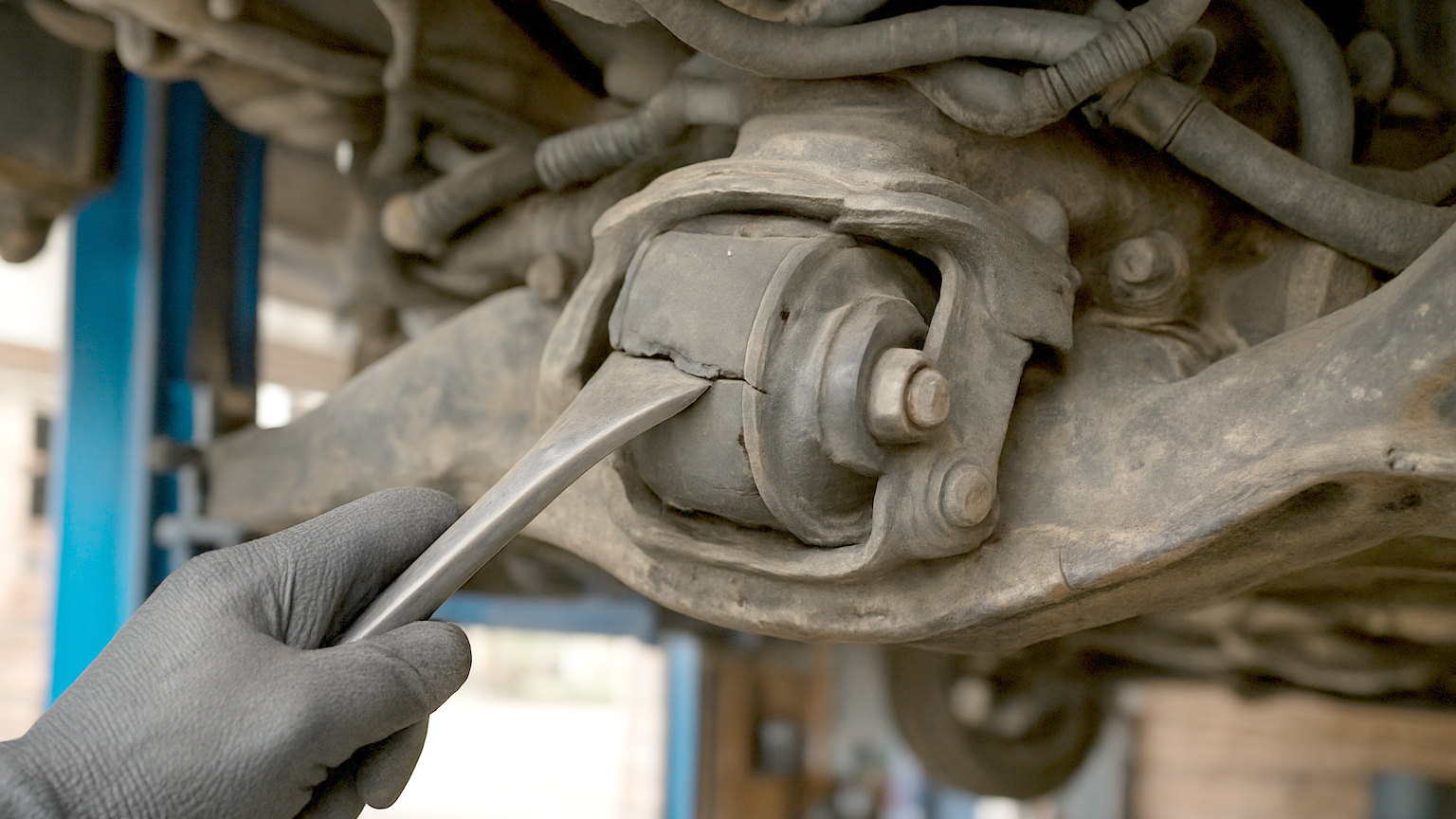
A creak or groan as the car rolls over a speed bump is one of the most common noise complaints and one of the least alarming. It appears at low speed under suspension movement, which points firmly at something rubbing rather than something rotating, and in practice that means dry rubber, a worn bush or a joint that has lost its lubrication.
Why does it happen at low speed?
Because a creak is produced by two surfaces moving slowly against each other under load, which is exactly what a speed bump creates. At higher speeds the same movement happens too quickly to generate the noise, and road noise masks it. That is why the fault appears in car parks and over humps and vanishes entirely on the open road.
What are the usual culprits?
Anti roll bar bushes, which are the single most common cause and are cheap to replace. Wishbone bushes, top mounts, and the rubber mountings around the springs. On some cars the plastic pads between a leaf spring or a coil and its seat dry out and creak. All of them are rubber components that have hardened with age.
How do you narrow it down?
Have somebody push down rhythmically on each corner of the car while you listen closely from outside. The noise usually reproduces, and it is far easier to locate with the car stationary than while driving. Opening the windows and driving slowly over a bump with a passenger listening from outside works well too.
Does it appear when steering?
If the creak occurs when turning the wheel at a standstill rather than over bumps, suspicion moves to the strut top mounts, which contain a bearing that allows the strut to rotate with the steering. A dry or failing top mount creaks or clicks as the wheel is turned, and it is a distinct fault from a bump related creak.
Can it be lubricated?
Temporarily, and it is a useful diagnostic. Applying a rubber safe lubricant to an anti roll bar bush and finding the noise disappears confirms the source. It will return, since the underlying rubber has hardened, and it tells you exactly what to replace. Petroleum based lubricants should be avoided since they attack rubber.
Is it an MOT problem?
The noise itself is not tested, and the worn component behind it may be. A bush with excessive play, a split rubber or a top mount with movement will be assessed on condition. A creak that has been present for a while is worth having looked at before the test rather than discovering it as an advisory or a failure.
Does it matter if it is only a noise?
Mostly not urgently, and it does indicate rubber that is past its best. Worn bushes allow small amounts of unwanted movement, which affects alignment under load and accelerates tyre wear. So while a creak is not dangerous, it is an early sign that a suspension refresh will improve how the car drives as well as how it sounds.
What does it cost to fix?
Anti roll bar bushes are inexpensive and quick, which is fortunate given how often they are the answer. Wishbone bushes vary enormously, since some can be pressed out and others require the whole arm. Top mounts are a moderate job because the strut has to come out. Identifying the source first is what keeps the bill sensible.
Could it be something other than suspension?
Occasionally, and it is worth keeping in mind. Interior trim, a loose seat rail, exhaust mountings and even body flex on an older car can all creak over the same bumps. A noise that clearly comes from inside the cabin rather than from underneath is worth chasing separately, since replacing suspension bushes will do nothing at all for a dashboard that has started to move.
The distinguishing test is usually whether the noise happens with the car stationary and somebody rocking it, since interior creaks generally will not reproduce that way.