
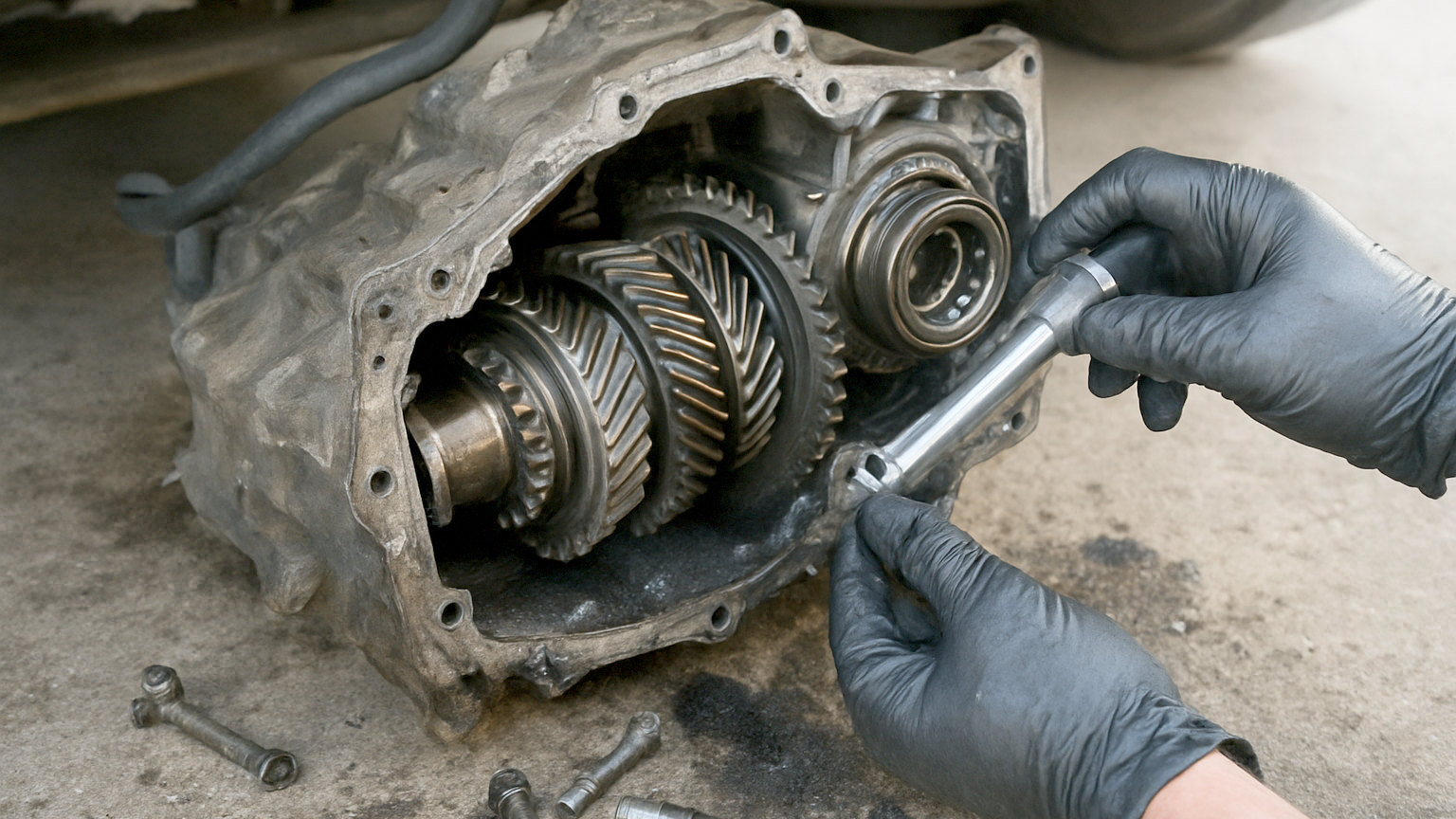
A whine from underneath the car is one of the more diagnosable noises, provided you ask the right question first. That question is not what it sounds like but what it follows. A noise tracking road speed comes from the transmission, driveshafts or wheels, while one tracking engine speed comes from the engine or something on the auxiliary belt. Answering that takes thirty seconds and eliminates most of the car.
How do you test which it follows?
Get up to a speed where the noise is clear, then select neutral and coast. If the whine continues unchanged while the engine drops to idle, it is road speed related and the gearbox is a candidate. If it disappears with the revs, it is engine driven. Then try the same road speed in a different gear, which changes the engine speed while the wheels turn at the same rate.
What does a worn gearbox bearing sound like?
A whine or hum that rises in pitch with road speed, often present in several gears and typically loudest under load. Input and output shaft bearings usually produce a noise present in every gear including neutral with the clutch up, since those shafts turn whenever the wheels or engine do. It generally starts subtly and becomes more insistent over months rather than appearing overnight.
Why does noise in only one gear matter?
Because it identifies the specific gear pair. Each ratio uses its own pair of gears, so a whine confined to third means the fault is in the third gear pair or its bearing, while everything else is sound. That is a genuinely useful observation and it changes the repair, since a single damaged gear set is a different proposition from general wear throughout.
Could it be the differential?
On a front wheel drive car the differential is inside the gearbox casing, so its noise arrives from the same place. Differential whine is typically present in all gears and varies with load, changing noticeably between accelerating and coasting at the same speed. A noise that alters when you lift off but keeps the same road speed points at the final drive rather than at an individual ratio.
Is it definitely not a wheel bearing?
Worth ruling out, since wheel bearings also follow road speed and produce a similar hum. The distinguishing test is cornering: a wheel bearing noise usually changes noticeably when the car is loaded to one side, growing louder when weight transfers onto the failing side and quieter the other way. Gearbox noise is largely unaffected by steering. Gentle sweeping curves at a steady speed reveal the difference.
Can low oil cause it?
Very much so, and it is the cheapest possible explanation. Manual gearboxes carry a modest quantity of oil and lose it slowly through worn shaft seals, often without leaving an obvious puddle. Running low starves the bearings and gears, which whine and then wear. Checking and correcting the level is inexpensive, and on a box caught early it can stop the deterioration entirely.
Does the oil specification matter?
Considerably. Modern gearboxes specify particular oils, and using the wrong type can cause noise, poor shifting and accelerated wear, particularly where synchromesh materials react badly to certain additives. If a box became noisy shortly after an oil change, the specification used is the first thing to check rather than the last.
How urgent is a whine?
A gradually developing whine on a high mileage box is usually a matter of months rather than days, provided the oil level is correct. What changes the picture is any accompanying symptom: difficulty selecting gears, jumping out of gear, a metallic grinding rather than a whine, or metal particles on the drain plug magnet. Any of those suggests something is breaking up rather than simply wearing.
What should you do first?
Establish whether it follows road or engine speed, note which gears it appears in and whether it changes on the overrun, then check the oil level and condition. Those observations cost nothing and they are exactly what a transmission specialist will ask. Arriving with them makes the diagnosis considerably faster and cheaper than arriving with a car that makes a noise.


