
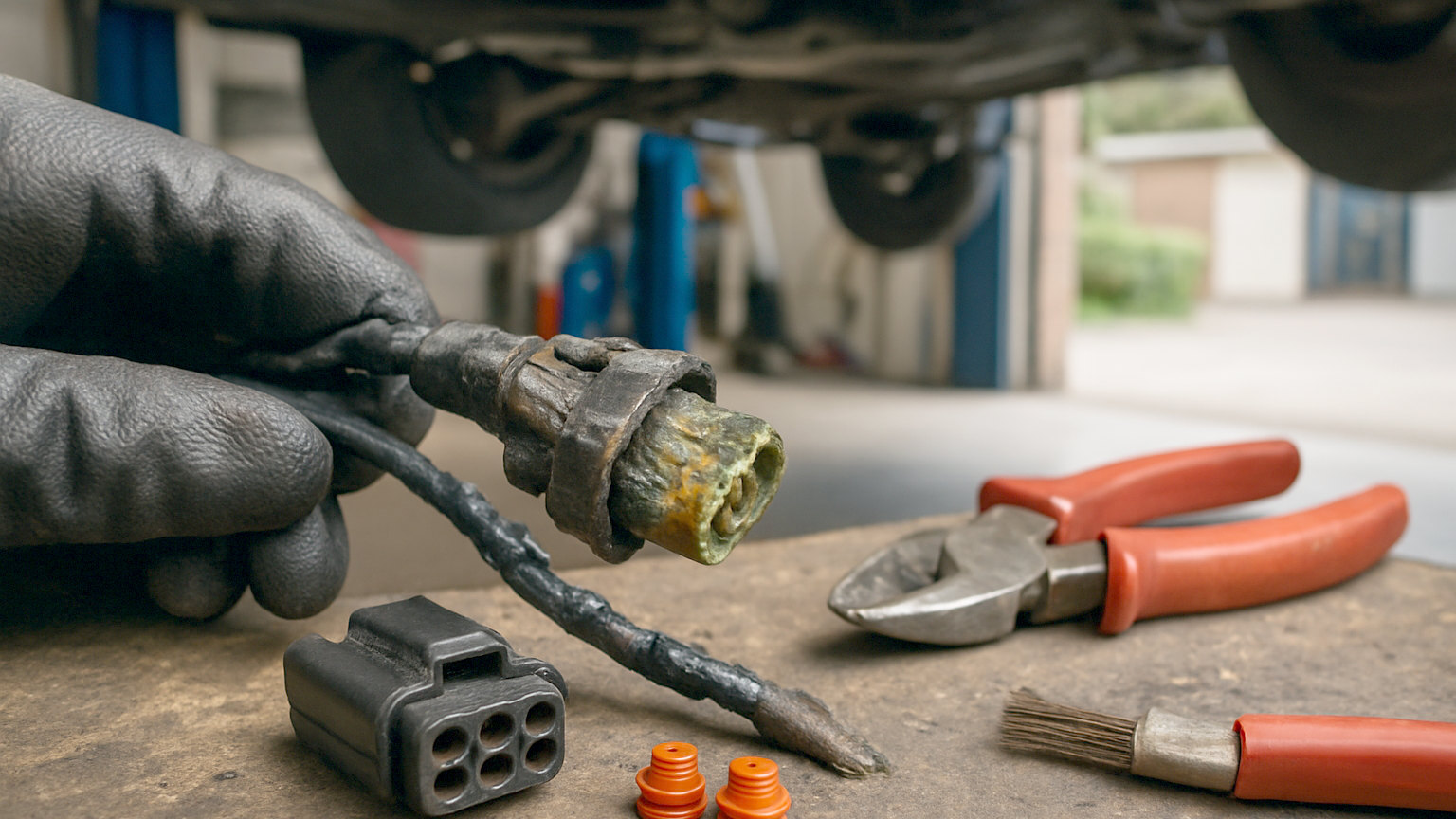
Water is the most destructive thing that happens to car wiring, and the damage it causes is peculiarly difficult to trace because water does not stay where it entered. It travels along the inside of insulation by capillary action, running downhill inside the loom, and it pools wherever a connector sits at a low point. The corrosion therefore appears somewhere quite different from the leak.
How does water get inside a wire?
Through any break in the insulation, a damaged crimp, or an unsealed connector. Once inside, the space between the copper strands acts as a wick, drawing water along the length of the wire regardless of the outer sheath. This is why a connector can be full of water while the visible loom around it is completely dry, and why cutting a wire back sometimes reveals green corrosion many inches from any obvious damage.
What does corrosion do to the copper?
It converts the surface of the strands to copper oxides and salts, which are poor conductors, so resistance rises. The wire still appears connected and will pass a continuity test, while failing to deliver current under load. As the corrosion progresses, strands break and the effective cross section falls further. The characteristic green powder inside the insulation is the visible stage of a process that started much earlier.
Where does water usually get in?
Blocked scuttle drains below the windscreen, which back up into the bulkhead. Failed door membranes, letting water into the sill and along the floor. Perished grommets where the loom passes through panels. Sunroof drains that have blocked or detached. Rear light cluster seals. Boot and tailgate seals. And on older cars, corroded floor panels admitting road spray directly.
What are the symptoms?
Multiple unrelated electrical faults appearing over a period, often affecting whichever systems share a soaked earth point. Faults that come and go with the weather. A damp or musty smell inside the car. Carpets that feel wet under the sound deadening even when the surface looks dry. Modules failing entirely, since electronic units sitting under a wet carpet corrode internally.
How do you find the leak?
Lift the carpets and check the underlay and the floor pan, since water is often trapped beneath rather than visible. Check the footwells, the boot floor and under the rear seats. Then apply a hose systematically, one area at a time, with someone inside watching for water entry. Working from the bottom upwards prevents confusion about where a stream originated.
Can wet wiring be saved?
Sometimes, if it is caught early. Drying thoroughly, cleaning connectors and applying dielectric grease can recover a loom that has been damp but not corroded. Once green corrosion has taken hold inside the insulation, the affected sections need cutting out and replacing, because cleaning the visible ends leaves corroded copper in the middle that will continue to deteriorate.
What about flood damaged cars?
They are a different scale of problem entirely, and worth understanding for anyone buying used. Water that has reached the level of the seats has been through the floor looms, the module locations under the seats and carpets, and frequently the airbag control unit. Faults typically emerge over the following months and years rather than immediately, which is precisely why flood damaged vehicles are troublesome long after they appear dry.
How do you check a used car for it?
Lift a corner of the carpet and feel the underlay. Look for silt lines, rust in unusual places such as seat rails and seatbelt anchor bolts, mismatched or unusually clean carpets, and a persistent damp smell masked by air freshener. Check under the spare wheel. Any car with unexplained multiple electrical faults and a history in a flood affected area deserves considerable caution.
What is the correct repair?
Fix the water entry first, since everything else is temporary otherwise. Dry the interior completely, removing carpets and underlay rather than hoping. Then clean or replace corroded connectors and earth points, and cut out and replace corroded wiring sections properly with soldered or crimped joints and heat shrink. Finally protect everything with dielectric grease.
Why is it worth acting quickly?
Because corrosion is progressive and the cost rises steeply as it spreads. A damp footwell dealt with within weeks means a dried carpet and a cleaned earth point. The same leak ignored for two years means a corroded loom, a failed module and a car with faults nobody can permanently resolve. This is one area where prompt attention genuinely changes the outcome.


