
A wire repair is either invisible in five years or a source of intermittent faults within two winters, and the difference is entirely method. The environment inside a car loom is hostile: vibration, temperature swings, moisture and salt. A joint that would last indefinitely in a house will fail quickly under a bonnet, which is why the standards for automotive repair are higher than most people expect.
What should you never use?
Quick splice connectors that clamp over a wire and cut into it, which sever strands and admit moisture. Twisted joints wrapped in insulating tape, which unwind with vibration and let water in as the adhesive dries out. Domestic terminal blocks, which vibrate loose. Solder alone with no mechanical support or sealing. Each of these produces a joint that works on the day and fails later.
Is soldering or crimping better?
Both are correct when done properly, and opinion divides on which is preferable. A good crimp made with the right tool is gas tight and slightly flexible, which suits a vibrating environment, and it is what manufacturers use. Solder makes an excellent electrical connection but stiffens the wire, creating a hard point where flexing concentrates, so a soldered joint must be supported and never left where the wire bends.
How do you make a good soldered joint?
Strip both ends cleanly without nicking the strands, slide the heat shrink on before joining, and interleave or lap the conductors rather than twisting them into a lump. Heat the wire and let it melt the solder rather than melting solder onto cold copper, and use rosin cored electrical solder. The finished joint should be smooth and shiny, with solder having flowed into the strands rather than sitting on top.
How do you make a good crimp?
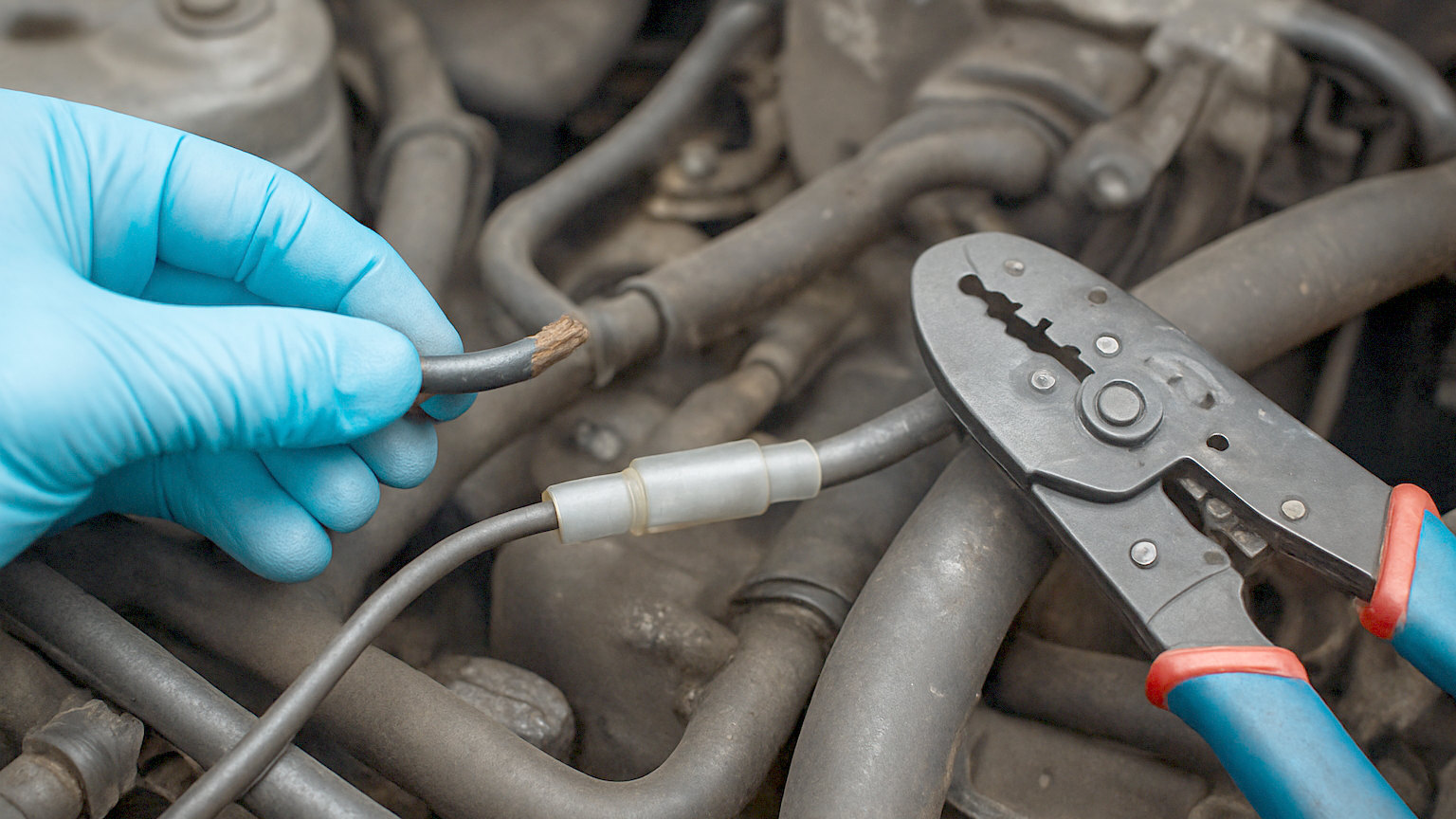
With a proper ratchet crimping tool matched to the terminal, not with pliers or a cheap stamped tool. The insulation grip should hold the sheath and the conductor grip should hold bare copper, with the correct size selected for the wire gauge. Test every crimp by pulling firmly. One that comes apart in your hand was going to come apart on a cold morning instead.
Why does adhesive heat shrink matter?
Because ordinary heat shrink covers a joint without sealing it, and water wicks straight along the inside of the insulation past it. Adhesive lined heat shrink contains a glue that melts and flows as it shrinks, bonding to the insulation on both sides and forming a genuine moisture seal. On any joint exposed to weather it is the single most important part of the repair.
What does staggering joints mean?
Where several wires in a loom are being repaired, the joints should be offset along the length rather than all sitting at the same point. Aligned joints create a thick rigid section that will not flex with the rest of the loom and becomes a stress point. Staggering them keeps the repaired section close to the original diameter and flexibility, which matters enormously in a door gaiter.
What wire should you use?
Automotive grade cable of the same or slightly larger cross section than the original, with insulation rated for the temperature it will see. Household mains cable is the wrong thing entirely, since it is usually solid core or has too few strands and will fatigue and break. Match the colour where possible, because the next person to work on the car will thank you.
How should the repair be finished?
Wrapped back into the loom with proper cloth loom tape rather than shiny insulating tape, and supported so the repaired section is not carrying any strain. Any protective conduit should be reinstated. Where the joint is in an exposed position, positioning it so water runs away rather than pooling, and adding a small drip loop, both make a real difference to how long it lasts.
When is a repair not appropriate?
On airbag circuits, where manufacturers generally specify that damaged wiring must be replaced rather than repaired, and on some shielded or data cables where the shielding and impedance matter. In those cases the correct answer is a replacement section or a new loom, and it is worth checking rather than assuming a repair is acceptable.


