
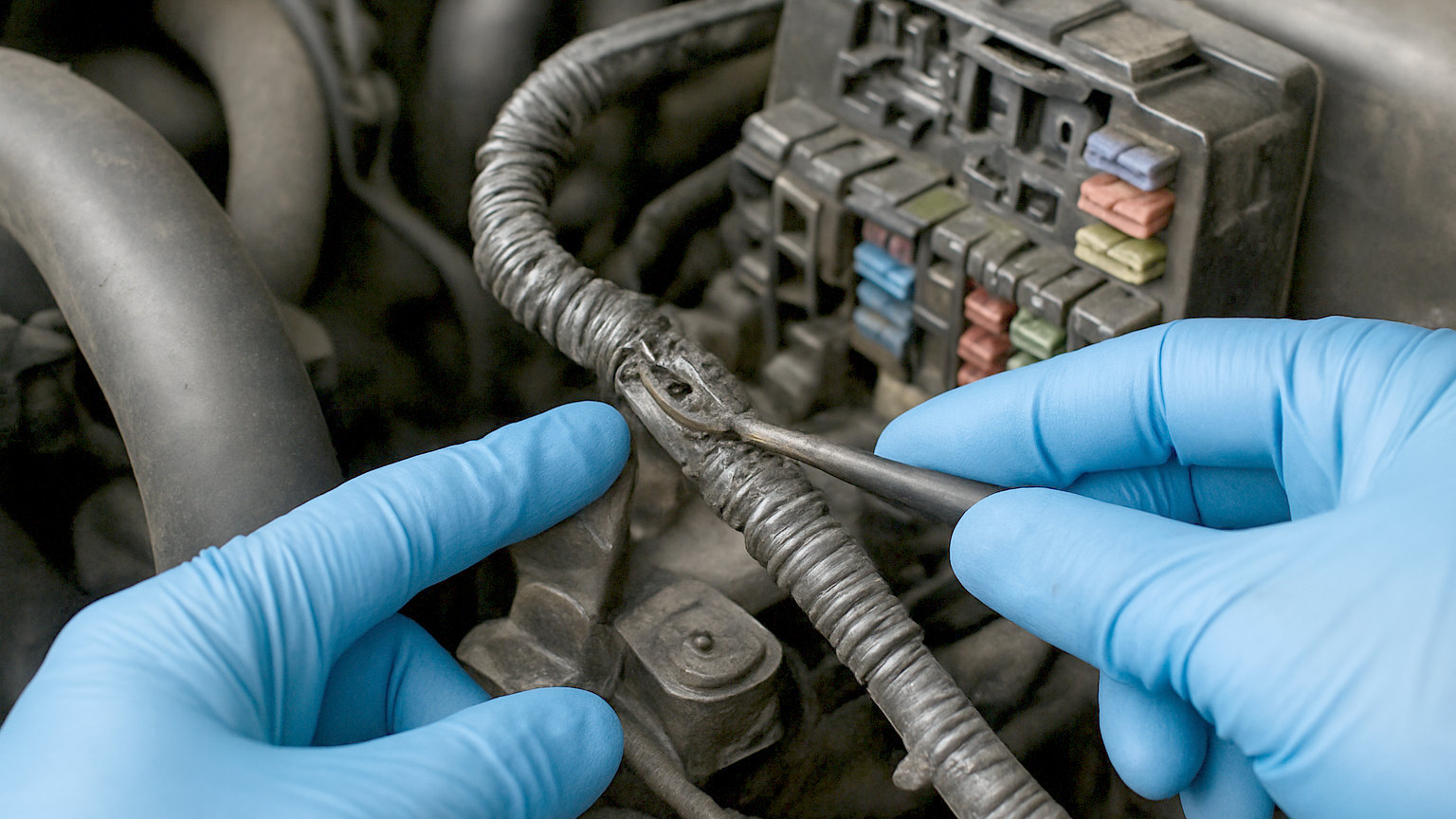
Finding a short circuit has a reputation for being difficult, and the reason is usually that people start by looking rather than by thinking. It is a process of elimination, and worked through in a sensible order it is methodical rather than mysterious. The aim at every stage is to halve the amount of circuit still under suspicion.
What do you need to know first?
Which fuse is blowing, and everything that fuse supplies. The fuse box lid or the handbook gives a starting point, and a wiring diagram gives the full picture. Without that list you are searching the whole car rather than one circuit, and that single piece of information often reduces a day of work to an hour.
Why fit a circuit breaker in place of the fuse?
Because a short can be tested for repeatedly without consuming fuses. A self resetting circuit breaker of the same rating will trip and reset continuously while the fault is present, which lets you work through the circuit systematically. It also gives an audible and repeatable indication of whether the short is still there as you disconnect things, which a blown fuse cannot.
What is the elimination method?
Disconnect every component on the circuit, then reconnect them one at a time until the fault reappears. If the fuse survives with everything disconnected, the wiring is sound and one of the components is at fault. If it still blows with everything disconnected, the short is in the wiring itself, which is a different and slower job. That single test tells you which of the two you have.
How do you narrow down wiring?
By halving. Find a connector roughly midway along the circuit, disconnect it, and see whether the fault persists. If it does, the short is between the fuse and that point. If it clears, it is beyond it. Repeat on the remaining half. Each step removes half the remaining wiring from suspicion, so even a long loom is narrowed down in a handful of tests.
What does a short finder do?
It replaces the fuse and sends a pulsing current through the circuit, which generates a pulsing magnetic field along the wire carrying it. A probe or compass is then moved along the route of the loom, following the pulse. The point where the signal stops is where the current is leaving the wire, which is the short. It is the fastest method for a fault buried inside a loom.
Where should you look physically?
Anywhere the loom moves, rubs or passes through metal. Door and tailgate gaiters, where wires flex constantly. Grommets in bulkheads and floor panels, where a perished grommet lets the panel edge cut insulation. Behind the dashboard, particularly where recent work has been done. Under the car and around the engine, where heat and debris attack the loom. And anywhere an accessory has been fitted.
How do you find an intermittent short?
By recreating the conditions. If it blows over bumps, have someone press on the fuse or watch a test lamp while the car is rocked or the suspension is loaded. If it blows on full lock, turn the wheel through its range while watching. If it blows in the rain, a hose applied carefully to different areas will often reproduce it. Intermittent faults are found by pattern rather than by inspection.
What tools are genuinely useful?
A multimeter, a test lamp, a self resetting circuit breaker in the common fuse sizes, a clamp meter that reads low current, and a wiring diagram. That combination handles most jobs. A short finder is worth having if you do this regularly. What is not useful is guessing, since replacing components on suspicion in an electrical fault is even less productive than it is elsewhere.
When should you hand it over?
When the short is inside a loom rather than at a connector, when it involves the engine management or airbag systems, or when it is intermittent and resists reproduction. Auto electricians have the diagrams, the tools and the experience of where particular models chafe. Given that diagnosis time is the main cost, arriving with the circuit already narrowed down saves real money.


