
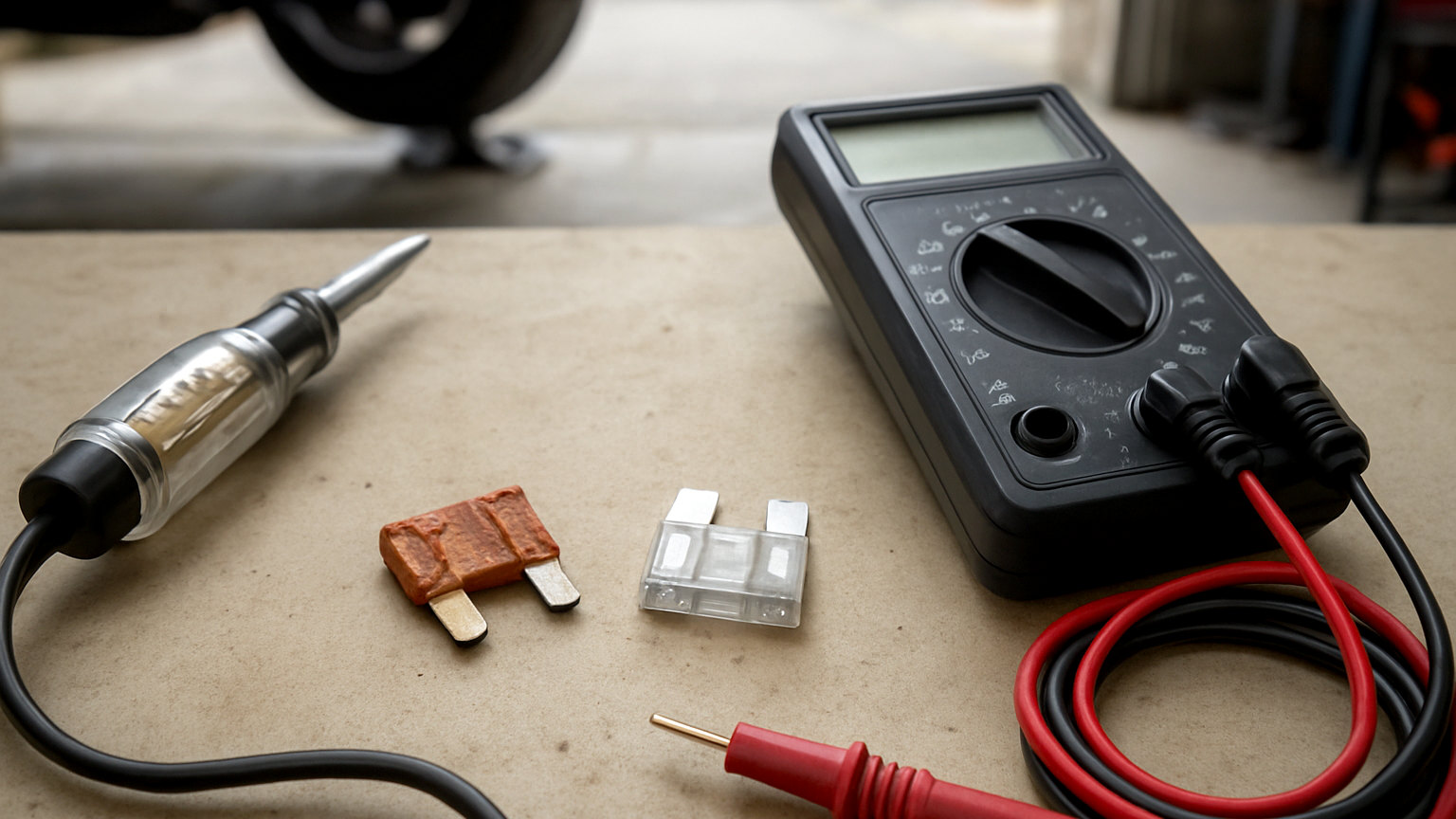
Electrical diagnosis is the area where the right tool makes the largest difference, because you cannot see electricity and guessing is unusually expensive. The encouraging part is that most home diagnosis needs only two inexpensive items, and understanding what each tool cannot tell you is as important as owning it.
What does a multimeter give you?
It is the fundamental tool. It measures voltage, which tells you whether power is reaching a point; resistance, which tells you whether a path exists when the circuit is isolated; and current, though usually only small amounts. A basic unit is inexpensive and adequate. Look for one with a decent set of leads, since cheap probes cause more misleading readings than any other single factor.
Is a test lamp still worth having?
Yes, and it does something a meter does not. A meter draws almost no current, so it will happily show twelve volts through a connection so corroded that it could not light a bulb. A test lamp draws real current, so it only lights when the circuit can actually deliver. Using both together is genuinely informative: voltage present on the meter but no light on the lamp indicates high resistance.
What about LED test lamps?
They draw very little current, which makes them safer around sensitive electronics but reduces their ability to reveal a weak connection. They are also less likely to damage a delicate circuit than a traditional filament lamp, which is a real consideration on modern cars. Having both, and knowing which is appropriate, is better than choosing one.
Why is a clamp meter useful?
Because it measures current without breaking the circuit, simply by clamping around a wire. That makes parasitic drain testing far easier, since the battery does not have to be disconnected and the car does not wake up. A model reading direct current at low values is what you want, since many cheap clamp meters only read alternating current and are useless on a car.
What does a circuit breaker do for you?
A self resetting breaker fitted in place of a fuse allows a short circuit to be hunted without consuming a bag of fuses. It trips and resets continuously while the fault is present, giving repeatable feedback as components are disconnected. They cost very little in the common fuse sizes and they transform a frustrating job into a systematic one.
Is a power probe worth buying?
For anyone doing this regularly, they are excellent. A power probe connects to the battery and can apply power or earth to a circuit at the touch of a switch while also reading voltage, which lets you test a motor or actuator directly without running temporary wires. They must be used with care, since applying power to the wrong circuit on a modern car can damage a module.
What about a code reader?
Essential now, and inexpensive at the basic level. A modest reader or a phone adapter accesses engine codes and live data on almost any modern car. The limitation is that airbag, ABS and body systems often need manufacturer specific protocols, so a cheap reader can report a car as fault free while an ABS light is showing. Know which type you have before drawing conclusions.
When do you need an oscilloscope?
When you need to see how a signal behaves over time rather than its average value. Sensor waveforms, ignition patterns and network communication all require it, and a multimeter cannot show them. It is specialist equipment with a genuine learning curve, and for most owners it marks the sensible boundary between home diagnosis and a professional.
What else is worth having?
A proper ratchet crimping tool, adhesive lined heat shrink, a soldering iron, a set of terminal release picks for removing pins from connectors, dielectric grease and a good torch. None of these are diagnostic, but they are what turns a found fault into a lasting repair rather than a temporary one.


