
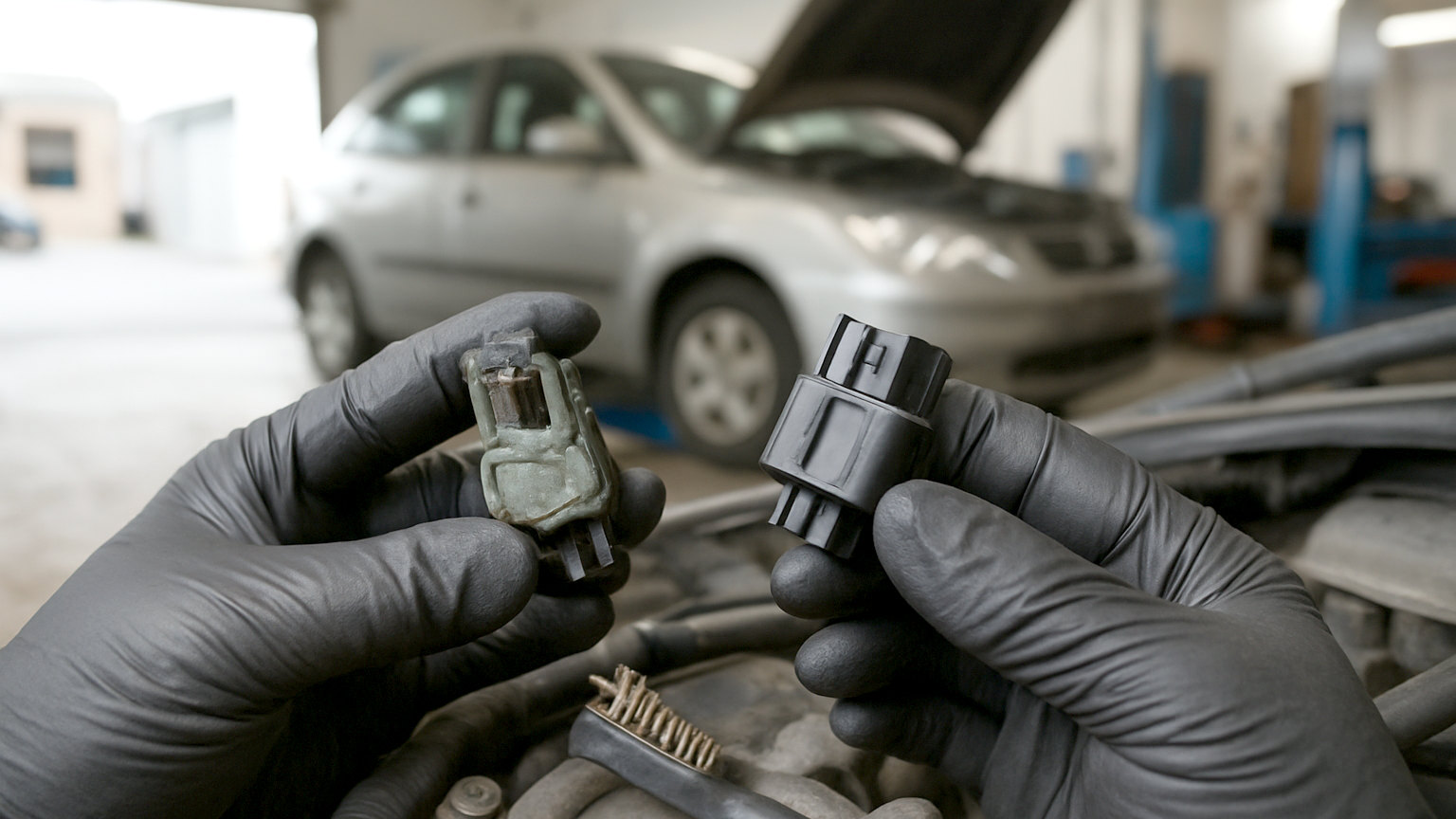
Corrosion is the most common wiring fault on any car more than a few years old, and it is also the least dramatic. It rarely breaks a circuit outright. Instead it adds resistance, which reduces the voltage reaching a component and produces symptoms that look like the component itself has failed. A great many perfectly good parts are replaced because of a green deposit on a connector pin.
Why does resistance cause such strange symptoms?
Because voltage falls as current passes through resistance, so the component at the end receives less than it should. A motor runs slowly, a lamp glows dimly, a sensor reports an incorrect value and the engine management logs a fault against it. Worse, the effect varies with current draw, so a circuit can work perfectly at low load and fail completely under demand. That is why these faults appear intermittent.
What causes the corrosion?
Water, principally, combined with road salt and dissimilar metals. Connector seals harden and shrink with age, allowing moisture in. Wiring that runs downhill into a connector carries water along the inside of the insulation by capillary action, which is why a connector can be soaked while everything around it is dry. Heat cycling in the engine bay accelerates the breakdown of seals considerably.
Where does it happen most?
Anywhere low, exposed or hot. Wheel speed sensor connectors in the wheel arches. Rear light clusters and number plate lamps. Reversing and towbar wiring. Earth points bolted to the bodywork, particularly under carpets where a water leak has gone unnoticed. Engine bay sensor connectors near the exhaust. And any connector that has been disturbed and not resealed properly after previous work.
How do you clean one properly?
Disconnect the battery first if the circuit is live. Use a dedicated electrical contact cleaner rather than a general solvent, since some solvents attack plastics. A small brass brush, a fibreglass pen or a fine abrasive works on heavier deposits, taking care not to remove the plating from the pins or spread the female terminals. Allow it to dry fully before reconnecting.
Should you use grease afterwards?
Yes, and dielectric grease specifically. It is non conductive, so it does not bridge pins, and it displaces moisture and air from the joint while the metal contact surfaces still press through it. Applied to the connector body and pins before reassembly, it dramatically slows future corrosion. This is one of the highest value ten minute jobs available on an older car.
What if the pins are damaged?
Individual terminals can usually be released from the connector body with a small pick and replaced, and repair kits with the correct pins are available for common connector families. That is far better than cutting the connector off, because a factory connector is sealed and keyed while a bodged joint is neither. Spreading a female terminal slightly to tighten a loose fit is a legitimate repair when done carefully.
How do you confirm a connector is at fault?
A voltage drop test, measured across the connector while the circuit is under load. A healthy connection loses almost nothing. Anything more than a few tenths of a volt indicates resistance that should not be there. This is far more reliable than a visual inspection, since corrosion inside a crimp or under a pin is invisible while being perfectly measurable.
Why is this worth checking before replacing parts?
Because it is free, quick, and it is the actual fault surprisingly often. Sensors, motors and modules are all expensive, and all of them can be condemned by a connector that costs nothing to clean. Any diagnosis that concludes with a component replacement should include a check of that component connector first, and a workshop that does this as standard is worth staying with.
Can it be prevented?
Partly. Fixing water leaks promptly, replacing perished grommets and seals, and applying dielectric grease whenever a connector is disturbed all help considerably. On a car that will be kept long term, going round the accessible earth points and exposed connectors once, cleaning and greasing them, prevents a great many future faults for the cost of an afternoon.


