
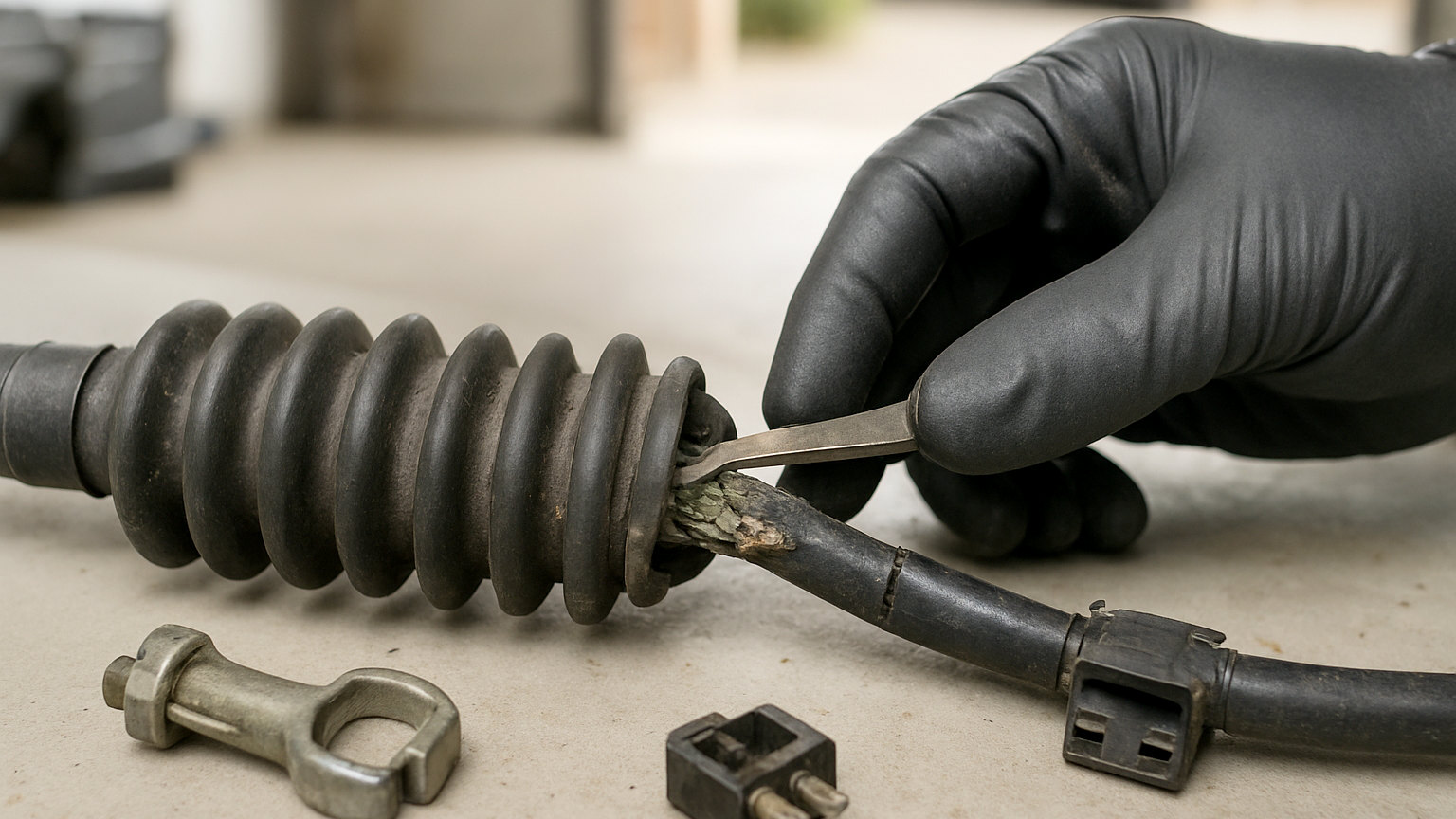
The flexible rubber concertina running between the body and each door, and between the body and the tailgate on a hatchback or estate, carries a bundle of wires through one of the harshest environments on the car. Those wires bend every time the door opens and straighten every time it closes, tens of thousands of times, and eventually the copper inside fatigues and breaks while the insulation looks perfectly intact.
What does the loom carry?
Rather more than most people realise. On a front door: the window motor, central locking, mirror adjustment and heating, the door speaker, courtesy lights, the door ajar switch and often the airbag or side impact sensor. On a tailgate: the rear wiper and washer, heated screen, number plate lights, boot lock, rear camera and high level brake light. One broken wire takes out one of those.
What are the symptoms?
Distinctively intermittent and position sensitive. A window that works when the door is nearly closed and stops when it is fully open. A rear wiper that operates only when the tailgate is held at a certain angle. Central locking that works on three doors and not the fourth. A heated rear screen that comes and goes. Anything that changes when the door or tailgate is moved points here directly.
Why do the wires break inside the insulation?
Because the copper conductor is a bundle of fine strands, and repeated bending work hardens and fractures them one at a time. The insulation, being more flexible, survives long after the copper has failed, so the wire looks perfect from the outside. That is why these faults survive visual inspection and why they can be maddening to find without knowing where to look.
How do you confirm it?
By operating the affected component while flexing the gaiter by hand, with someone watching or listening. If the fault comes and goes as the rubber is squeezed and bent, the diagnosis is complete. A voltage drop or continuity test on the individual wires, carried out while the loom is flexed, identifies exactly which conductor has failed. A continuity test on a stationary loom may well pass.
How do you get access?
The gaiter usually unclips from the body and the door with a twist or a squeeze of retaining tabs, and then the whole rubber boot can be slid along the loom to expose the wiring. The connectors at each end are frequently released from inside the door trim panel or the body pillar, which means removing trim. It is fiddly rather than difficult, and clips break if forced when cold.
How should the repair be done?
By cutting out the fatigued section entirely and splicing in new wire of the same or slightly larger gauge, using soldered joints with heat shrink or properly crimped connectors. The critical part is that the repair must be staggered, so the joints do not all sit in the same place, and the new section must be flexible enough to survive the same bending. Stiff repairs simply fail again alongside.
Should the whole loom be replaced?
Sometimes it is the better answer. If several wires have already broken, the remainder are the same age and have done the same work, so repairing one at a time becomes a recurring job. Replacement looms are available for many vehicles, and although the part costs more, it removes the problem completely rather than postponing it.
Why does the gaiter itself matter?
Because it keeps water out of the door and the body. A gaiter that has split or been left unclipped allows water into the door cavity and along the loom into the connectors, causing corrosion on top of the mechanical damage. Any repair should end with the boot correctly seated at both ends, and a perished gaiter should be replaced rather than taped.
Can it be prevented?
Not really, since it is a wear item by nature. What helps is avoiding anything that increases the bending, such as a door that has dropped on its hinges and pulls the loom at an angle, or a tailgate strut that has failed so the door is caught rather than supported. Fixing those reduces the strain, and the loom lasts longer as a result.


