
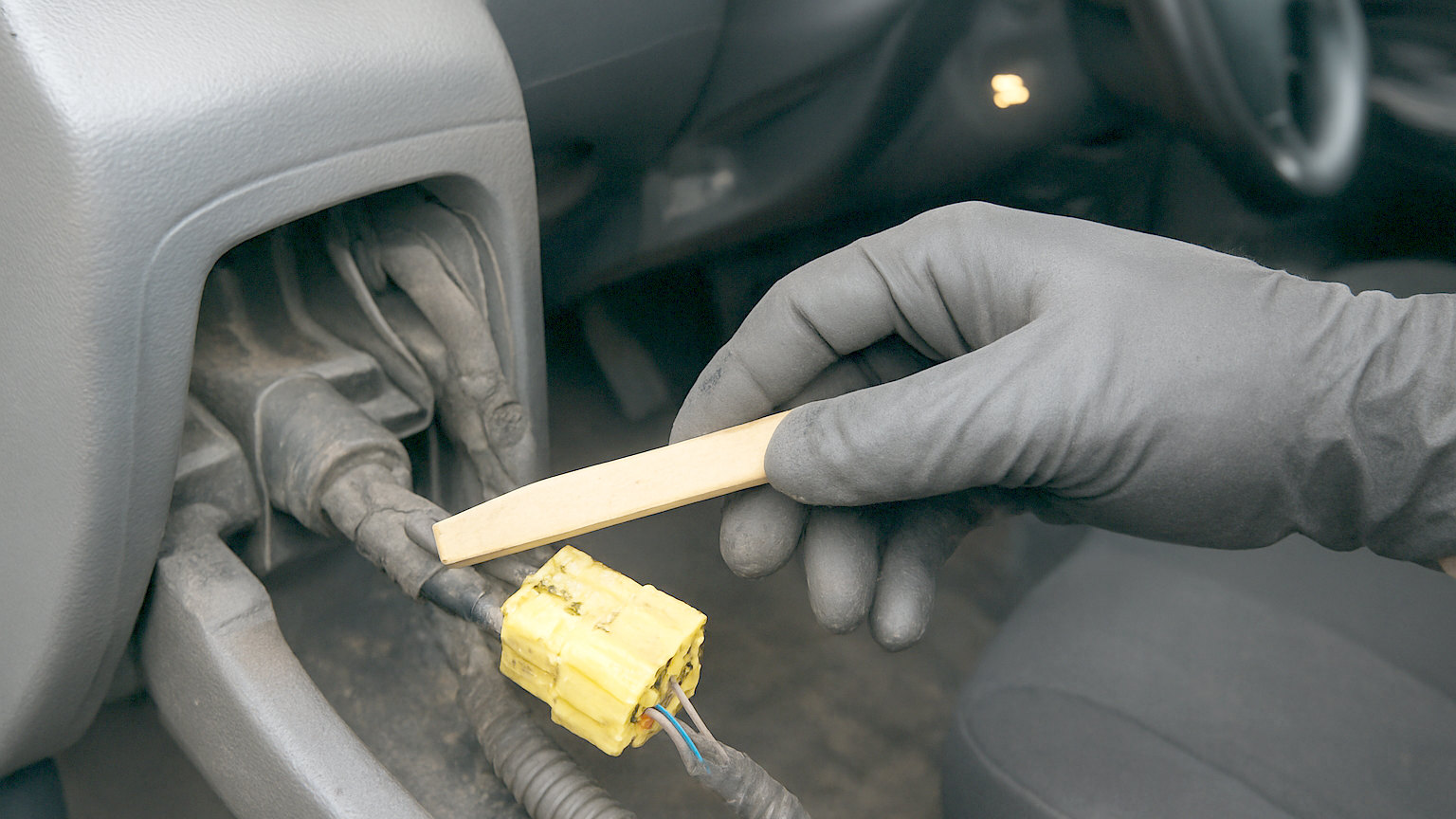
The airbag warning light, often labelled SRS for supplementary restraint system, is one of the few dashboard warnings with no performance symptom at all. The car drives exactly as it did yesterday, which makes the light easy to ignore. What it means is that the system has detected a fault and disabled itself, so in a collision the airbags may not deploy at all.
What does the system cover?
More than the airbags themselves. The same module controls the seatbelt pretensioners, which tighten the belts in an impact, and on many cars the occupant detection sensors that decide whether a passenger airbag should fire. It monitors every one of those components continuously, including the wiring and connectors, and a fault anywhere in the network illuminates the same lamp.
What causes it most often?
Connectors under the front seats, by a wide margin. The wiring to seat mounted airbags, belt tensioners and occupant sensors runs beneath the seat and flexes every time the seat is adjusted. Over years the connectors work loose or the wires fatigue and break. This is why the light frequently appears after something has been stored under a seat, after a valet, or after the seats have been moved for cleaning.
What is a clock spring?
A coiled ribbon cable inside the steering column that maintains the electrical connection to the driver airbag while allowing the wheel to rotate. It wears out, and when it fails it usually takes the horn and the steering wheel controls with it. That combination, an airbag light plus a horn that has stopped working, points almost directly at the clock spring and is a common failure on higher mileage cars.
Can low battery voltage trigger it?
It can. The module monitors its own supply and will record a fault if voltage drops far enough, which happens during a flat battery or a jump start. Faults recorded that way sometimes clear once the battery is healthy and the code is cleared, so if the light appeared immediately after a starting problem, that history is worth mentioning before anyone starts dismantling seats.
Why should you not work on it casually?
Because airbags are explosive devices. An accidental deployment during work causes serious injury, and the units contain propellant that makes them hazardous to handle and dispose of. The battery should be disconnected and a period allowed for the system capacitors to discharge before any connector is touched. This is genuinely a system where the risks of an amateur approach outweigh the saving.
Does it affect the MOT?
Yes, on cars fitted with airbags from new. An illuminated SRS warning lamp is a failure, and so is a lamp that fails to illuminate during the initial bulb check, which prevents the obvious workaround. Testers also check that airbags are present, so a missing unit is a failure in its own right. It is worth resolving before the test rather than discovering it there.
Does it matter if the car has been in an accident?
Considerably. Once airbags have deployed, the module usually stores a crash record that cannot be cleared, and the module itself typically has to be replaced along with the airbags and pretensioners. A car being sold with an SRS light on and a history of accident damage is worth investigating carefully, since a system that will not reset may indicate a deployment that was never properly repaired.
What should you do about it?
Have the airbag codes read, noting that they sit in a separate system from engine codes and many basic readers cannot access them. Expect a seat connector or the clock spring to be the answer in most cases. Do not simply clear the code and hope, because the fault will return and in the meantime you are driving a car whose restraint system has switched itself off.
Is it worth fixing on an older car?
Yes, for two reasons. It is an MOT failure, so the car cannot legally be used without resolving it. And the system exists to reduce injury in a crash, which is not a feature worth economising on regardless of what the vehicle is worth.


