
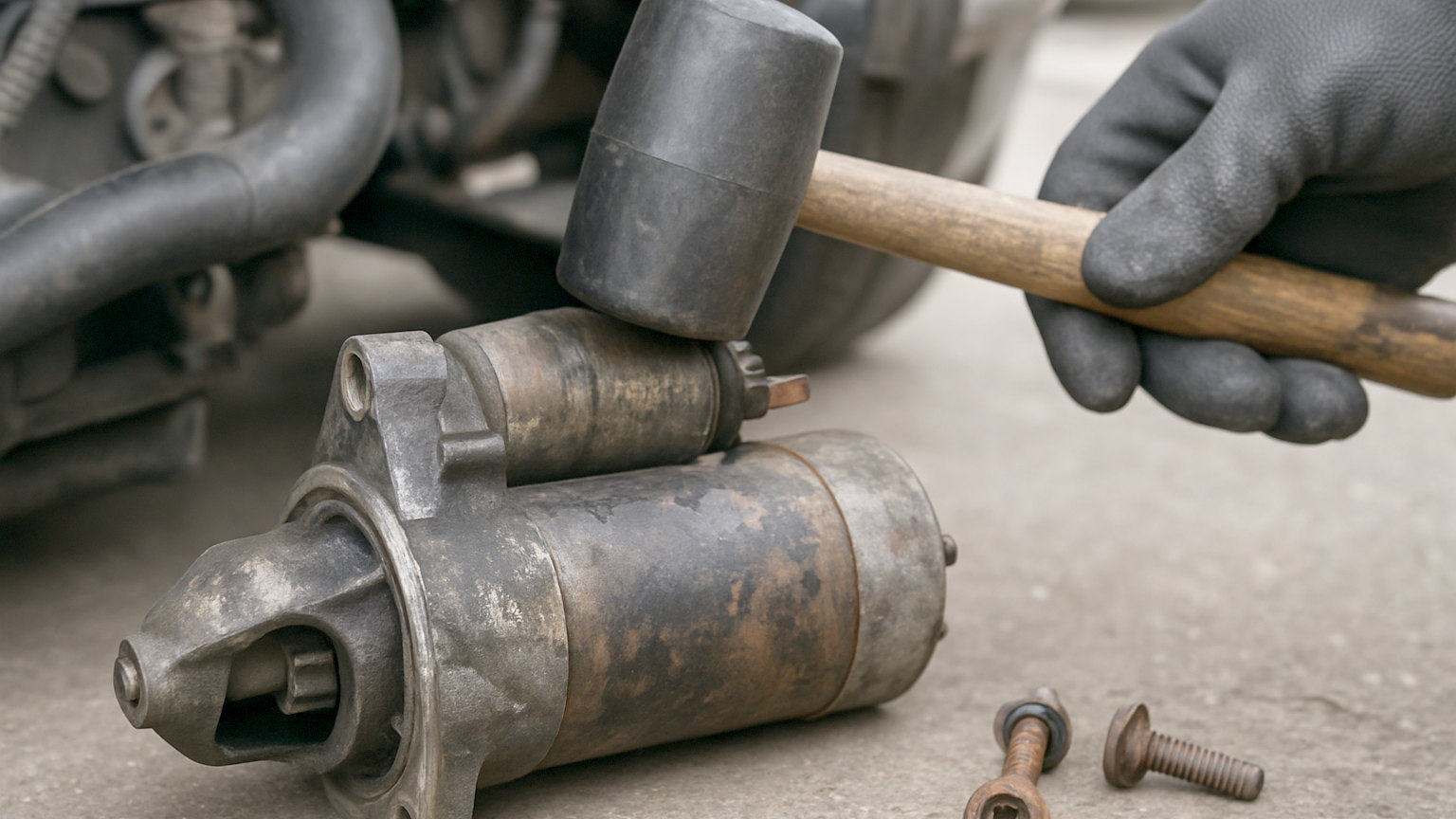
Striking a starter motor with a mallet to make a car start is one of the oldest tricks in motoring, and unlike most folk remedies it genuinely works. It also tells you something quite specific, which is that the starter has reached the end of its life. Understanding why the tap works explains why it is a diagnosis rather than a repair and why the fault will return.
What is happening inside the motor?
The armature spins on a shaft, and current reaches it through carbon brushes pressed against a segmented copper commutator by small springs. As the brushes wear down over tens of thousands of starts, the springs extend further and the pressure holding the brushes against the commutator falls. Eventually there are positions where contact is not made at all, and nothing happens when the key is turned.
Why does a knock restore contact?
The shock jars the brushes within their holders, momentarily pressing them back against the commutator, and it can also shift the armature slightly so a different segment is presented. Either is enough to complete the circuit for long enough to start the engine. It is a mechanical nudge to a component that no longer reaches where it needs to on its own.
What is a commutator dead spot?
Each segment of the commutator connects to a different winding within the armature. If one winding has failed or a segment has burnt, the motor will not turn while the brushes rest on that particular spot. Since the engine tends to stop in a small number of positions, and the armature with it, the fault appears at apparently random intervals but is really following a pattern.
Where should you actually tap?
The body of the motor, which is the cylindrical section, rather than the solenoid on top or any of the electrical terminals. A firm tap with a rubber mallet or the wooden handle of a hammer is enough; hitting it hard with a steel hammer can crack the casing or damage the field magnets, which turns a car that sometimes starts into one that never does. Keep clear of moving parts and have someone else turn the key.
Does it work on a solenoid fault too?
Sometimes, for a different reason. A plunger that is sticking through dirt or corrosion can be freed by a knock, and burnt solenoid contacts occasionally make better connection after a jolt. If tapping works, it does not tell you whether the brushes or the solenoid are responsible, only that something inside has worn to the point of unreliability.
How long can you rely on it?
Not long, and it is worth being honest about that. Brushes continue wearing, so the number of taps needed rises and eventually no amount of persuasion helps. People routinely carry a mallet in the boot for months, which works until the morning it does not, usually somewhere inconvenient. Treat the first successful tap as notice that the starter needs replacing.
Can the starter be rebuilt instead?
Often. Brush sets are inexpensive and a specialist rebuilder will replace brushes, bearings and solenoid contacts and skim the commutator, producing a unit that is effectively as good as new for less than a replacement. Since the labour to remove the starter is the same either way, a reconditioned or rebuilt unit is frequently better value than the cheapest new aftermarket one.
Is there anything else worth checking first?
Yes, because a poor connection produces similar intermittent behaviour. Clean and tighten the battery terminals, check the earth straps between engine, body and battery, and have the battery load tested. If those are all good and tapping still makes the difference, the starter is confirmed as the fault and the diagnosis is complete.
Should you carry a mallet in the meantime?
Many people do, and it is a reasonable short term measure while a replacement is arranged. Be aware that it stops working eventually and usually without notice, so treat it as a way of keeping the car usable for a fortnight rather than as an indefinite arrangement.


