
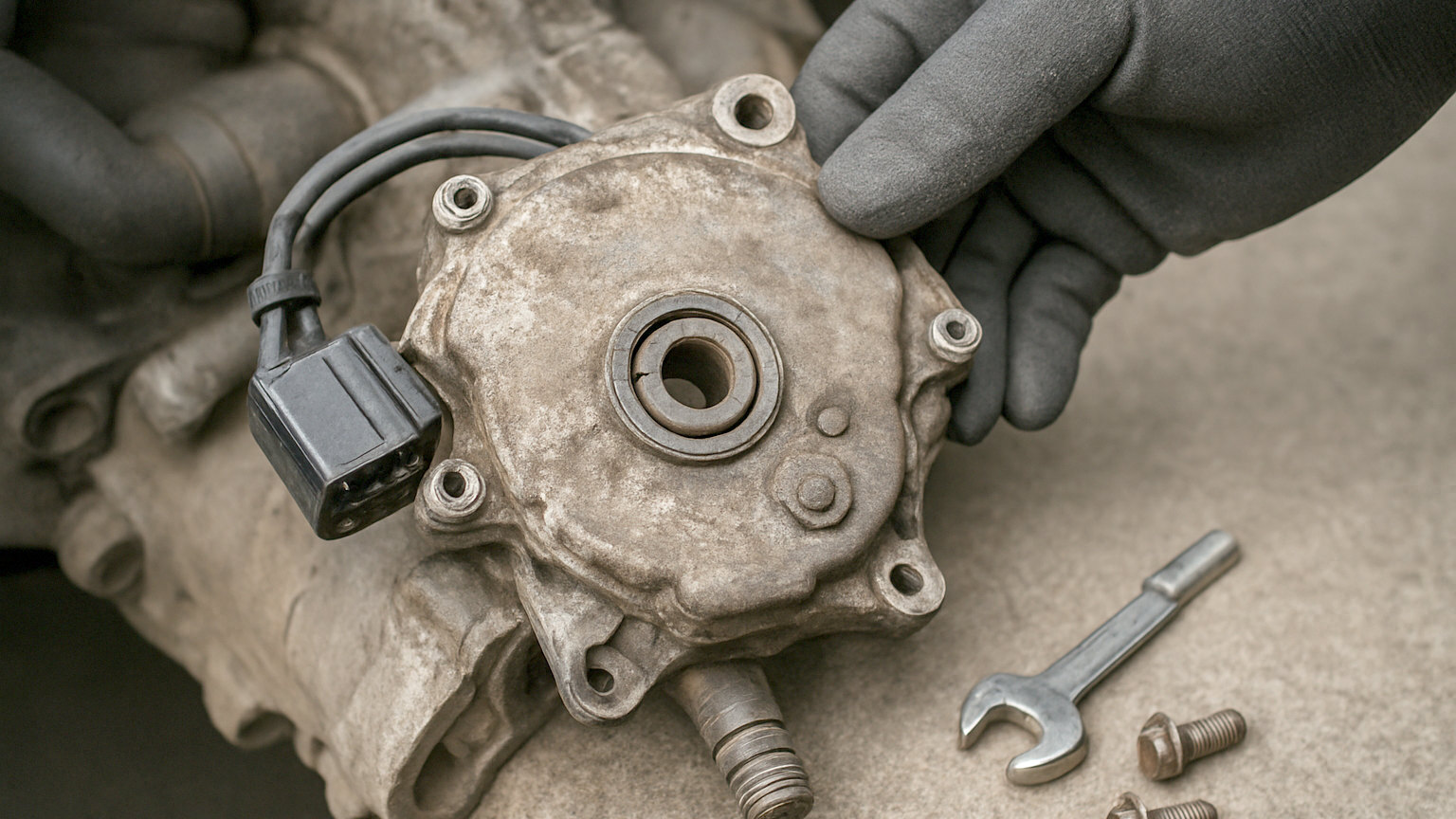
Among all starting faults, this one is unusually specific. A car that refuses to crank in park but starts immediately in neutral has effectively diagnosed itself, because there is one component whose entire job is to tell the car which position the selector is in. It is inexpensive, it wears predictably, and recognising the symptom saves a great deal of unnecessary investigation.
What is the switch and what does it do?
It is called an inhibitor switch, a neutral safety switch or a transmission range sensor depending on the manufacturer, and it is mounted on the gearbox where the selector linkage arrives. Its job is to confirm the transmission is in park or neutral before allowing the starter circuit to complete, which prevents a car being started in gear. It also usually controls the reversing lights and tells the engine management which gear is selected.
Why does it fail in park first?
Because park is used on every single stop and neutral is used far less, so the contacts corresponding to park wear out long before the others. Inside the switch are contact tracks that the selector wipes across thousands of times, and the park section simply accumulates more wear. That is why the failure appears as a car that will not start in park while behaving perfectly in neutral.
Is it always the switch?
Not always, and the alternative is worth checking because it costs nothing. The selector linkage between the lever and the gearbox can stretch or become misadjusted, so the lever indicates park while the switch is not quite reaching the park position. Symptoms are identical. If the fault appeared after gearbox or linkage work, adjustment is the more likely cause and it is often the whole fix.
What other clues confirm it?
Reversing lights that have stopped working, or that come on in the wrong position, since the same switch usually controls them. A gear position display on the dashboard that shows the wrong letter or flickers between two. Occasionally an automatic that shifts oddly, because the engine management is receiving incorrect range information. Any of those alongside the starting fault confirms the switch rather than the starter.
Can it be adjusted rather than replaced?
Often, yes. Many switches are mounted on slotted holes specifically so they can be rotated slightly to align with the selector shaft, and a switch that has drifted out of position or one whose worn contacts still have unworn areas can sometimes be restored by adjustment. It is a quick job on an accessible gearbox and it costs only labour, so it is worth attempting before buying a part.
What does replacement involve?
Usually removing the selector cable from its lever, unbolting the switch from the gearbox casing and fitting the new one, then aligning it correctly. Alignment is the critical step, since a switch fitted in the wrong position produces exactly the fault you were trying to cure. Access varies, and on some cars the switch sits awkwardly close to the exhaust or requires the car to be raised.
Is it safe to keep starting in neutral?
It works, but it means the safety interlock is no longer functioning as designed, and a switch that is failing progressively may eventually prevent starting in neutral too, usually at an inconvenient moment. Always apply the handbrake firmly when starting in neutral, since the car is not held by the transmission in that position and will roll on any slope.
Does the same fault exist on manual cars?
The equivalent is the clutch pedal switch, which confirms the clutch is fully depressed before allowing cranking. When it fails or moves out of adjustment, the car will not crank however hard you press the pedal. Pressing the pedal firmly to the floor sometimes works around it temporarily, and the switch itself is an inexpensive part usually mounted on a bracket above the pedal. It is worth trying that before assuming anything more serious, since it costs nothing and rules out one of the cheapest faults on the car.


