
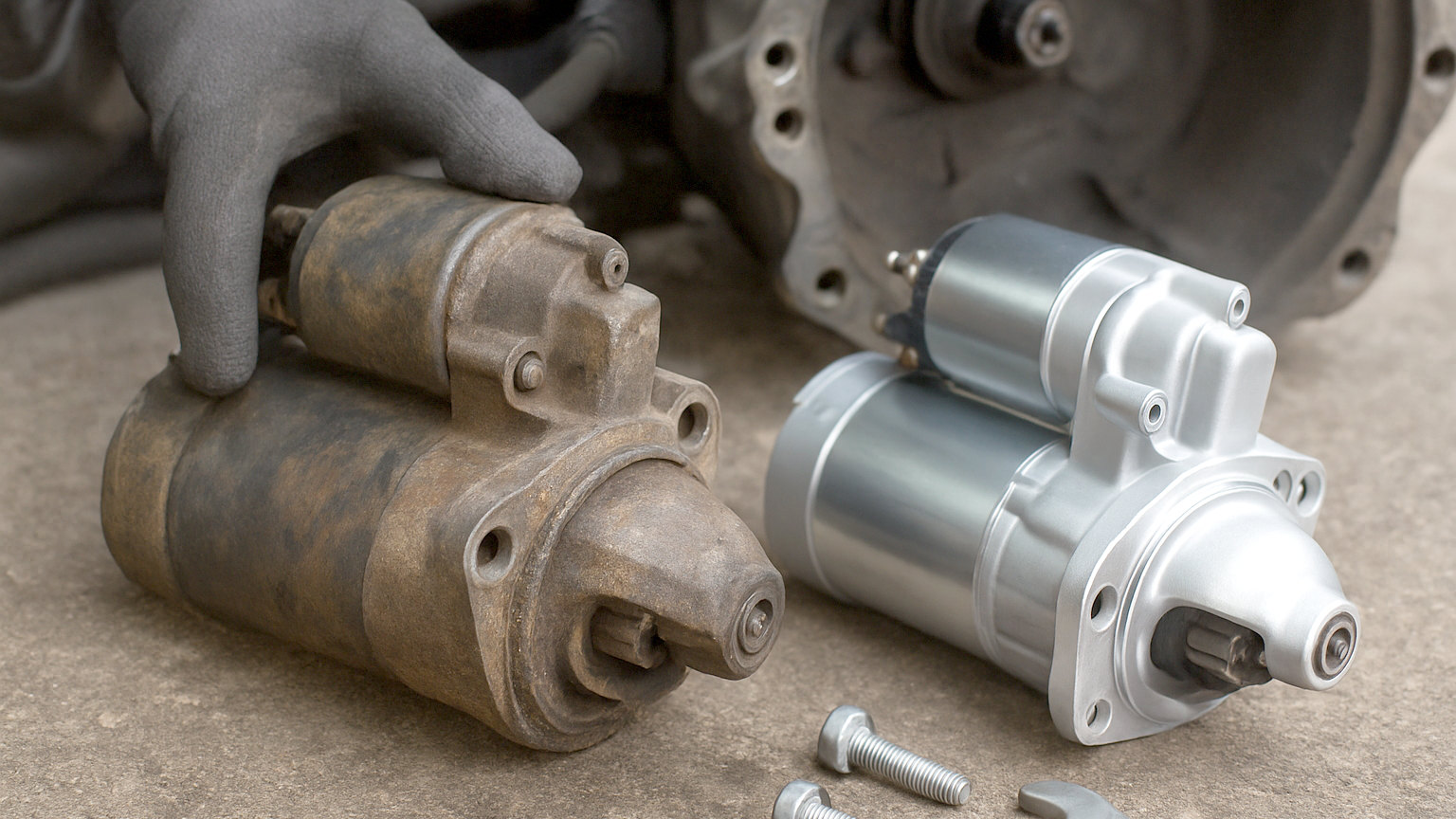
A car that starts reliably every morning and refuses after twenty minutes at the supermarket is describing a heat related fault, and a worn starter is the most common cause. The pattern is so specific that it is close to a diagnosis in itself, and understanding the mechanism explains why the car mysteriously starts again once it has stood for half an hour.
What is heat soak?
When a hot engine is switched off, airflow through the engine bay stops but the heat does not. Temperatures around the exhaust manifold and turbocharger actually rise for several minutes afterwards. Starters are frequently mounted low on the engine, close to those components, and they absorb a great deal of that heat while sitting still with no cooling at all.
Why does heat stop a worn starter working?
Electrical resistance rises with temperature. In a healthy starter that makes no practical difference, because there is plenty of margin. In one with worn brushes, a pitted commutator or degraded windings, the additional resistance is enough to reduce current below what is needed to turn the engine. The result is a single click, a very slow crank, or nothing at all, on a car that was perfectly happy an hour earlier.
Why does waiting fix it?
Because nothing has actually broken. Once the starter cools, resistance falls back and the marginal component works again. That recovery period, typically twenty to forty minutes, is one of the clearest indicators of a heat related fault, since no mechanical failure repairs itself while you stand next to it. If your car reliably starts again after a wait, note how long it takes.
Could it be the battery instead?
Less likely with this pattern, since heat affects batteries differently and a battery struggling with a warm engine would generally struggle more with a cold one. That said, heat is hard on battery life over time, so a battery near the end of its life can contribute. A free load test rules it in or out in minutes and should come before a starter is ordered.
What about the wiring and earths?
Worth checking, because they behave the same way. A corroded connection or a degraded earth strap has resistance that also rises with temperature, and the effect can be enough to tip a marginal circuit over the edge. Voltage drop tests carried out while the fault is occurring, rather than on a cold car in the morning, are far more revealing and are the right test to ask for.
Is there such a thing as a starter heat shield?
There is, and some cars are fitted with one from the factory. It is a metal or composite cover that shields the starter from radiated exhaust heat. If one has been left off after previous work, or has corroded away, the starter runs considerably hotter than intended and fails early. Checking whether your car should have one is worth doing, particularly if this is a second starter in a short period.
What can you do at the roadside?
Wait, mostly, since that is what actually works. Some cars respond to the mallet trick, tapping the starter body while someone turns the key, which jars worn brushes back into contact. Avoid repeated cranking attempts, because they add more heat to an already hot starter and flatten the battery, making the situation worse rather than better.
How urgent is it?
Reasonably. A starter behaving this way is worn and the fault will spread from hot days to ordinary ones over the following months. It is also a fault that strands you in exactly the situations where it is least convenient, since it appears after journeys rather than before them. Replacing it while you can choose the timing is considerably better than discovering the limit in a car park.
What should you tell the garage?
That the car starts reliably from cold and fails only when hot, and roughly how long it takes to recover. That description points straight at heat related resistance and saves a workshop from testing a car first thing in the morning, when the fault will be entirely absent and everything will appear perfectly normal.


