
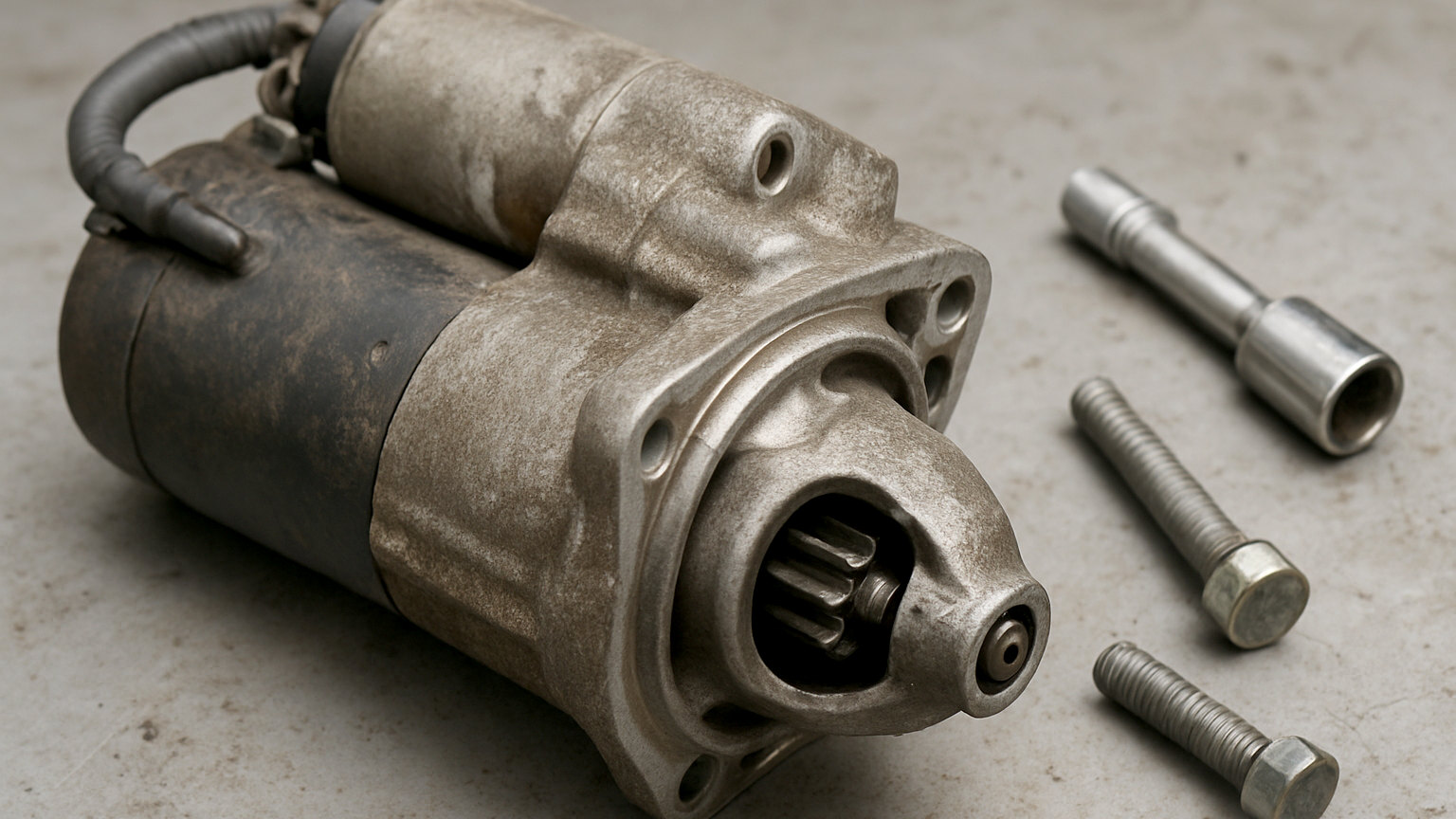
A starter that spins freely with a high pitched whirring noise, while the engine itself stands completely still, is describing a mechanical failure rather than an electrical one. The motor is clearly receiving power and turning, so the battery, cables and solenoid have all done their jobs. What has failed is the connection between the motor and the engine, and there are only a few ways that happens.
How is the drive supposed to work?
When the solenoid energises, it pushes the small pinion gear forward along the starter shaft until it meshes with the large ring gear on the flywheel. The motor then turns the engine through that gear pair. Once the engine fires and begins turning faster than the starter, a one way clutch inside the pinion assembly allows it to freewheel rather than being driven backwards to destruction.
What does a failed one way clutch do?
It slips in both directions instead of one, so the motor spins happily while transmitting nothing to the pinion. The result is exactly the symptom described: a smooth whirring that rises in pitch, no engine movement at all, and no grinding. It is a common failure on high mileage starters and it usually appears intermittently at first, working nine times out of ten before becoming permanent.
What if there is grinding instead of whirring?
Grinding means the gears are making contact but not meshing properly. That points at damaged teeth, either on the pinion or on the ring gear, or at a pinion that is not being pushed fully forward because the solenoid plunger or the shaft is worn or dirty. Grinding is more serious than whirring, because every attempt damages the ring gear further and that is a considerably larger repair.
Why do ring gear teeth get damaged?
Usually because a worn starter has been engaging badly for a long time, chewing the same section of teeth repeatedly. Engines tend to stop in one of a small number of positions, so the same few teeth take the punishment on every start. That is why ring gear damage often appears as a car that starts perfectly most of the time and grinds occasionally, depending on where the engine happened to stop.
How serious is ring gear damage?
Considerably more than a starter failure. On a manual car the ring gear is part of the flywheel, and replacing it means removing the gearbox. On an automatic it is on the flexplate, which also requires the transmission to come off. Either way the labour dwarfs the cost of a starter, which is why a grinding noise should be investigated promptly rather than driven around.
Can the starter be at fault without being noisy?
Yes. A starter mounted loosely, with a bolt missing or a mounting face that has corroded, sits slightly out of alignment and engages badly. That produces grinding and ring gear wear while the starter itself is mechanically sound. Checking that the mounting bolts are present and tight is worth doing before any parts are ordered, since it costs nothing and is occasionally the whole answer.
Is it safe to keep trying?
Not if it grinds. Each attempt removes more material from the ring gear, and the difference between a starter replacement and a gearbox-out flywheel job is substantial. If it whirrs without grinding, the ring gear is not being damaged, but the car is not going to start either. In both cases, repeated attempts also heat the starter and flatten the battery for no benefit.
What should be checked before ordering parts?
Ask for the ring gear to be inspected through the starter aperture once the starter is removed, since the teeth are visible from there and a mechanic can turn the engine to check the whole ring. Fitting a new starter to a damaged ring gear produces the same grinding within weeks, and discovering that after the work is finished is an avoidable disappointment.


