
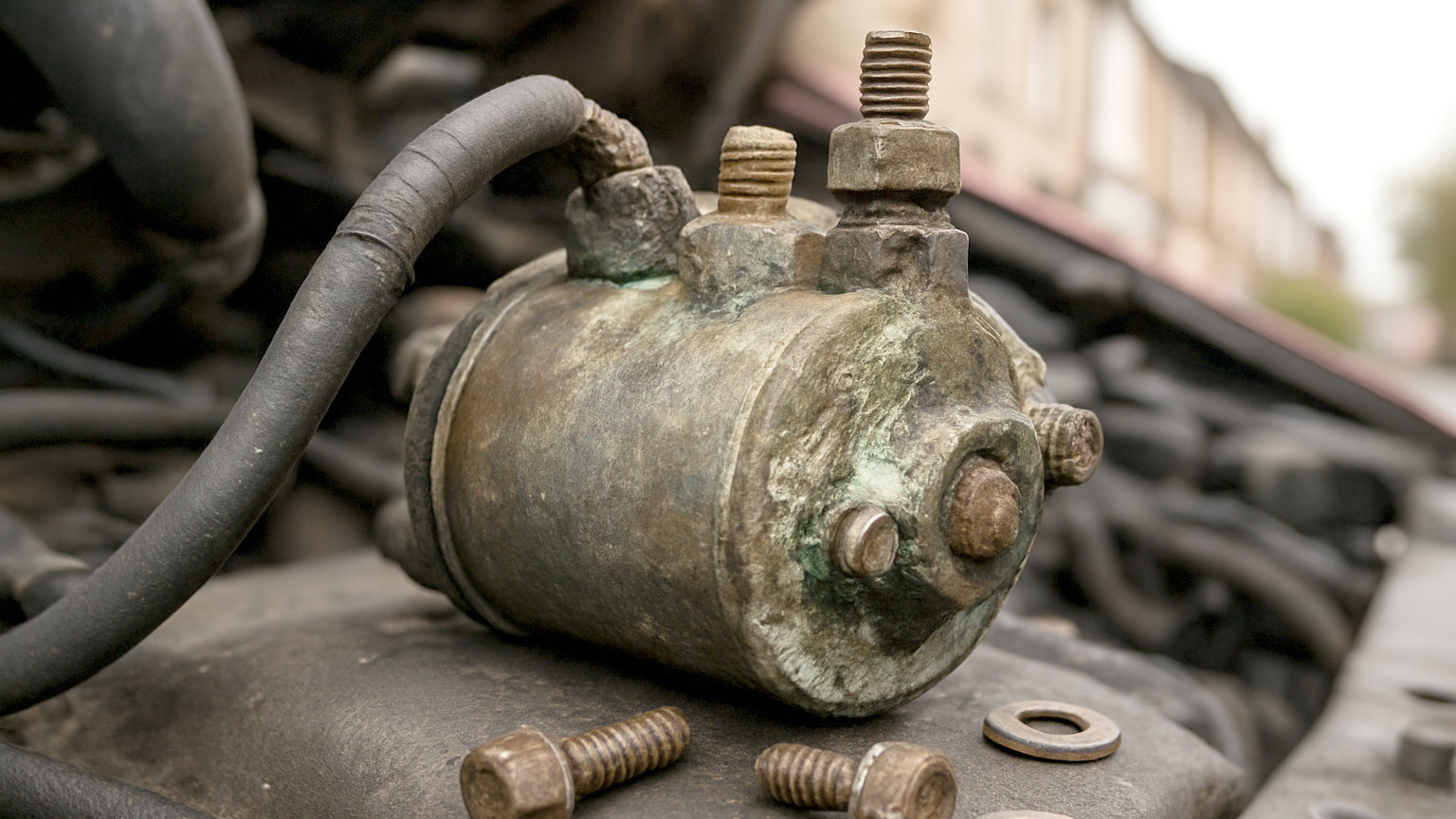
The solenoid is the component responsible for the click most people associate with a starting problem, and it is worth understanding because it fails in ways that are cheap to fix and frequently misdiagnosed as a whole starter failure. It is essentially a heavy duty electromagnetic switch, bolted to the starter and doing two jobs at once.
What are its two jobs?
First, it acts as a relay. A small current from the ignition switch energises a coil, which pulls a plunger in and closes a large internal contact, connecting the battery cable directly to the motor. Second, that same plunger movement pushes the pinion gear forward into mesh with the engine ring gear. One action therefore both engages the drive mechanically and completes the circuit electrically.
Why does it click?
The click is the plunger snapping into position. A single firm click with the dashboard lights staying bright means the solenoid has energised and stayed in, but the motor has not turned, which points at burnt contacts inside the solenoid or at the motor itself. Rapid repeated clicking means the plunger is pulling in and dropping out several times a second, which is the signature of insufficient voltage rather than a solenoid fault.
What burns the contacts out?
Every start sends several hundred amps through a pair of copper contacts inside the solenoid, and each make and break produces a small arc. Over tens of thousands of starts those contacts pit and erode until they can no longer pass full current. The result is a solenoid that clicks convincingly while delivering nothing useful to the motor, and it is one of the most common starter failures on high mileage cars.
Can the solenoid be replaced on its own?
On many starters, yes, and it is considerably cheaper than a complete unit. The solenoid usually unbolts from the starter body with two or three fixings, and repair kits containing new contacts and a plunger are widely available for common designs. The labour to remove the starter is the same either way, so the saving is on parts rather than time, but it can still be substantial.
What is the difference between a solenoid and a starter relay?
Many cars have both, and confusing them wastes time. The relay is a small plug-in component in the fuse box that carries the modest trigger current from the ignition switch to the solenoid. The solenoid is the large cylinder on the starter itself carrying the heavy current. A failed relay produces no click at all from the starter, while a failed solenoid produces a click but no cranking.
How do you test which is at fault?
Voltage measurement at the solenoid tells you most of it. With someone turning the key, check that the small trigger wire is receiving battery voltage. If it is not, the fault is upstream in the switch, relay or wiring. If it is, and the heavy cable also has full voltage, but nothing happens, the solenoid or motor is at fault. Comparing voltage on both sides of the solenoid while cranking reveals burnt contacts directly.
Why do people tap the starter?
The old trick of striking the starter body with a mallet works on worn brushes rather than the solenoid, jarring them back into contact with the armature. If tapping produces a start, the starter is worn out and should be replaced before it strands you somewhere less convenient. It is a diagnosis rather than a repair, and the fault will return sooner rather than later.
Should you fix the solenoid or replace the starter?
If the car is otherwise sound and the starter has no other symptoms, a contact kit or a replacement solenoid is good value. If the motor is also noisy, slow or high mileage, replacing the whole unit makes more sense, because the labour is identical and the remaining components have done the same work. Ask what was measured before agreeing, since the two repairs differ considerably in cost.


