
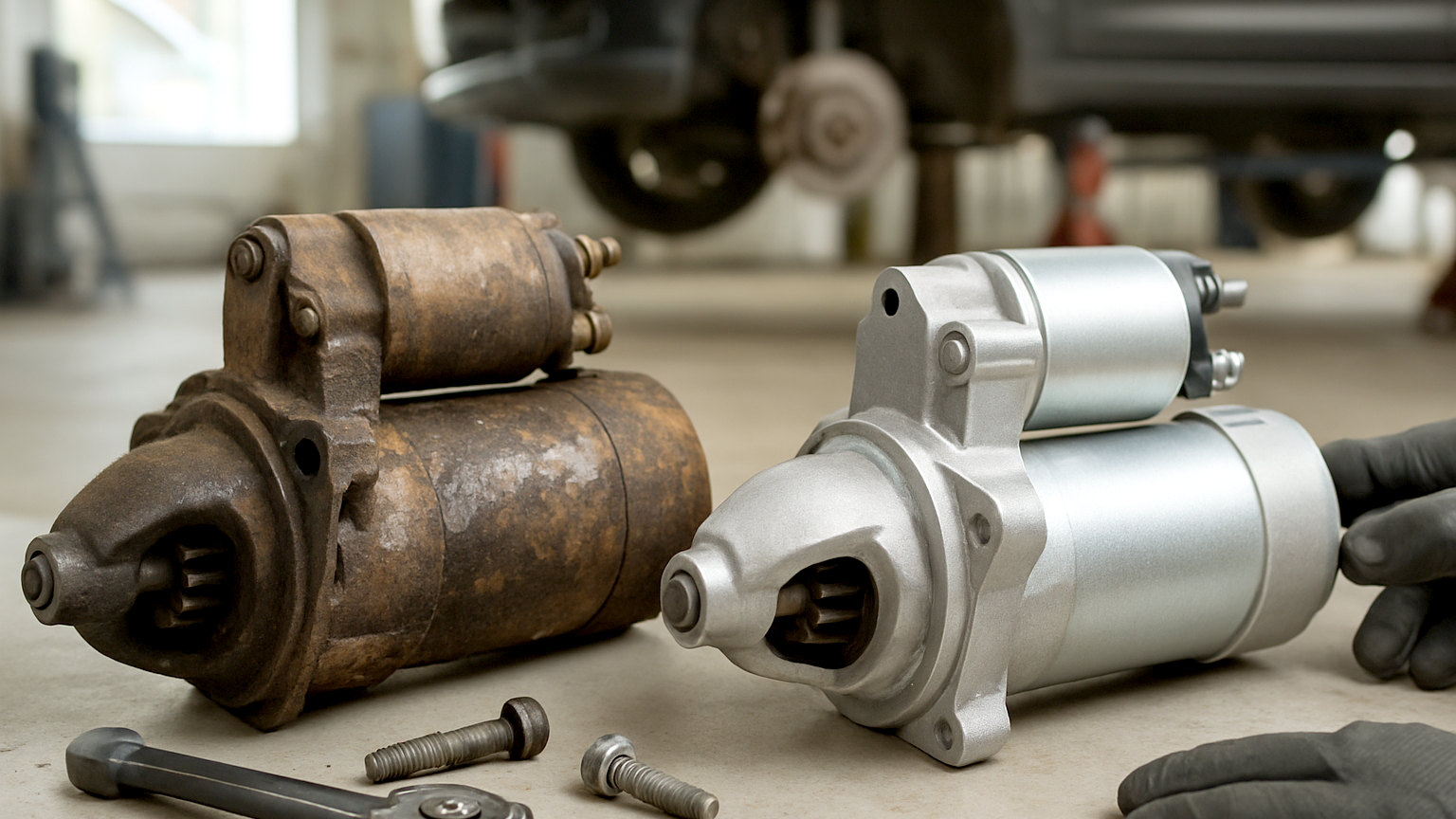
The cost of replacing a starter motor is dominated by where the manufacturer decided to put it. The part itself sits within a fairly predictable range for most mainstream cars, while the labour ranges from well under an hour on an accessible engine to the best part of a day where the subframe has to be lowered or the inlet manifold removed. Asking about labour time before agreeing to work is therefore the useful question.
What drives the labour cost?
Access, entirely. Some starters sit at the top of the engine bay held by two bolts and a cable, and come out in twenty minutes. Others are buried behind the exhaust manifold, under the inlet manifold, or on the back of the engine where the only route is from underneath with the subframe partially dropped. Transverse engines in small cars are frequently the worst, and V engines often require the inlet manifold to come off.
Is the part expensive?
Less than most people expect for common vehicles, and considerably more for premium marques and larger diesels. Quality varies widely at the cheaper end, and since the labour is identical whichever unit goes on, fitting the cheapest available part is a poor trade if it fails within two years. Ask what warranty applies and whether it covers labour if the unit fails.
Is a reconditioned unit worth considering?
Frequently it is the best value option. A properly remanufactured starter from a specialist has had its brushes, bearings, solenoid contacts and drive assembly replaced and the commutator skimmed, then been bench tested. It often costs less than a new original part while outlasting the cheapest aftermarket new unit. Many suppliers operate a surcharge system where the old unit is returned for credit.
Can just the solenoid be replaced?
On many starters, yes, and where the fault has been confirmed as burnt solenoid contacts it is a genuine saving on parts. The labour is the same, since the starter still has to come off on most cars, so this only makes sense where access is reasonable and the rest of the unit is sound. On a high mileage starter with other symptoms, replacing the whole thing is the better decision.
Is it a sensible job to do yourself?
It depends entirely on access, and that is worth researching for your specific engine before starting. Where the starter is reachable from above, it is a straightforward job requiring the battery to be disconnected first, the cables labelled and removed, and two or three bolts undone. Where it is only reachable from underneath, proper axle stands are essential and the job becomes considerably less appealing on a driveway.
What else should be checked at the same time?
The ring gear, which is visible through the starter aperture once the unit is out and should be inspected for chipped or missing teeth by turning the engine over by hand. The battery and its terminals. The earth straps. The heavy supply cable. Fitting a starter without checking those is how a repair comes back, and all of them are quick while everything is already apart.
How do you avoid paying twice?
Insist on measurement rather than assumption. A voltage drop test on the supply and earth, a battery load test and a check of the trigger wire cost very little and confirm the starter is genuinely at fault. A proportion of replaced starters were never faulty, and the original problem was a corroded earth strap or a failing battery that then destroys the new unit as well.
Is it worth doing on an older car?
Usually, since a car that will not start is worth very little regardless of its other condition, and a starter is a one-off cost rather than a recurring one. Where labour is unusually high on a low value vehicle, it is worth getting more than one quote, because labour times for the same job vary considerably between workshops and some have done that particular engine many times before.


