
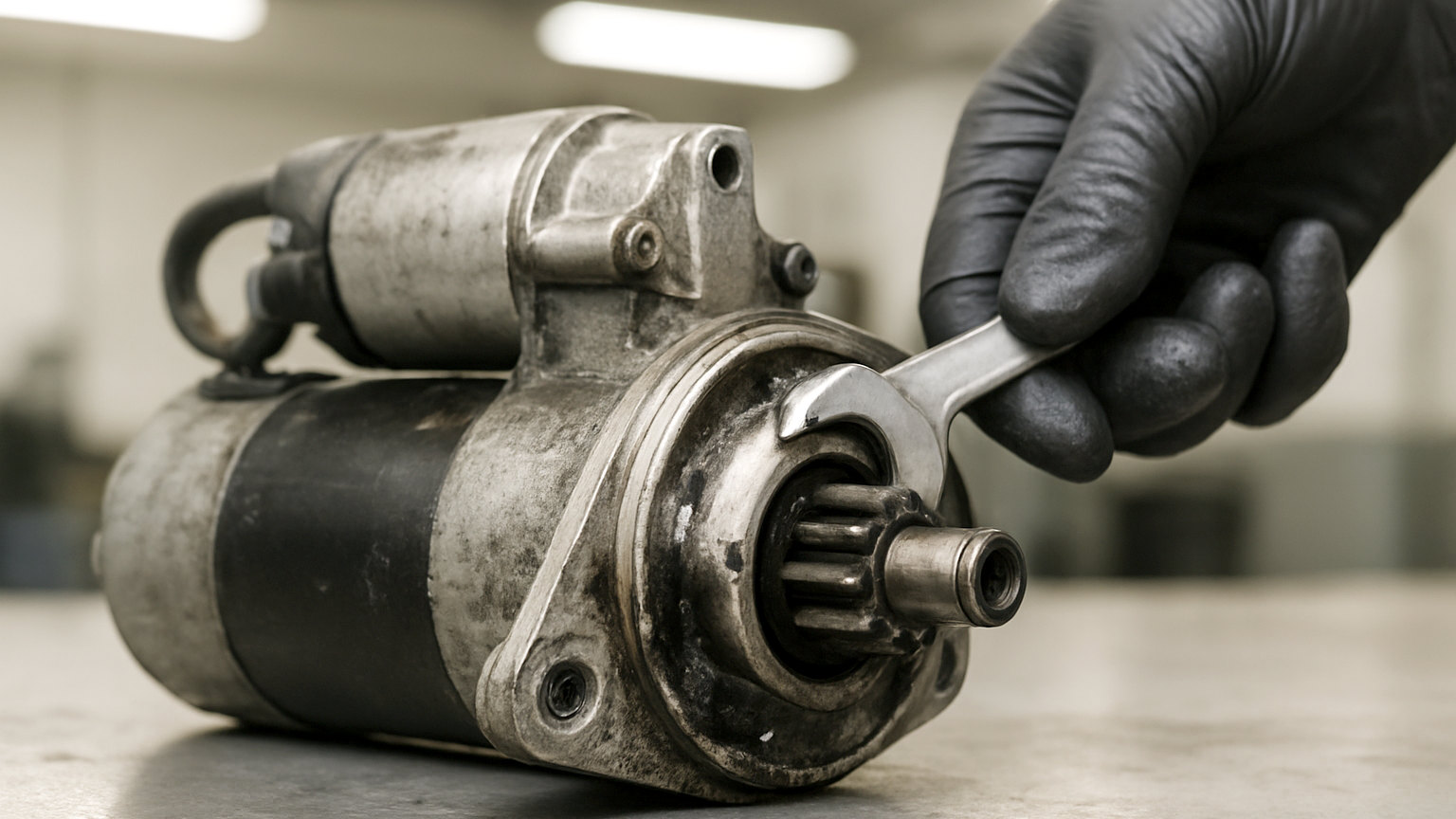
A starter motor is designed to run for a second or two at a time. If it remains engaged after the engine has fired, it is being driven at many times its intended speed by an engine producing far more power than it can survive, and it will destroy itself within seconds. This is one of the few starting faults that requires an immediate response rather than a diagnosis.
How would you know it is happening?
A harsh grinding or screaming noise that continues after the engine has started and settled, quite different from the brief whirr of normal starting. On some cars the noise rises with engine speed. There may be a smell of hot metal or burning insulation within a very short time. The engine itself usually runs normally, which is why the noise is the only clue.
What should you do immediately?
Switch the engine off. If the noise continues after the ignition is off, which happens when the solenoid has stuck closed, disconnect the battery negative terminal if you can do so safely, since that is the only way to stop current reaching the motor. Do not attempt to drive the car. Every second the starter remains engaged is doing damage to it and to the ring gear.
What causes a solenoid to stick?
The plunger corrodes or becomes contaminated and fails to return when the current is removed, or the internal contacts weld themselves together after years of arcing under heavy current. Once the contacts are welded, the motor continues receiving full battery current regardless of the key position, which is why switching off the ignition does not help and disconnecting the battery does.
Can the ignition switch be responsible?
It can. A worn switch that fails to return fully from the start position keeps sending the trigger signal, so the solenoid stays energised because it is being told to. A sticking key barrel or a damaged return spring produces the same result. On push button cars the equivalent fault sits in the start button or the module that controls the starter relay.
Could it be the relay?
Yes, and it is one of the cheaper explanations. A starter relay whose contacts have welded shut will keep the solenoid energised even with the ignition off. Since relays are inexpensive and often identical to others in the fuse box, this is worth checking early. It is also a reminder that the fault might not be the starter at all, even though the starter is the component making the noise.
What damage does it do?
The motor overheats rapidly, the windings can burn out and the armature can be damaged beyond repair. The one way clutch in the pinion drive, which is meant to protect the motor from being driven by the engine, takes the full force and usually fails. Ring gear teeth can be damaged. In the worst cases the wiring overheats to the point of melting insulation, which is a fire risk.
Is the car safe to use afterwards?
Not until the cause is found. A solenoid that has stuck once will do it again, and next time it may happen while the car is parked and unattended, which is when a welded contact becomes a genuine fire hazard. Have the starter, solenoid, relay and ignition switch checked before the car is used, and expect the starter to need replacing given what it has already been through.
What should you tell the garage?
Whether the noise stopped when the ignition was switched off or continued until the battery was disconnected, because that single detail separates a switch or relay fault from a welded solenoid. Mention how long it ran, since that indicates how much damage to expect. Both facts shorten the diagnosis considerably.
Can it happen again after a repair?
It can if only the obvious component was replaced. A welded solenoid and a stuck relay both leave the same symptom, so if the relay was the cause and only the starter was changed, the new unit will be destroyed in the same way. Ask which component was tested rather than which was replaced.


