
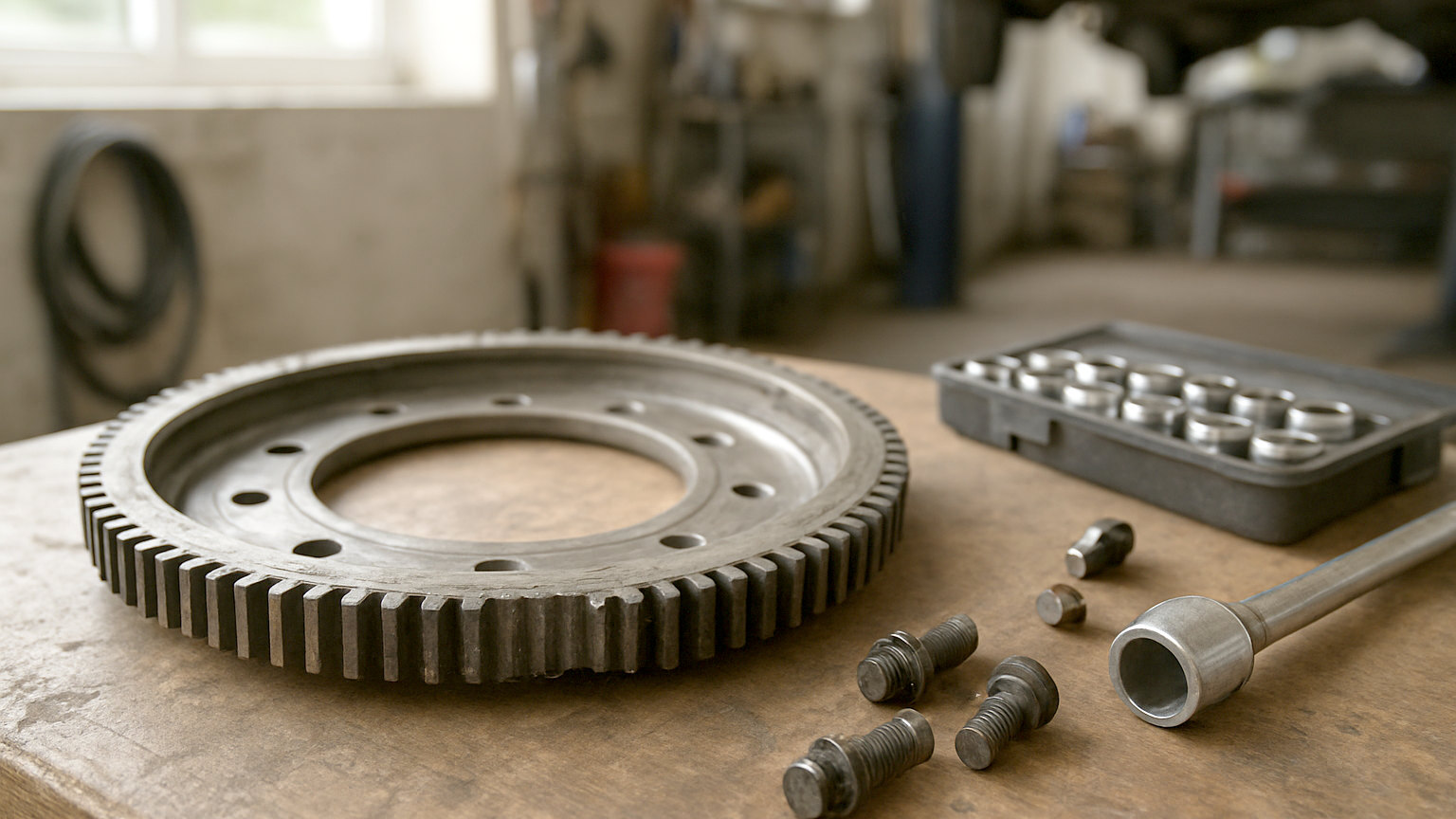
The ring gear is a large toothed ring fitted around the outer edge of the flywheel on a manual car or the flexplate on an automatic. It is what the starter pinion meshes with, and the enormous difference in diameter between the two is what allows a small electric motor to turn a cold engine. It is also, when damaged, one of the more expensive things on a car to put right.
Why does the size difference matter?
Gear ratios trade speed for torque. A starter pinion might have a dozen or so teeth against well over a hundred on the ring gear, so the motor spins many times for each turn of the engine and multiplies its torque by the same proportion. Without that reduction, no starter small enough to fit under a bonnet could turn an engine against compression.
Why do the teeth get damaged?
Because engines do not stop in random positions. Compression means they come to rest in one of a small number of places, so the same handful of ring gear teeth take the initial impact on almost every start. Over hundreds of thousands of engagements those teeth wear, and if a worn starter has been engaging badly they chip. Damage is therefore usually concentrated in one or two spots rather than spread evenly.
What are the symptoms?
A harsh grinding when starting, occurring on some attempts and not others, which is the pattern you would expect if damage is confined to particular positions. A car that starts perfectly nine times and grinds horribly on the tenth is a textbook description. In severe cases the starter spins without engaging at all because there is nothing left for the pinion to grip in that position.
How is the damage confirmed?
By removing the starter and looking through the aperture it leaves, which gives a direct view of the ring gear teeth. The engine is then turned over by hand, usually with a spanner on the crankshaft pulley, so the whole ring can be inspected. This takes a few minutes once the starter is out and it should be done as a matter of routine whenever a starter is replaced for grinding.
Why is the repair so expensive?
Because the ring gear is on the flywheel or flexplate, which sits between the engine and the gearbox. Reaching it means removing the gearbox, which is a substantial job on any car and a major one on some. On a manual, the clutch is usually replaced at the same time since it is exposed and the labour is already being paid for. The part itself is a fraction of the total.
Can a ring gear be replaced separately?
On many older flywheels, yes. The ring gear is a separate steel ring shrunk onto the flywheel, and a specialist can heat it, remove it and fit a new one. On modern dual mass flywheels and most flexplates that is not practical, and the whole assembly is replaced. Which applies to your car makes a meaningful difference to the parts cost, so it is worth asking.
How do you avoid the damage in the first place?
Deal with starter faults promptly rather than driving on them. A starter that grinds intermittently is actively removing metal from the ring gear on every bad engagement, so each week of delay increases the chance that a starter replacement becomes a gearbox-out repair. Also avoid repeatedly cranking a car that will not start, since each attempt is another engagement.
Is it always worth repairing?
On a car with plenty of life left, yes, particularly if the clutch is due anyway, since combining the two jobs makes the arithmetic much better. On an older car of modest value it can approach the point where the repair exceeds what the vehicle is worth. Get the ring gear inspected and quoted properly before deciding, rather than working from the noise alone.


