
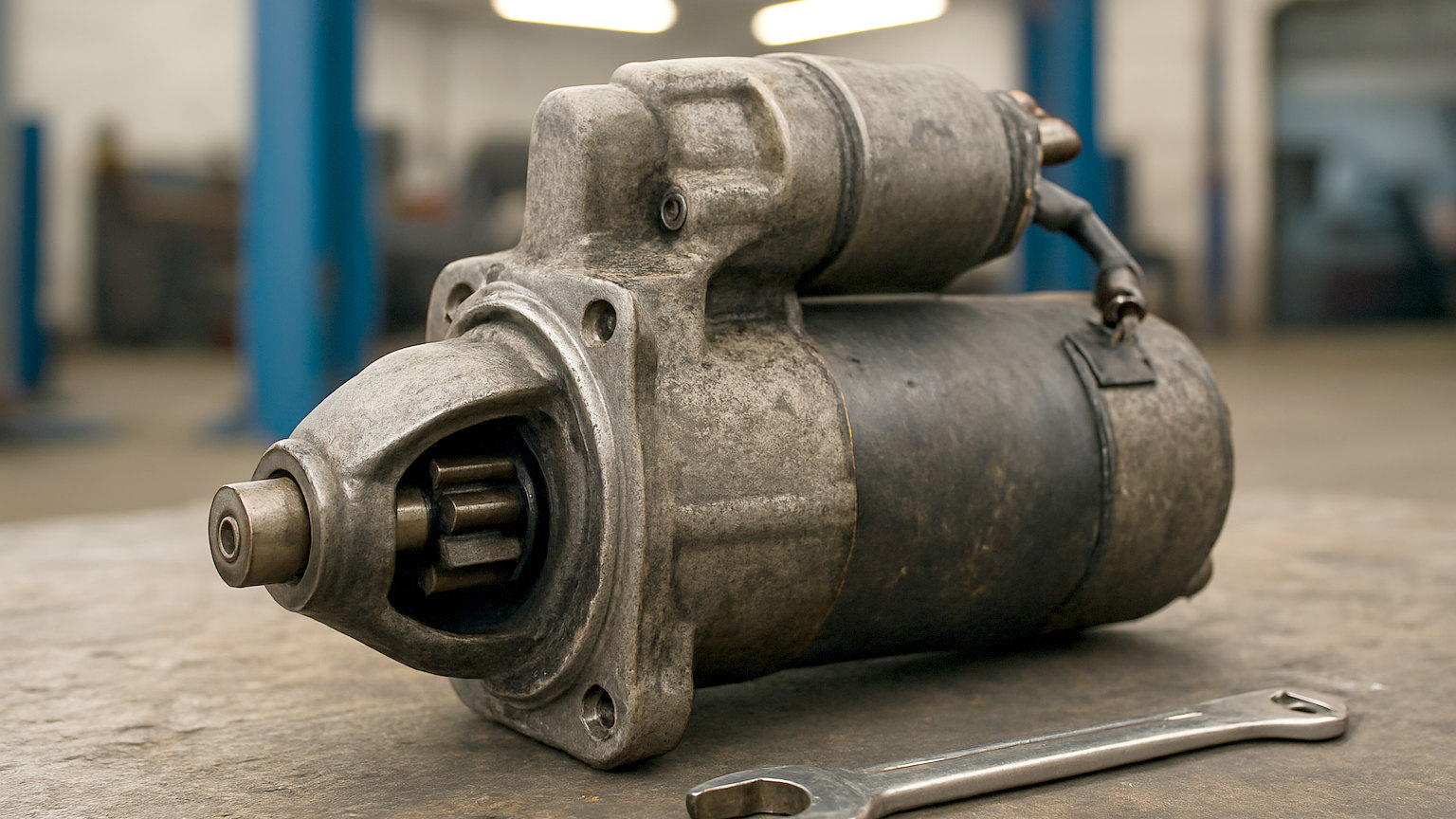
A starter motor has a brief and violent job. For a second or two it has to turn a cold engine against full compression, which needs an enormous amount of power, and then it has to get out of the way entirely. Understanding how it manages both makes almost every starting symptom easier to interpret, because each distinct noise corresponds to a different part of that sequence failing.
What happens when you turn the key?
A small current travels from the ignition switch to the starter solenoid, which is an electromagnet mounted on the starter itself. That current is modest, a few amps at most, and it is all the switch ever has to carry. The solenoid then does the heavy work, closing a large internal contact that connects the battery directly to the motor through a thick cable capable of carrying several hundred amps.
Why is there a separate solenoid at all?
Because running that much current through the ignition switch and the dashboard wiring would be impossible. The solenoid acts as a relay, letting a small switch control a very large load. On most starters it does a second job at the same time, using its plunger to push the small pinion gear forward into mesh with the engine, so one movement both engages the drive and completes the circuit.
What is the pinion and ring gear?
The pinion is the small toothed gear on the end of the starter shaft. The ring gear is the large toothed ring around the edge of the flywheel or flexplate on the engine. The size difference gives the starter enormous mechanical advantage, which is how a compact motor can turn an engine at all. The pinion slides forward to engage, turns the engine, then withdraws once the engine fires.
Why does the pinion need a one way clutch?
Because the moment the engine starts, it is turning far faster than the starter ever could, and a rigidly connected motor would be spun to destruction in seconds. The pinion assembly, often called a Bendix drive, contains a one way clutch that transmits drive in one direction and freewheels in the other. When that clutch wears, the motor spins with a whirring noise while the engine stands still.
How much current does it actually draw?
Between roughly one hundred and fifty and four hundred amps on a typical car, and more on a large diesel turning cold thick oil. For comparison, a headlight bulb draws around five amps and a radio around two. That enormous difference explains why a battery can run every light in the car and still fail to turn the starter, and why a slightly corroded terminal that passes small loads perfectly can block the starter entirely.
Why does the earth path matter so much?
Current has to return to the battery, and on a starter it does so through the engine block and the earth straps connecting it to the body and the battery. That return path carries the same several hundred amps as the supply cable. A corroded or loose earth strap therefore produces exactly the same symptoms as a flat battery or a failed starter, and it is a far cheaper fault to fix.
What tends to wear out?
The carbon brushes that carry current to the spinning armature wear down over tens of thousands of starts. The solenoid contacts burn and pit from repeatedly making and breaking a huge current. The pinion clutch wears and the pinion teeth chip. Bearings wear, allowing the armature to touch the field windings. Each of those produces a characteristic symptom, which is why the noise the car makes is genuinely diagnostic.
How long should one last?
Usually the life of the car on a vehicle doing longer journeys, since the number of starts matters far more than the mileage. A car doing many short trips accumulates starts rapidly and may need one sooner. Stop-start vehicles multiply that count enormously, which is why they use a substantially different design built for a far higher number of cycles.


