
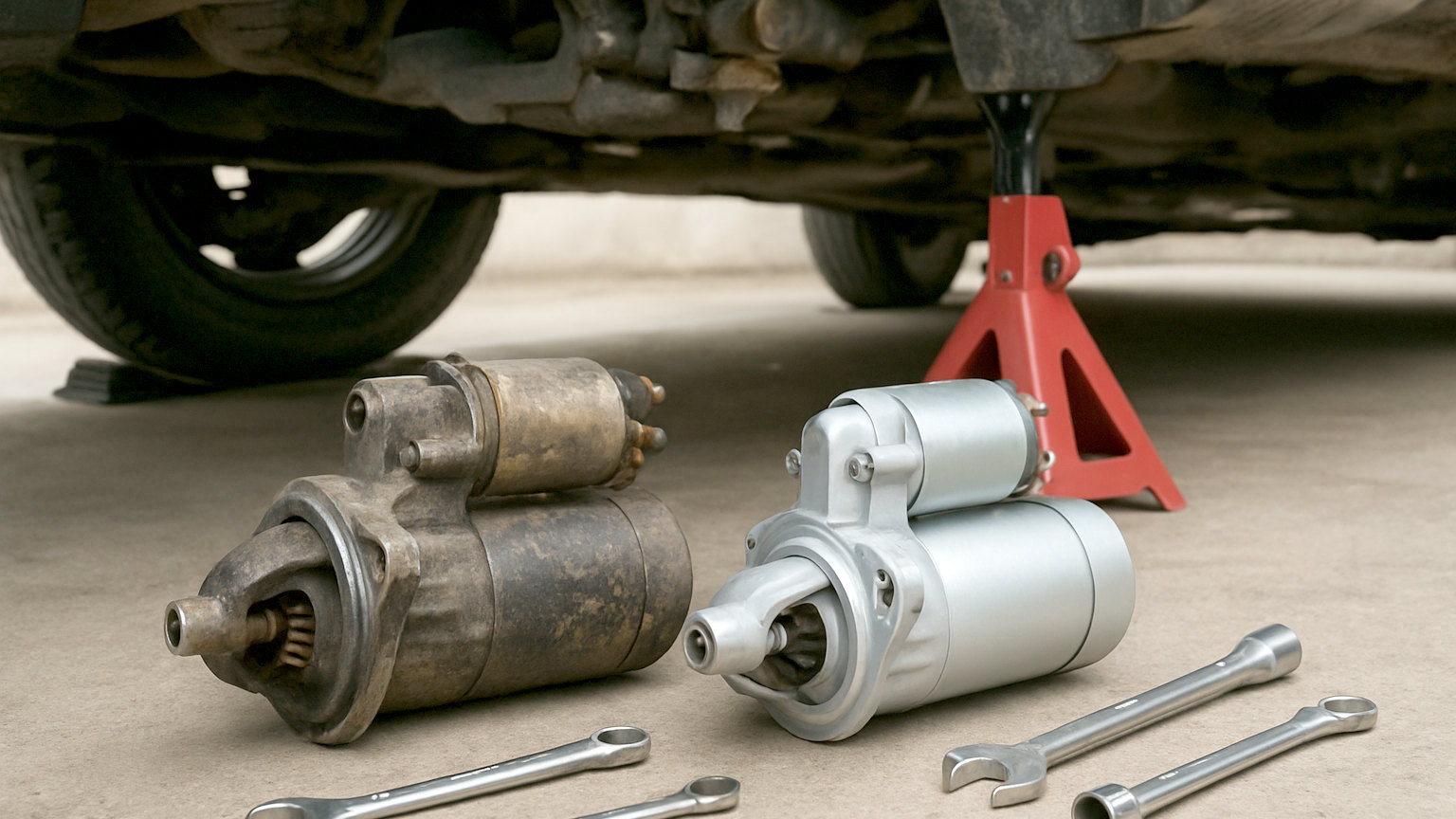
An intermittent starting fault is more frustrating than a total failure and more urgent than it feels, because a car that starts nine times out of ten still leaves you stranded on the tenth. Intermittent behaviour also has a fairly specific set of causes, and worn starter internals are near the top of the list precisely because of how they wear.
Why do starters fail intermittently rather than suddenly?
The motor turns on carbon brushes that press against a segmented copper commutator on the armature. As the brushes wear down, the spring pressure holding them against the commutator falls, and contact becomes unreliable. Whether the motor turns then depends partly on where the armature happened to stop last time, which is effectively random. That is why the fault appears to have no pattern at all.
What is a dead spot?
The commutator is divided into segments, each connected to a different winding. If one winding has failed or one segment is burnt, the motor will not turn when the brushes happen to rest on that spot. Move the armature slightly, by tapping the starter or by trying again after a rocking movement, and it works perfectly. A car that starts on the second or third attempt with no other symptom often has exactly this.
What else causes intermittent starting?
Solenoid contacts that have burnt unevenly, so the connection is made on some attempts and not others. A worn ignition switch that loses contact in the final position. A failing starter relay. A corroded connector at the starter trigger wire. Battery terminals or earth straps that are marginal, passing enough current on a warm day and not on a cold one. All produce a car that starts unpredictably.
Does temperature affect it?
Frequently, and the direction is informative. A car that fails when hot and works when cold points at a starter whose windings gain resistance as they heat, which is a classic sign of a worn unit. A car that fails when cold and works when warm points more towards the battery, since cold reduces the current available while thick oil increases the demand. Noting which way round it goes is genuinely useful.
How do you tell the starter from the battery?
Watch the dashboard lights while it fails. If they stay bright and steady and the car simply does nothing, the battery is delivering current and the fault is beyond it. If they dim heavily or the car clicks rapidly, the battery or its connections are the problem. A free battery load test settles it in minutes and should always come before a starter is ordered.
Does tapping it prove anything?
It does. If striking the starter body with a mallet while someone turns the key produces a start, the brushes or the commutator are worn and the unit is at the end of its life. It is a diagnosis rather than a repair. The same applies to a car that starts after being rocked in gear, which moves the engine and therefore the armature to a different position.
How long will it go on working?
Unpredictably, but the trend is always downward. Brushes do not recover, and the proportion of failed attempts rises over weeks or months. Most people replace a starter after it fails at the least convenient possible moment, having noticed the intermittent behaviour some time earlier. Acting while it is still occasional means choosing when the car is off the road.
What should you do first?
Clean and tighten the battery terminals and check the earth straps, since those mimic every fault here and cost nothing. Get a free battery and charging test. Then ask specifically for voltage to be measured at the starter while the fault is occurring, because a reading taken during a failed attempt distinguishes a supply problem from a starter problem definitively.
If the fault is difficult to reproduce on demand, note the conditions each time it happens, including how long the car had been running and how warm the weather was, since that record often reveals the pattern that a single workshop test cannot.


