
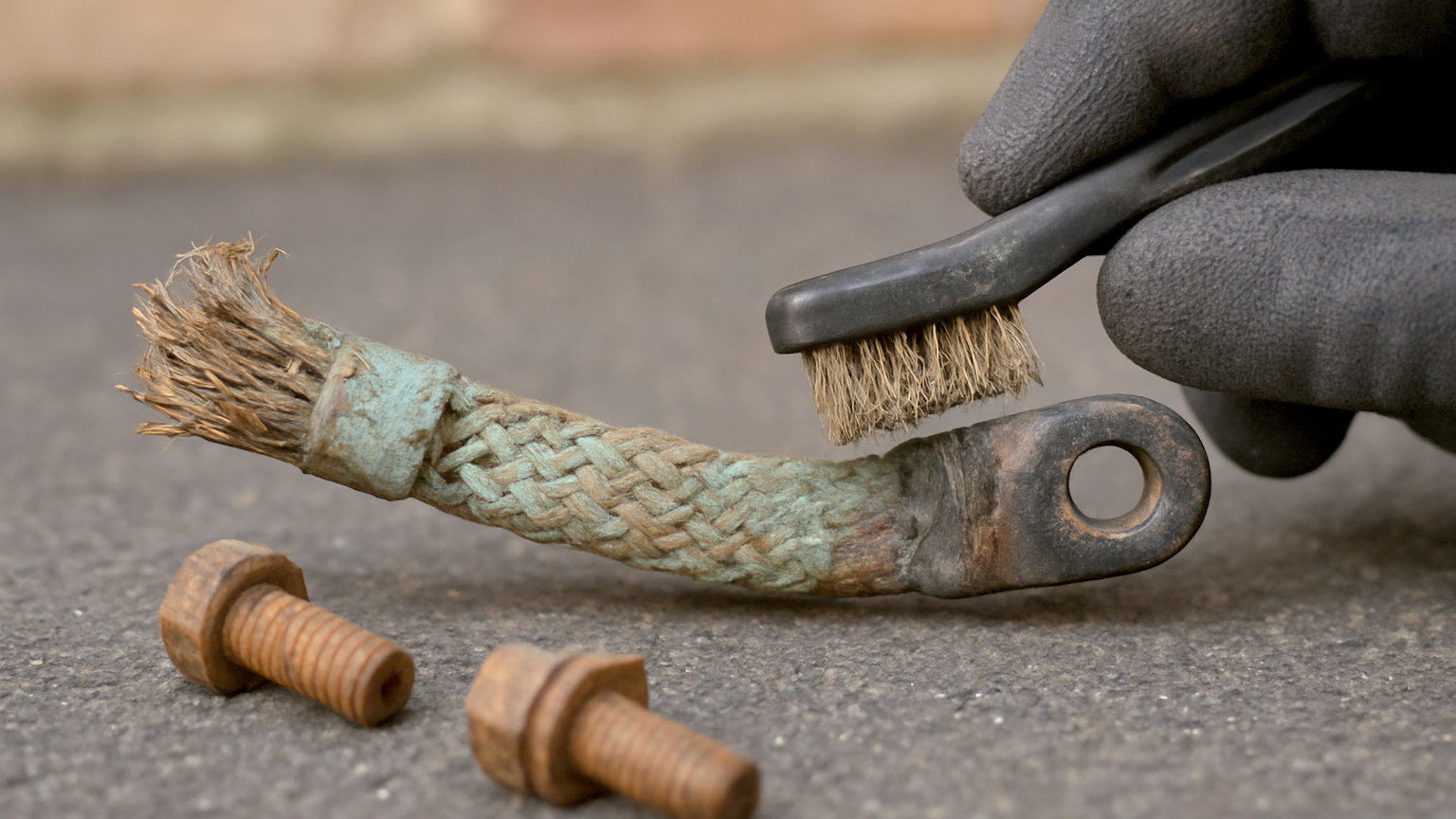
Earth faults are among the most commonly missed causes of starting problems, because almost everyone thinks about electricity arriving at a component and almost nobody thinks about it getting back. A starter draws several hundred amps, and every one of those amps has to return to the battery through the engine block and a set of braided straps. Corrode one of those and the starter stops working as completely as if the battery were flat.
How does the earth circuit actually work?
The battery negative terminal connects to the bodyshell and, usually through a separate braided strap, to the engine block. The starter is bolted to the engine, so it earths through its mounting. Current flows from the battery positive through the heavy cable to the starter, through the motor, out through the casing into the block, along the earth strap and back to the battery negative. Any weak point in that loop restricts the whole circuit.
What are the symptoms?
They mimic every other starting fault, which is the difficulty. A single click, a slow laboured crank, rapid clicking, or nothing at all, often accompanied by dashboard lights that dim during the attempt. A characteristic clue is odd behaviour elsewhere in the car, such as lights that brighten or dim when other circuits are switched, since current is finding alternative return paths through wiring never intended to carry it.
Why do earth straps fail?
They live in exposed positions, low down and directly in the path of road spray and salt. The braid corrodes from the inside where it cannot be seen, so a strap that looks acceptable can be almost entirely consumed beneath its outer surface. The bolted joints at each end corrode too, particularly where the strap meets painted or rusty bodywork, and engine movement flexes the strap constantly until strands break.
How do you test for it?
A voltage drop test, measured while cranking. Put the meter between the battery negative post and the engine block and have someone turn the key. The reading should be very small, a few tenths of a volt at most. Anything larger means the earth path is losing voltage that should be reaching the starter. Repeat between the block and the starter body to check the mounting itself.
Why is voltage drop better than a visual check?
Because corrosion inside a braided strap is invisible, and because a joint that looks clean can still have a high resistance film between the surfaces. A voltage drop test measures what is actually happening under load, which is the only condition that matters. It is also quick, needs only a cheap meter, and can be done without removing anything.
What is the fix?
Replace any strap that is corroded rather than trying to clean it, since a strap that has corroded internally will not recover. Clean both mounting faces back to bright metal, refit with the correct fixings, and protect the finished joint with grease or a suitable sealant. Straps are inexpensive parts and the labour is usually modest, which makes this one of the better value repairs in the whole starting circuit.
Should you add an extra earth?
Fitting an additional braided strap between the engine block and the chassis is a common and legitimate improvement on older cars, and it does no harm on any vehicle. It provides a parallel return path and reduces the load on the original. It is not a substitute for replacing a failed strap, but on a car with a history of intermittent electrical oddities it is a cheap and worthwhile addition.
What should you check before buying a starter?
Both earth straps and both battery terminals, cleaned and tightened, followed by voltage drop tests on the supply and return sides while cranking. Those checks take under half an hour and they identify a proportion of no-crank faults that would otherwise result in a perfectly good starter being replaced and the fault remaining.


