
Faults that appear only once everything is hot are among the most frustrating to diagnose, because the car behaves impeccably at the garage first thing in the morning. The pattern itself is valuable information though. Heat affects electronic components and electrical connections in predictable ways, and a fault that reliably clears after twenty minutes of standing has told you a great deal already.
What does heat actually do to a sensor?
Electrical resistance in most conductors rises with temperature, and semiconductor devices behave differently as they warm. A component with a marginal internal connection, a partially failed winding or degraded solder joints can work perfectly at twenty degrees and lose its signal at ninety. Nothing has broken; a weakness that was tolerable has been pushed past its limit.
Why does the fault clear on its own?
Because cooling reverses the effect, and this is the strongest clue available. Mechanical failures do not repair themselves while you stand next to the car. Anything that works again after a rest is temperature dependent by definition, and that single observation eliminates a great many possibilities before any test is carried out.
Which sensors are most prone?
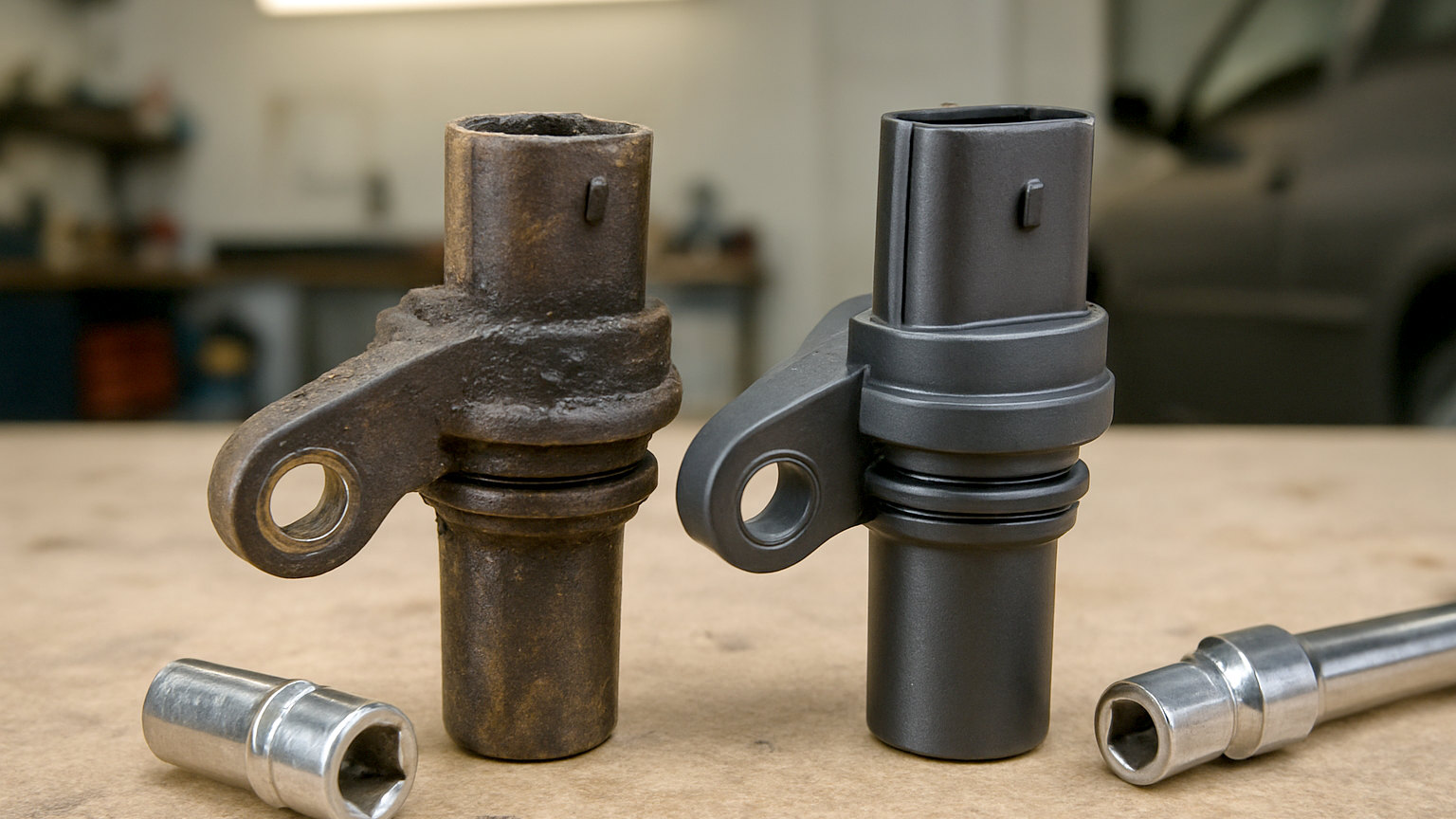
The crankshaft position sensor is the classic, producing an engine that cuts out after half an hour and restarts once cool. Camshaft sensors behave similarly. Oxygen sensors and their heater circuits are exposed to extreme heat by design. Any sensor mounted near the exhaust manifold or turbocharger sits in the worst thermal environment on the vehicle and ages accordingly.
Is it always the sensor?
No, and connectors deserve equal suspicion. A corroded or loose connector has resistance that rises with temperature, and heat also causes plastic housings and metal terminals to expand at different rates, which can open a marginal contact. Wiring insulation that has hardened and cracked near a heat source produces intermittent shorts that appear only once everything has expanded.
What is heat soak?
The period after switching off a hot engine when airflow stops but the heat does not, so under bonnet temperatures actually rise for several minutes. Components that survive normal running can fail during heat soak, which is why some cars start perfectly cold, run fine, and then refuse to restart after a twenty minute stop. That specific pattern points strongly at heat rather than at anything mechanical.
How do you catch a fault that will not appear?
By capturing evidence rather than trying to reproduce it. Freeze frame data records engine speed, load and coolant temperature at the moment a code was stored, which often shows the fault occurring only above a certain temperature. A diagnostic tool left recording during a normal drive will capture the moment it happens. Both are far more productive than a workshop test on a cold car.
Can a garage recreate it?
Sometimes, with a heat gun applied carefully to a suspect component while watching live data for the signal to drop out. It is a legitimate technique and it identifies the culprit directly. The reverse also works: freeze spray applied to a component while the fault is occurring, with the fault clearing immediately, confirms it just as convincingly.
What should you record?
How long the car runs before it happens, whether it is worse in warm weather, how long it takes to recover, whether it happens in traffic or at speed, and whether any warning light appeared before or after. That description is worth more than the car itself on the day of the appointment, because the fault will almost certainly not appear while anyone is looking at it.
Why act sooner rather than later?
Because these faults worsen. A component that fails at ninety degrees this summer will fail at seventy next, and the window in which the car behaves normally shrinks steadily. They also tend to strand people, since the failure happens partway through a journey rather than before it starts, which is the least convenient version of any fault.


