
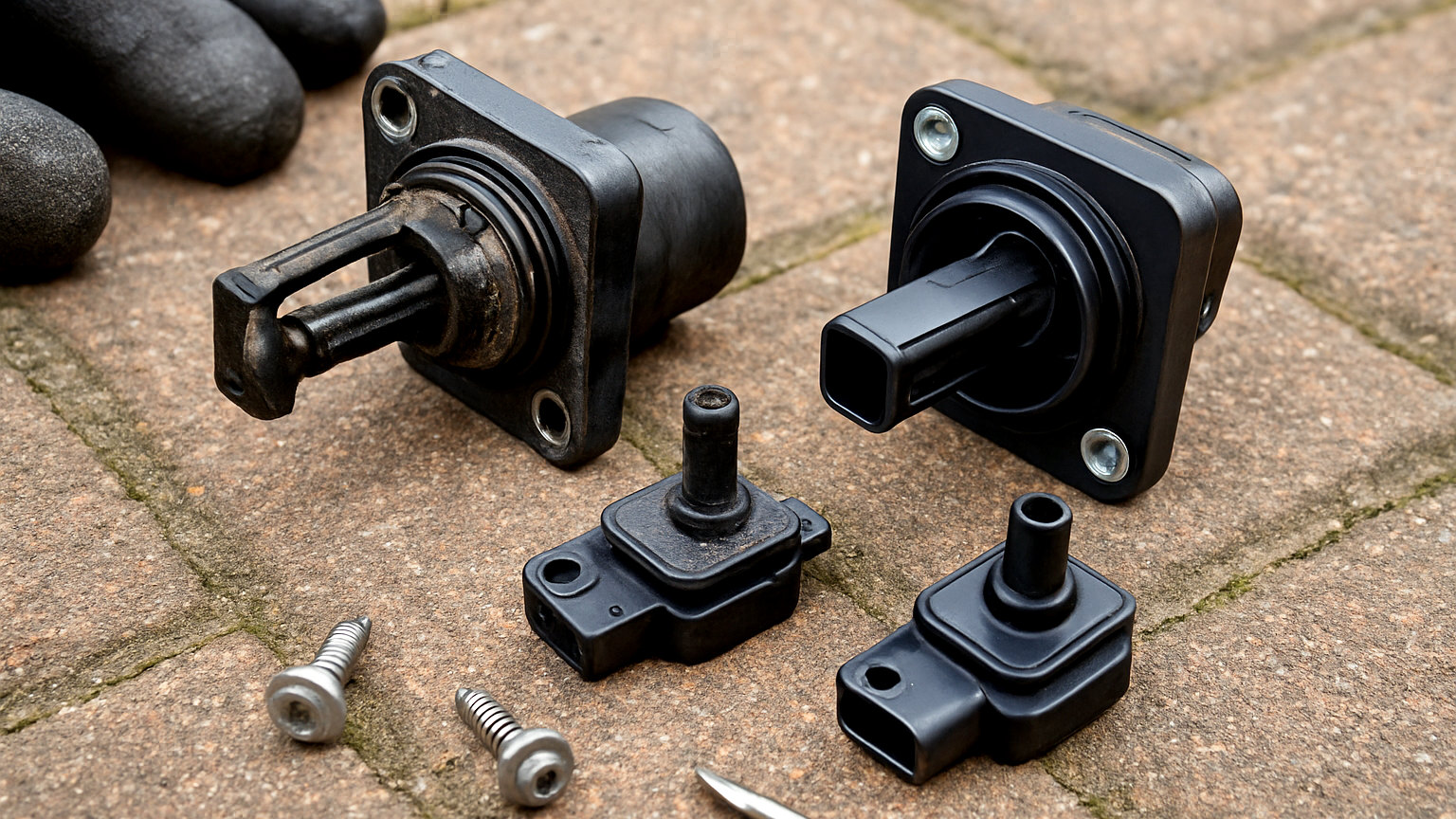
Both of these sensors exist to answer the same question, which is how much air is entering the engine, because that figure determines how much fuel to inject. They answer it in completely different ways, and knowing which your car uses, or whether it uses both, makes the symptoms considerably easier to interpret.
How does a mass airflow sensor work?
It sits between the air filter and the throttle and measures air directly. Most use a heated wire or film held at a constant temperature, with air passing over it removing heat. The current needed to maintain that temperature is proportional to the mass of air flowing, so the sensor reports actual mass rather than volume, which is what the fuelling calculation needs.
How does a manifold pressure sensor work?
It measures the pressure inside the inlet manifold instead, and the system infers airflow from that reading combined with engine speed, temperature and known engine characteristics. This approach is called speed density. On a turbocharged engine the same type of sensor also measures boost pressure, which is why underboost and overboost faults often involve it.
Which cars use which?
Both approaches are common, and many modern engines use both, cross checking one against the other. Naturally aspirated petrol engines have historically favoured airflow sensors, while some manufacturers have preferred pressure based systems for their simplicity and reliability. Turbocharged engines almost always have a pressure sensor for boost control regardless of what else is fitted.
What symptoms does a failing airflow sensor cause?
Hesitation on acceleration, a flat spot at particular throttle openings, rough idling or stalling shortly after starting, noticeably worse economy and reduced power. Fault codes typically relate to airflow range or performance, or to lean or rich fuel trims, which are consequences of the bad reading rather than separate faults. Contamination of the sensing element is the usual cause.
What symptoms does a failing pressure sensor cause?
Broadly similar, which is the difficulty: poor running, incorrect fuelling, hesitation and reduced power. On a turbocharged engine, add underboost or overboost codes and limp mode. Because the sensor sits in the manifold, it can also be affected by carbon and oil contamination from the breather system, and its vacuum hose on older designs can perish or block.
Why do air leaks affect airflow sensors so much?
Because any air entering after the sensor is unmeasured, so the engine receives more air than the system believes and runs lean. On a speed density system a leak still changes manifold pressure, so the system sees at least part of the effect. This is why unmetered air causes such pronounced symptoms on airflow sensor cars, and why a split intake hose is worth checking before condemning the sensor.
Can either be cleaned?
An airflow sensor frequently can, using a dedicated cleaner sprayed onto the element without touching it, and it is a genuinely worthwhile fifteen minute job. A pressure sensor sometimes responds to careful cleaning of its port and passage where carbon has built up. Neither should be cleaned with brake cleaner or general solvent, which damages the sensing elements.
How are they tested?
By comparing live data against expectation. An airflow sensor reading can be compared against the theoretical flow for that engine size and speed, and a sensor reading consistently low is degraded. A pressure sensor should read close to atmospheric with the ignition on and the engine off, then fall to a predictable vacuum at idle. Both checks are quick with a diagnostic tool.
Are aftermarket replacements a risk?
More than with most parts. Both sensors are precision devices, and cheap replacements have a poor reputation for accuracy, frequently producing the same symptoms straight out of the box. This is one area where a genuine or reputable brand part is worth the difference, since the alternative is often paying twice and losing confidence in the original diagnosis. Look at the old sensor for the manufacturer name and buy the same brand where possible.


