
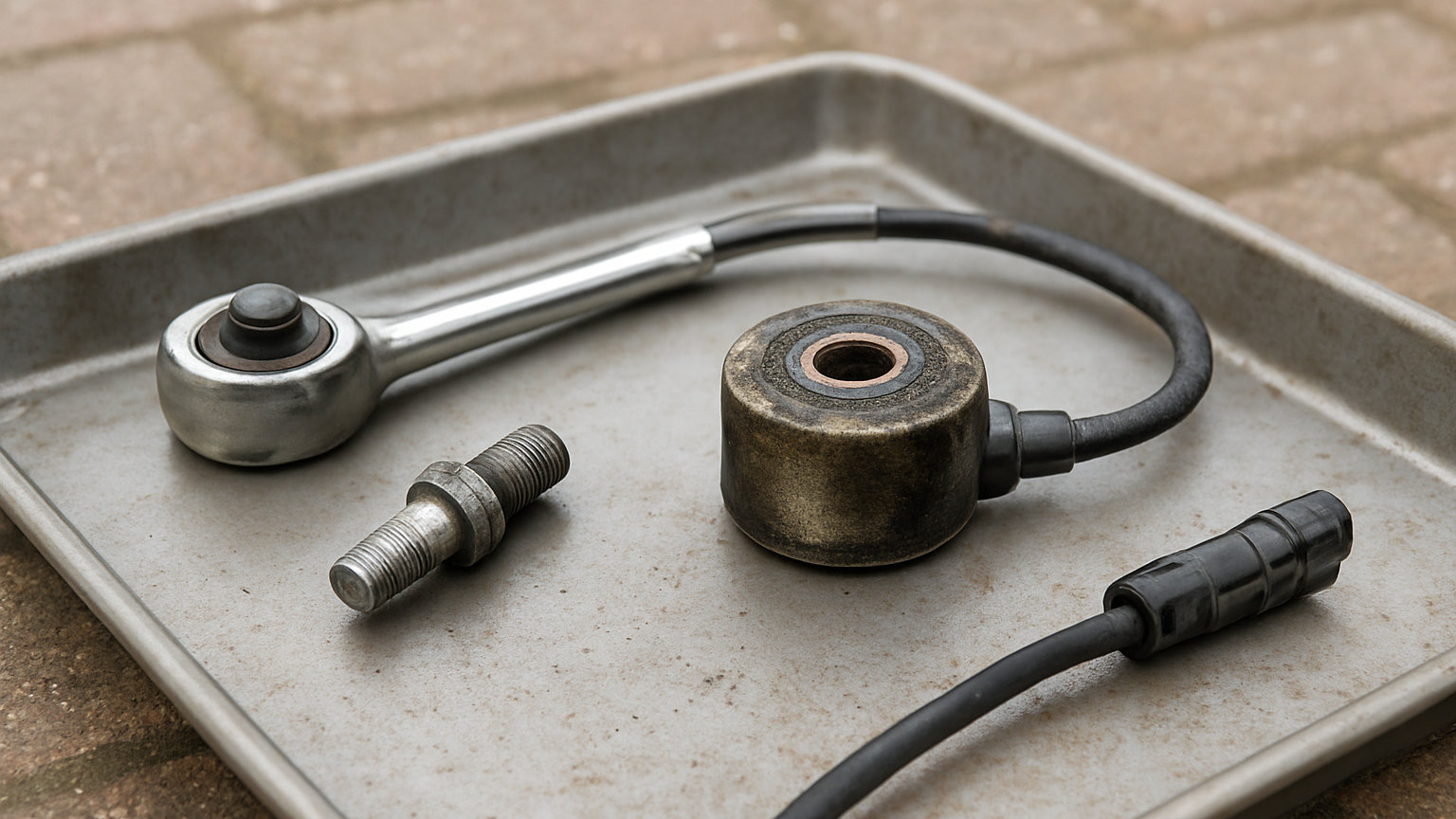
A knock sensor is essentially a microphone bolted to the engine block, tuned to hear the specific frequency produced by detonation. Its job is to detect combustion going wrong before it does damage, and its usual working state is entirely invisible to the driver. Because it protects the engine silently, most people only encounter it when a fault code appears.
What is it listening for?
Detonation, sometimes called pinking, where the fuel and air mixture ignites spontaneously ahead of the spark rather than burning smoothly outwards from it. The colliding flame fronts produce a sharp pressure spike that rings the metal at a characteristic frequency. The sensor is a piezoelectric device that generates a small voltage when vibrated, and the module filters for that specific frequency.
What does the module do about it?
It retards the ignition timing, firing the spark slightly later so that peak cylinder pressure falls and detonation stops. It then advances the timing again gradually until knock reappears, continuously seeking the most advanced timing the fuel and conditions will allow. This is happening constantly on a modern engine, which is why a car can run on lower octane fuel than specified without any audible pinking.
What happens when the sensor fails?
The module loses its feedback and cannot know whether detonation is occurring, so it adopts a safe strategy and retards the timing across the board. The result is noticeably reduced power, worse fuel economy and a car that feels flat, usually with an engine management light. It is a genuinely protective response, since running with advanced timing and no knock detection risks piston damage.
Why does the fault feel like a fuel problem?
Because retarded timing produces exactly the symptoms people associate with poor fuel or a blocked filter: sluggish acceleration, reduced top end, higher consumption and a general lack of willingness. Nothing sounds wrong, nothing smokes and the car drives perfectly smoothly. That combination sends people towards fuel system diagnosis when the answer is an inexpensive sensor.
Can it report knock that is not happening?
Yes, and this is the more troublesome direction. Because the sensor listens for mechanical noise, other noises at similar frequencies can be misread as detonation. Worn bearings, loose heat shields, failing accessory pulleys and even an incorrectly torqued sensor mounting bolt can all produce false knock signals, causing the module to retard timing unnecessarily and rob the engine of power.
Why does the mounting torque matter?
Because the sensor detects vibration transmitted through its mounting face, so it must be clamped to a clean surface at the specified torque. Too loose and it cannot hear properly; too tight and it distorts and reads incorrectly. It is one of the few components where the torque figure genuinely changes whether the part works, and it is frequently ignored during replacement.
How is it tested?
By checking the resistance across the sensor against specification, by monitoring knock retard values in live data while the engine is under load, and on some systems by tapping the block near the sensor with a small spanner while watching for the module to respond. A sensor showing no response to a deliberate tap is not doing its job.
Is the fault always the sensor?
No. Genuine detonation caused by carbon deposits, low octane fuel, an overheating engine or a lean mixture will produce knock codes with a perfectly healthy sensor. Before replacing anything, it is worth trying a tank of the correct grade fuel and a decent motorway run, checking the coolant temperature is correct, and looking for air leaks. The sensor may be reporting the truth.
Is it expensive to replace?
The part is usually modest, and access is the variable. Some sit accessibly on the side of the block, while others live under the inlet manifold, which turns a small job into a substantial one. On engines with two sensors, replacing both while access is available is often the sensible choice given how much of the cost is labour.


