
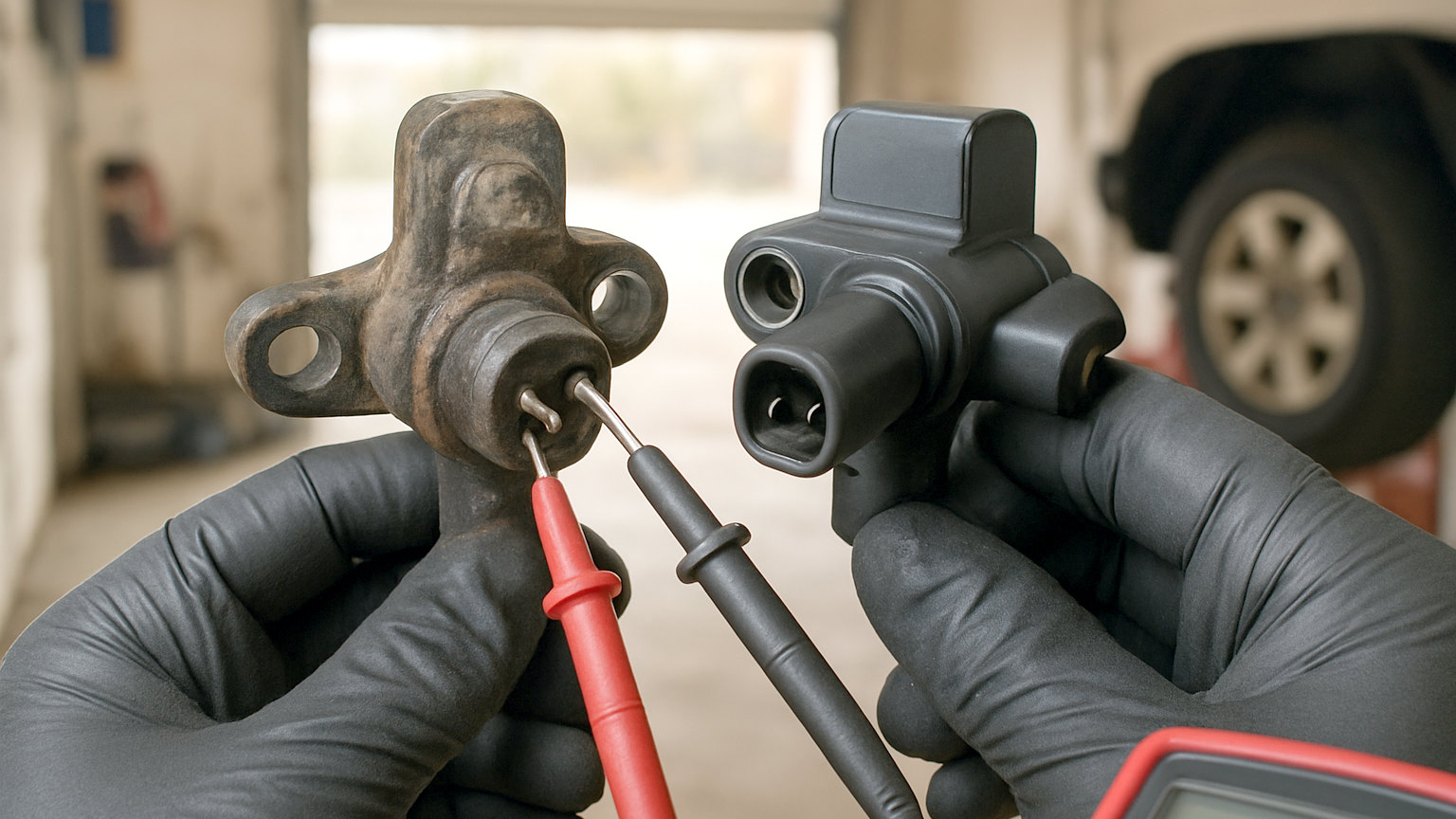
Testing a sensor properly means asking a different question from the one a code reader answers. A code tells you that a value fell outside an expected range at some point. A test asks whether the sensor is reporting reality accurately right now. Those are genuinely different questions, and only the second one distinguishes a failed sensor from a healthy sensor reporting a real problem.
What is a plausibility check?
Comparing what the sensor says against what you know to be true. On a car that has stood overnight, every temperature sensor should read close to ambient, so an intake air sensor reporting forty degrees on a cold morning has failed a plausibility check without any equipment beyond a diagnostic tool. It is the simplest and most powerful test available, and it costs nothing.
How do you compare sensors against each other?
Cars carry several sensors measuring related things, and on a cold engine many should agree. Coolant temperature, intake air temperature and fuel temperature should all read within a few degrees of each other and of ambient after a night standing. Any one that disagrees with the others has identified itself. On engines with two banks, comparing the same sensor on each side is equally revealing.
What does a circuit test involve?
Measuring at the sensor connector rather than relying on the module. Most sensors receive a reference voltage, commonly five volts, along with an earth, and return a signal. Checking that the reference is present and correct, that the earth is good, and that the signal changes as expected establishes whether the sensor is receiving what it needs and whether its output is getting back.
Why is testing the earth so important?
Because a sensor signal is measured relative to earth, so a poor earth shifts every reading it produces. A sensor with a corroded earth reports values that are consistently wrong while being entirely healthy itself. This is a common cause of sensors being replaced unnecessarily, and a voltage drop test on the sensor earth takes a minute and rules it out.
When do you need an oscilloscope?
When the shape of a signal matters rather than its average value. Crankshaft and camshaft sensors produce rapidly changing waveforms that a multimeter cannot represent, and a scope shows missing teeth, noise, dropouts and weak amplitude directly. It also allows two signals to be compared in time, which is how camshaft to crankshaft correlation is properly assessed.
What is the substitution test and when is it valid?
Swapping a suspect sensor with an identical one elsewhere on the engine, such as between banks, and seeing whether the fault follows the part. When it does, the diagnosis is confirmed. It is legitimate and quick where identical sensors exist. What is not legitimate is buying a new part to test with, since a wrong guess leaves you with an unnecessary purchase and no answer.
How do you test a sensor by simulating conditions?
By changing what it measures and watching the reading respond. Warming a temperature sensor in hot water should produce a smooth predictable change. Applying vacuum to a pressure sensor with a hand pump should move the reading proportionally. Blowing gently through an airflow sensor should register. A reading that jumps, sticks or fails to respond has failed the test.
What does freeze frame data add?
Context for a fault that is not currently present. It records engine speed, load, temperature and fuel trims at the moment the code was stored, which reveals whether the problem occurs cold or hot, at idle or under load. For intermittent sensor faults it is frequently the only useful evidence available, and it should be recorded before any codes are cleared.
What should you ask a garage to do?
To show you the live data value and explain why it is implausible, rather than quoting for the part named in a code. That is a reasonable request and a good workshop will happily do it. It also tends to reveal whether the diagnosis was reasoned or assumed, which is useful information about where to take the car next time.


