
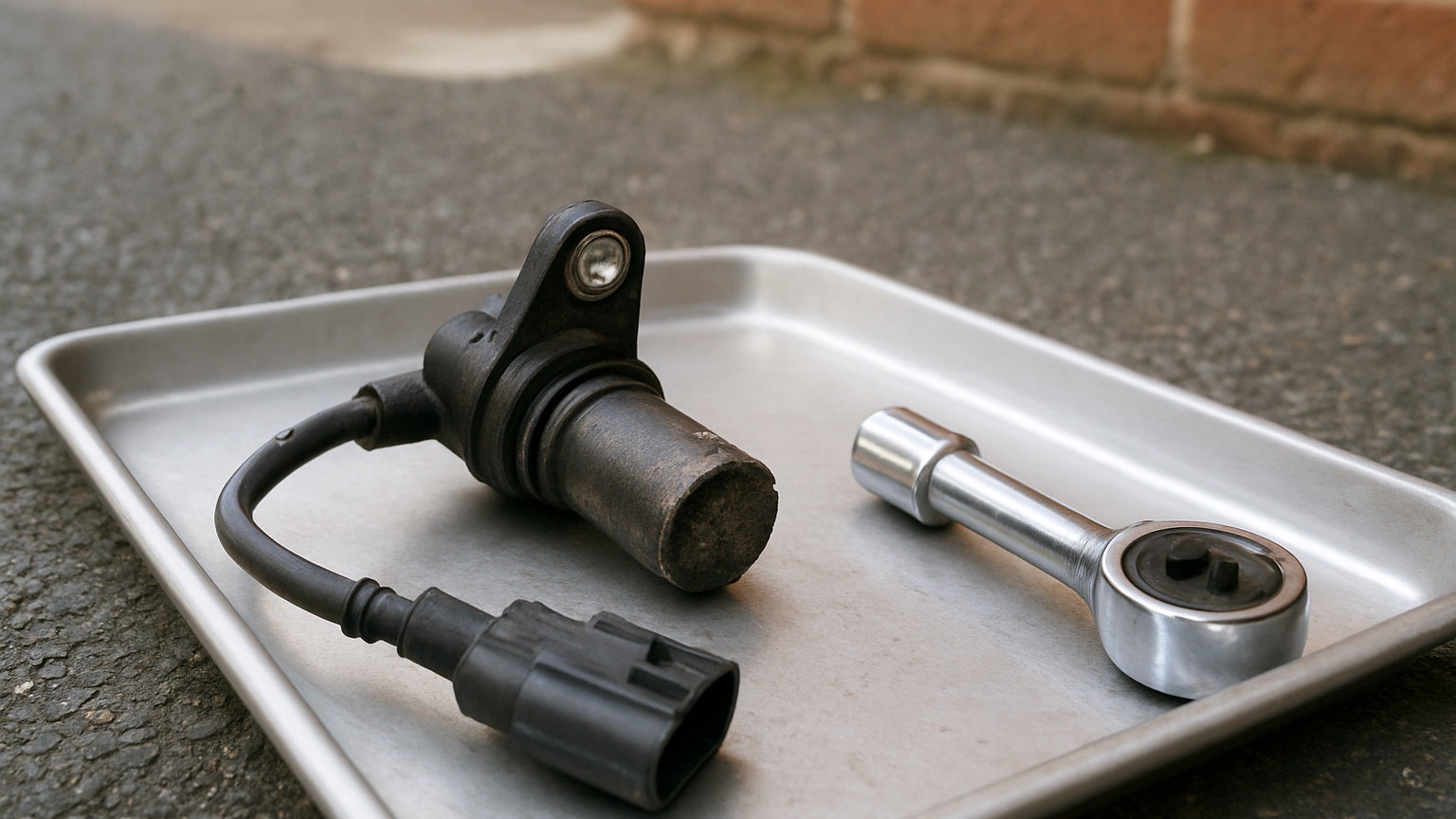
The crankshaft position sensor is one of the few components on a modern engine whose failure stops the car completely and immediately. It tells the engine management exactly where the pistons are and how fast the crankshaft is turning, and without that information the system cannot decide when to inject fuel or fire the ignition. There is no limp mode for this one; the engine simply stops.
How does it work?
A toothed ring, usually on the crankshaft or flywheel, passes close to the sensor as the engine turns. Most sensors are either inductive, generating a small alternating voltage as each tooth passes, or Hall effect, producing a square wave signal. A deliberate gap in the teeth gives the system a reference point, so it knows not just the speed but the exact angular position of the crankshaft.
What are the symptoms of failure?
Complete failure produces an engine that cranks strongly and never fires, usually with no warning light beforehand and sometimes with no stored code. Partial or intermittent failure produces an engine that cuts out while driving, as though the ignition had been switched off, and then restarts after a period. Others include a rev counter that drops to zero momentarily, hesitation, and a stumble at particular engine speeds.
Why is the hot failure pattern so common?
Because the sensor is a small electronic component mounted close to a hot engine, and as its internal windings or electronics age they can lose their signal above a certain temperature. The classic symptom is a car that cuts out after half an hour of driving, refuses to restart at the roadside, then starts perfectly twenty minutes later once it has cooled. That pattern points at this sensor more strongly than at anything else.
Why does the fault sometimes leave no code?
Because the module needs the sensor signal to run its own diagnostics on ignition and fuelling, and when the signal disappears entirely the system may simply stop rather than record a fault. Some vehicles do log a crank signal code, but its absence proves nothing. This is one situation where a clean code read should not be taken as evidence that the sensor is healthy.
How is it tested?
An oscilloscope is the definitive method, showing the actual waveform while cranking and revealing a weak, noisy or intermittent signal that a meter would miss. A multimeter can measure the resistance of an inductive sensor against specification, and can check supply and earth on a Hall effect type. Live data showing engine speed reading zero or erratically during cranking is also revealing.
Can something other than the sensor cause it?
Yes, and it is worth checking before ordering parts. Metal debris collecting on the sensor tip disrupts the signal, and it can simply be cleaned off. A damaged or corroded reluctor ring with a missing tooth produces the same fault. Wiring damage and corroded connectors are common, since the sensor lives in an exposed position. And on a few engines a stretched timing chain shifts the relationship enough to log related faults.
Is it an expensive repair?
The sensor itself is usually modest. Access varies enormously, from a single bolt reachable from above to a position behind the starter, under the inlet manifold or only accessible with the car raised. That variation is what determines the bill, so it is worth asking about labour time rather than assuming it will be quick.
Should you carry a spare?
On a vehicle with a known reputation for this failure and easy access, some owners do, since a roadside replacement is genuinely possible on certain engines. More practically, if your car has already shown the hot cut out pattern once, replacing the sensor before it strands you is a small cost against a recovery call, and the fault does not improve on its own.
What should you tell a garage?
Whether the engine cranks normally, whether it cut out while driving or failed to start from cold, and crucially how long it takes before it will start again. That recovery time is the detail that identifies a heat related electronic failure, and it is the piece of information most likely to be missing when a car arrives on a recovery truck already stone cold.


