
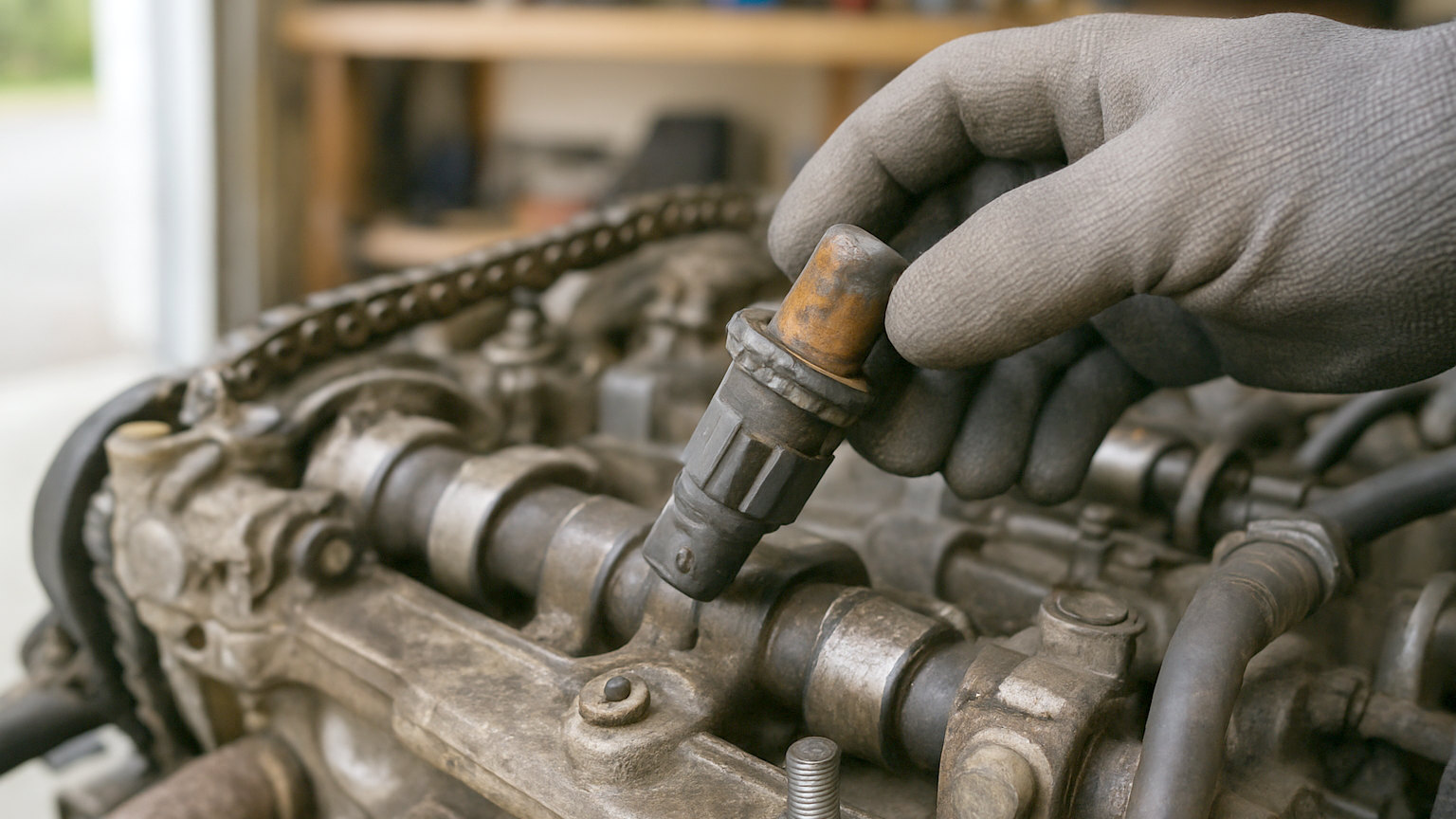
The camshaft position sensor works alongside the crankshaft sensor, and the division of labour between them is worth understanding. The crank sensor knows where the pistons are, but on a four stroke engine each piston passes top dead centre twice per cycle, once on compression and once on exhaust. The cam sensor is what tells the system which of those two is happening.
Why does that distinction matter?
Because fuel and spark must arrive on the compression stroke and not the exhaust stroke. Without cam position, the management can only guess, and many engines will start by firing on both and sorting themselves out, which produces a noticeably longer crank before starting. On engines with sequential injection or variable valve timing, accurate cam position is essential rather than helpful.
What are the symptoms of a failed sensor?
Extended cranking before the engine catches, particularly from cold. An engine management light with a cam position code. Rough running or a misfire. Loss of power and sometimes limp mode, since variable valve timing will be disabled without reliable cam data. Some vehicles will not start at all, while others run acceptably on the crank signal alone with reduced refinement and economy.
What is a correlation code?
The most commonly misread code in this area. A camshaft position correlation fault means the module has compared the crank and cam signals and found they do not line up as expected. Both sensors may be working perfectly. What has changed is the mechanical relationship between the crankshaft and the camshaft, and that usually means the timing chain or belt has stretched or jumped.
Why does a stretched chain produce this?
As a chain wears it lengthens fractionally, and worn guides allow further slack. The camshaft therefore lags slightly behind where it should be relative to the crankshaft. The module measures that offset precisely and reports it. Fitting new sensors changes nothing at all, because the sensors were accurately reporting a mechanical problem. This is one of the classic wasted repairs.
How do you tell a sensor fault from a chain problem?
By listening and by measuring. A stretched chain usually produces a rattle for a second or two on cold start, worse after the car has stood overnight. Live data or an oscilloscope can show the actual cam to crank offset, and a workshop with the right equipment can measure it against specification. Checking the oil condition and service history helps too, since chain wear tracks oil neglect closely.
What about variable valve timing?
Many engines vary cam timing deliberately using an oil pressure driven actuator, and the cam sensor is what tells the module whether the commanded change has actually happened. A code relating to camshaft timing performance can therefore mean a blocked oil control valve, low oil pressure, dirty oil or a failing actuator rather than a sensor. Oil condition is genuinely part of the diagnosis here.
How is the sensor itself tested?
By checking supply and earth at the connector, then observing the signal in live data or on an oscilloscope while the engine runs. A sensor producing no signal, or one that drops out intermittently, is faulty. A sensor producing a clean signal that simply does not align with the crank signal is healthy and pointing at something mechanical.
Is it worth replacing preventatively?
Not particularly. These sensors are reasonably reliable and generally fail without much warning rather than degrading predictably. What is worth doing is keeping the oil fresh and to specification, since that protects the chain, the tensioner and the variable timing system, all of which are considerably more expensive than any sensor.
What should you ask before agreeing to work?
Whether the correlation has actually been measured, and whether the timing chain has been assessed. A quote for two sensors on the strength of a correlation code, with no mention of the chain, deserves a second opinion. Getting that right matters, because a chain that jumps completely can destroy an engine.


