
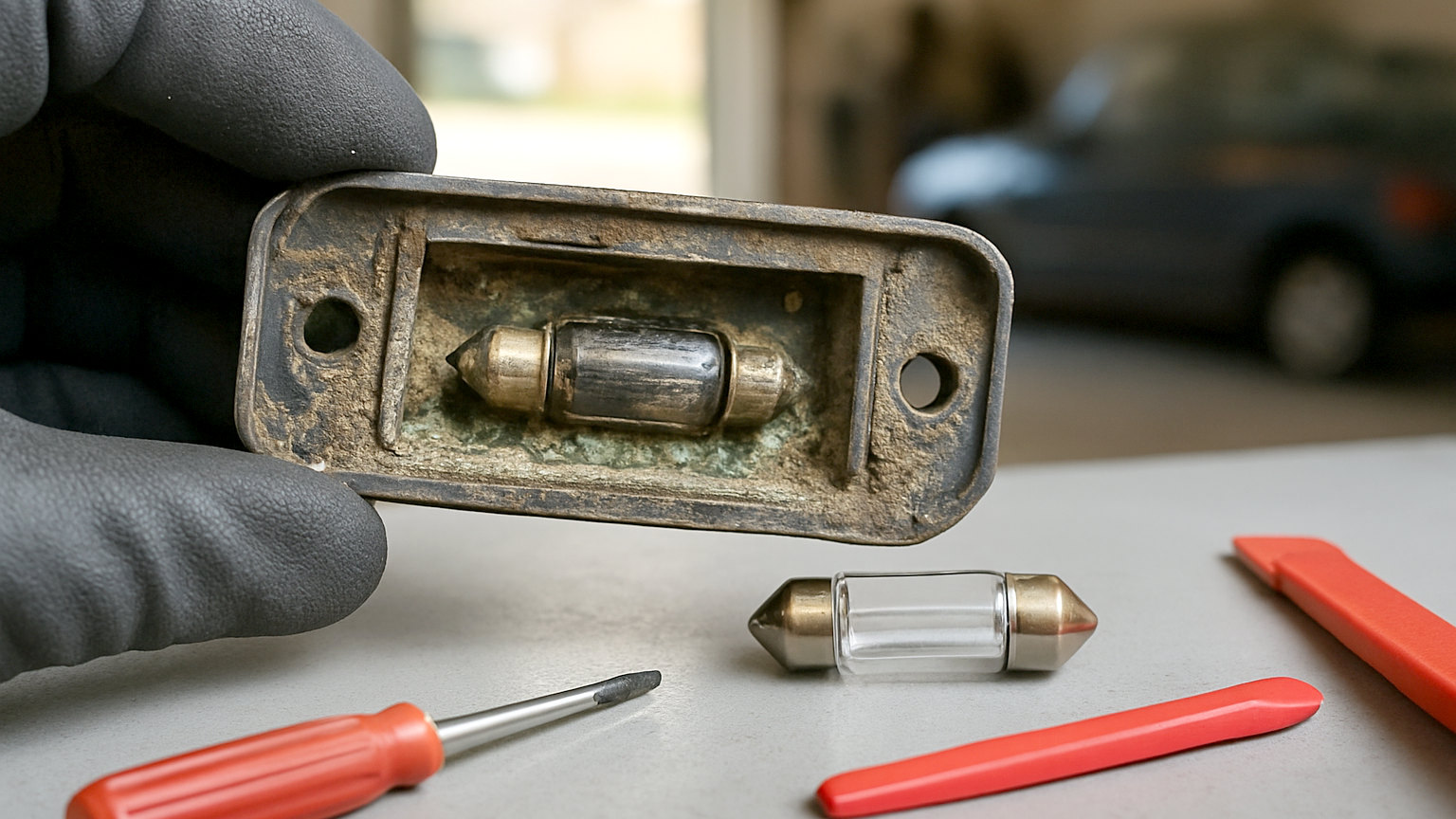
The small wedge base bulbs used for number plate lights and sidelights are the cheapest on the car and among the most frequently replaced. That is not because they are poorly made. It is because they sit in the most exposed positions with the smallest and least effective seals, and because a small failure there produces exactly the same MOT failure as a headlight.
Why do number plate lights suffer most?
They are mounted low at the back of the car, directly in the path of road spray, salt and everything thrown up by the rear wheels. The lamp units are small plastic housings with modest seals that harden and shrink with age. Water gets in, sits around the bulb contacts and corrodes them, and the resulting resistance and moisture destroy bulb after bulb.
What does corrosion actually do?
It creates resistance at the contact, which generates heat and produces an unstable supply. The bulb flickers, runs at the wrong voltage and eventually fails, and each replacement lasts a shorter time than the last as the corrosion worsens. Green or white deposits on the contacts inside the holder are the visible sign, and cleaning them is a temporary measure at best if water is still getting in.
How do you stop the water?
Replace the lamp unit gasket if one is available, since a hardened seal is the usual entry point. Check the lens for hairline cracks, which are easy to miss on a small unit. Make sure any drain holes are clear rather than blocked with dirt. A small amount of dielectric grease on the contacts after cleaning slows future corrosion considerably and is worth doing whenever a bulb is changed.
Why do sidelights fail so often?
Because on most cars they sit inside the headlight unit, where they run in a hot environment for long periods, often on whenever the car is in use. They are also frequently in the most awkward position to reach in the whole headlight, which is why they get left. A sidelight in a unit suffering from condensation will fail repeatedly for the same reasons as a number plate lamp.
Do these lamps really matter?
Legally yes, and it surprises people. A number plate that is not illuminated at night is an offence and an MOT failure, and it is one of the most common reasons for being stopped, since it is obvious to a following vehicle and invisible to the driver. Sidelights are equally required. The size of the bulb has no bearing on the seriousness of the failure.
Are LEDs a sensible upgrade here?
These are among the few positions where LED replacements make good sense, because no beam pattern is involved. They last far longer, run cooler and draw less current, which reduces the heat stress on a corroded holder. The requirements are that the light remains white and of a reasonable intensity, and on some cars a low current draw will trigger a bulb failure warning that needs addressing.
Why does one side fail and not the other?
Usually because that side has a worse seal, a cracked lens or a blocked drain, so it is holding water while the other stays dry. It can also be a poor earth on that side specifically. If the same position fails repeatedly while its twin never does, the fault is in that unit rather than in the bulbs, and replacing bulbs will continue indefinitely until the unit is addressed.
What should you do?
Clean the contacts, grease them lightly, replace or improve the seal, and fit a good quality bulb. If the unit is cracked or the holder is heavily corroded, replace the whole lamp assembly, since they are usually inexpensive. Then check both lamps monthly, because these are the two positions on a car that you will otherwise never notice have failed.
Are they easy to change?
Number plate lamps usually are, held by one or two small screws or a clip, though the screws are frequently seized and the plastic lens is easily cracked by force. Sidelights vary enormously, from a simple twist and pull to requiring the same access as a headlight bulb. Both are inexpensive parts, so the cost is almost entirely in the awkwardness.


