
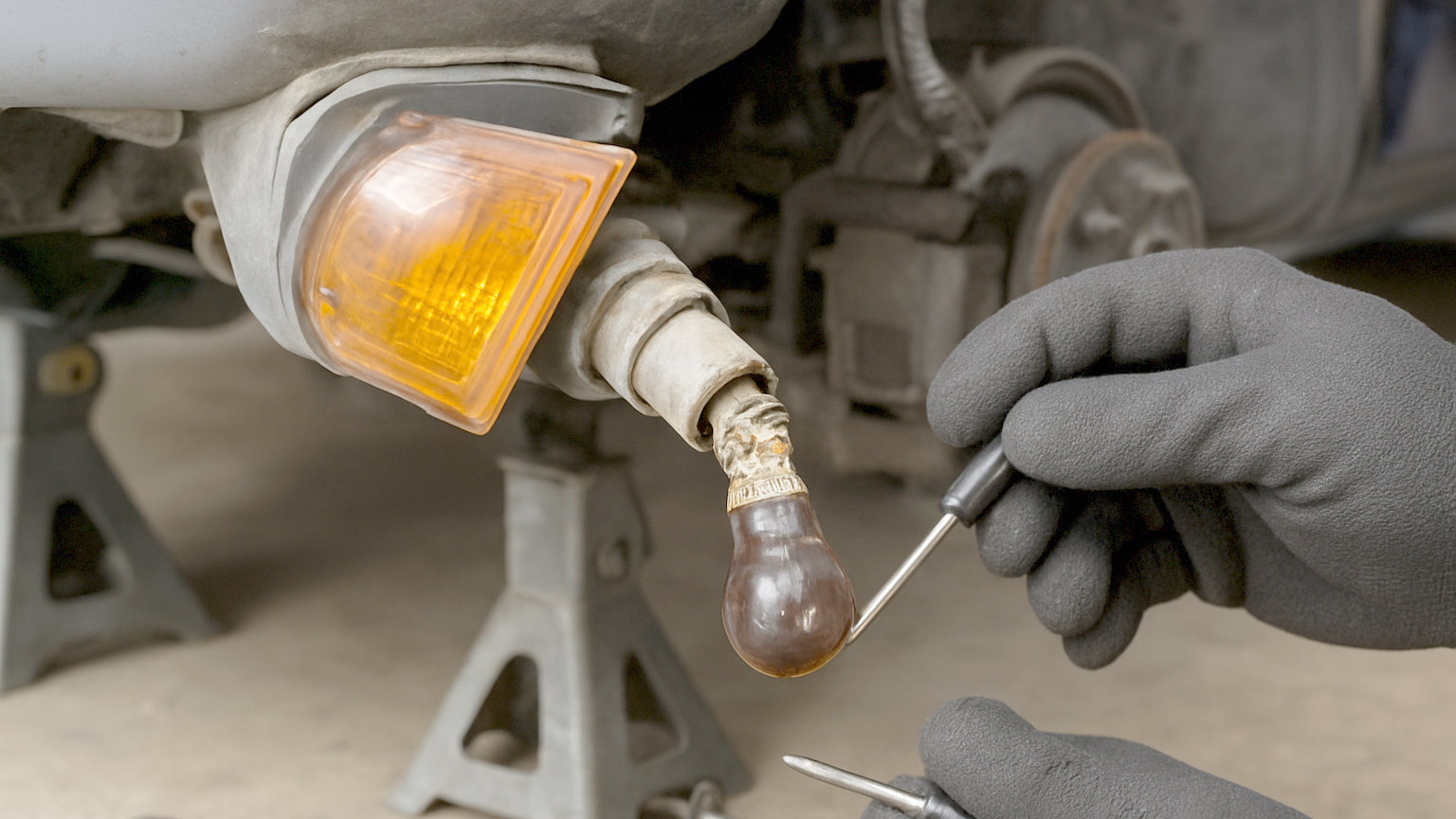
An indicator that suddenly flashes at roughly double its normal speed is not a fault in the indicator system. It is a deliberate warning designed into the car, telling the driver that a bulb on that side has failed. Once you know that, the diagnosis is usually a walk around the car rather than anything more involved.
How does the car know a bulb has failed?
On older cars the flasher unit was a thermal device whose timing depended on the current passing through it. With one bulb missing, current fell, and the unit flashed faster as a side effect that proved so useful it was retained deliberately. Modern cars monitor current electronically and produce the same rapid flash on purpose, often accompanied by a dashboard message naming the failed lamp.
Where should you look first?
Walk around the car with the indicator running on the affected side and check every lamp on it: front indicator, rear indicator, and the side repeater on the wing or mirror. It is easy to check the front and rear and forget the repeater, which is a small lamp and a very common failure. On cars with a trailer socket, a failed trailer bulb can produce the same symptom.
What if all the bulbs are working?
Then the fault is electrical rather than a bulb. A corroded bulb holder or connector adds resistance and reduces current, which the system interprets as a failed bulb even though the lamp still lights, sometimes more dimly than its opposite number. A poor earth at that lamp does the same. Compare the brightness of the two sides carefully, since a dim lamp is the clue.
Why do LED bulbs cause fast flashing?
Because they draw far less current than the filament bulbs they replace, and the system sees that reduced draw as a bulb that has failed. This catches out a great many people fitting LED indicators, and it is not a fault in the LEDs themselves. The car is behaving exactly as designed with a component it was never expecting.
How is that resolved?
Either with load resistors wired in parallel with each LED to restore the current the system expects, or with canbus compatible LED bulbs containing built in resistance. Resistors work but they convert the saved energy into heat, so they must be mounted on metal away from wiring and trim. On some cars the bulb check threshold can be adjusted with a diagnostic tool, which is a cleaner solution where available.
Could it be the flasher relay?
Less often than people assume, but it happens, particularly on older cars. A failing relay produces flashing that is too fast or too slow on both sides rather than one, which is the distinguishing feature. If both sides flash abnormally and every bulb is working, the relay or the indicator switch becomes the suspect rather than a lamp.
Does it matter beyond the annoyance?
Yes. A failed indicator bulb is an MOT failure and, more importantly, means other road users cannot see your intention on that side, which is a genuine safety issue at junctions and roundabouts. The rapid flashing is doing you a favour by making the failure impossible to ignore, so it is worth acting on the same day rather than at the weekend.
What should you check while replacing the bulb?
The holder contacts for corrosion, since green deposits cause resistance and will shorten the life of the new bulb. The lens seal, particularly on rear clusters, because moisture inside the unit corrodes contacts and causes repeat failures. And whether the bulb is the correct type, since an amber bulb behind a clear lens and a clear bulb behind an amber lens are not interchangeable.
What if the indicator does not work at all?
No flashing on one side, with no warning light either, usually points at the fuse, the flasher relay or the indicator switch rather than a bulb. Check the hazard lights, since on most cars they use the same lamps through a different circuit. If the hazards work and the indicators do not, the switch or relay is the suspect.


