
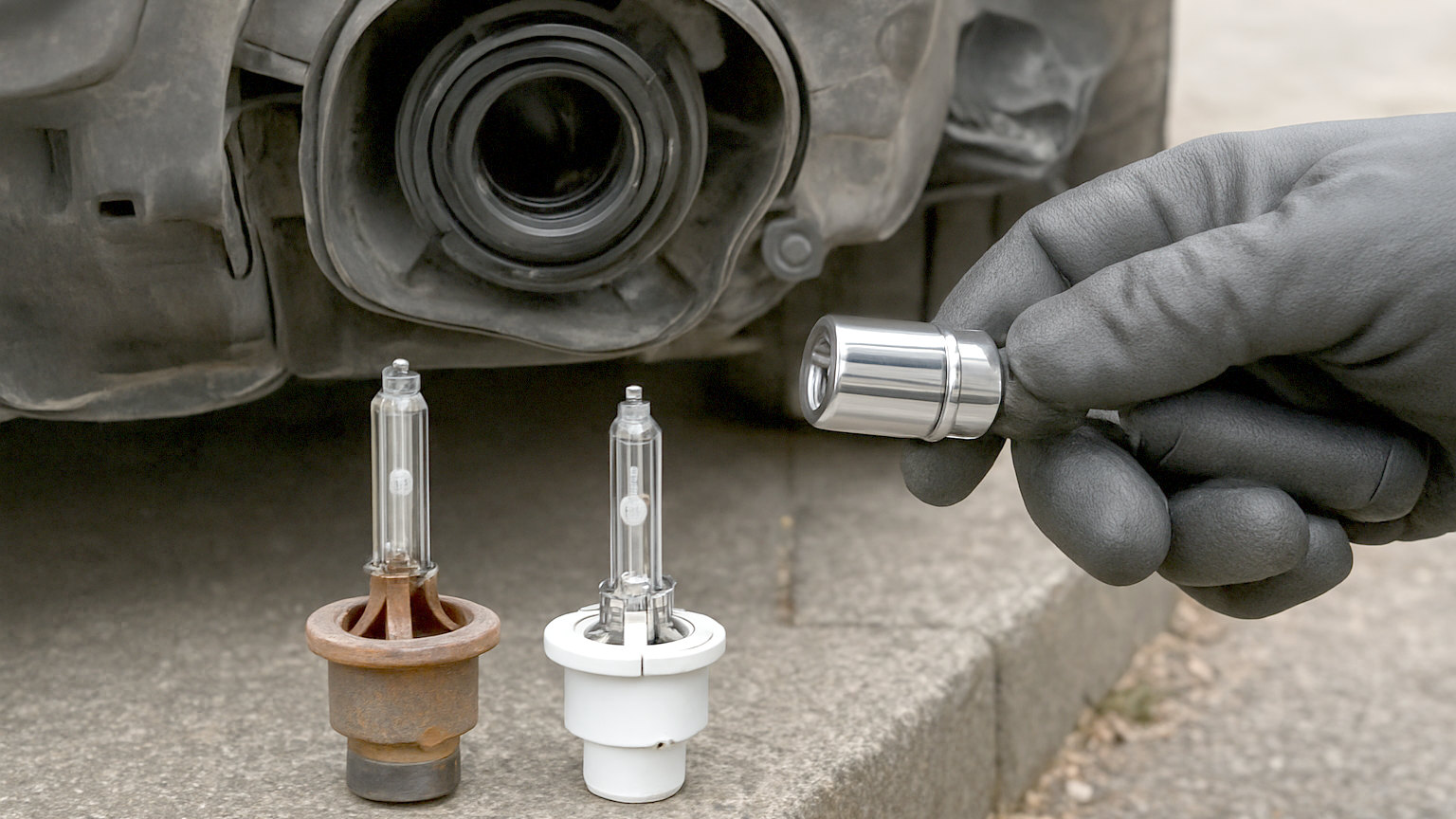
HID headlights, commonly called xenon, work on a completely different principle from the halogen bulbs most drivers are familiar with. Instead of heating a filament, they strike an electrical arc across a gas filled capsule. That produces considerably more light for less power, and it also produces a distinct set of faults, costs and safety considerations that owners meet only when something goes wrong.
How do they actually work?
A ballast converts the car supply into a very high voltage, and an igniter uses a pulse of many thousands of volts to strike an arc inside the bulb. Once running, the ballast maintains the arc at a much lower voltage. There is no filament at all, which is why these bulbs last far longer than halogen and why they take a few seconds to reach full brightness after switching on.
Why do they turn pink or purple with age?
Because the gas mixture and the electrodes degrade over time, shifting the colour of the arc. A xenon bulb approaching the end of its life typically turns pink, purple or noticeably dimmer, and it may flicker or take longer to strike. Unlike a halogen bulb, it fades rather than failing outright, so the loss of output is gradual and easy to miss.
Should they be replaced in pairs?
Yes, more so than with halogen. Because the colour shifts with age, one new bulb next to an older one produces a visibly mismatched pair, with one side white and the other pink. They also age at similar rates, so the second is usually not far behind. Given the cost, replacing both at once is both better looking and more economical than doing the job twice.
What is the safety risk?
The igniter produces a very high voltage capable of causing serious injury, so the system must be switched off and the circuit isolated before any connector is disturbed. Bulbs also contain gases under pressure and can shatter if dropped or mishandled. This is genuinely a system where the risks of a casual approach outweigh the saving, and many owners are better handing it over.
What fails besides the bulb?
The ballast, which is an electronic module and the most expensive common failure. The igniter, which is sometimes separate and sometimes built into the ballast or bulb holder. Wiring and connectors, which suffer from heat. Symptoms include a light that fails to strike, one that strikes and goes out, flickering, or one side working while the other does nothing.
Why do these cars have headlight washers?
Because vehicles with HID headlights are generally required to have a cleaning system and automatic levelling. The output is high enough that dirt on the lens scatters light and dazzles oncoming drivers, and the levelling prevents the beam rising when the car is loaded. Both are checked at the MOT on cars fitted with them, so a failed washer pump or levelling motor is a test issue rather than a convenience.
Can you convert a halogen car to HID?
Retrofit kits exist and generally should be avoided. A halogen reflector is not designed for an arc source, so the beam pattern scatters and dazzles regardless of how much light is produced. The vehicle also lacks the levelling and cleaning systems that come with factory HID. In practice such conversions frequently fail the MOT on beam pattern, and the approval position is against them.
How do LED headlights compare?
Factory LED units have largely replaced HID on new cars, offering instant full brightness, longer life and no ballast. The trade off is that the light source is usually integral to the unit, so a failure means replacing the whole headlight rather than a bulb, which is expensive. HID sits between halogen and LED both chronologically and in terms of what a repair involves.
How long should the bulbs last?
Considerably longer than halogen, often many years of normal use, since there is no filament to fail. That is part of why the cost per bulb is easier to accept. When one does begin to fade, treat it as notice that both are approaching the end of their useful life rather than as a single component failure.


