
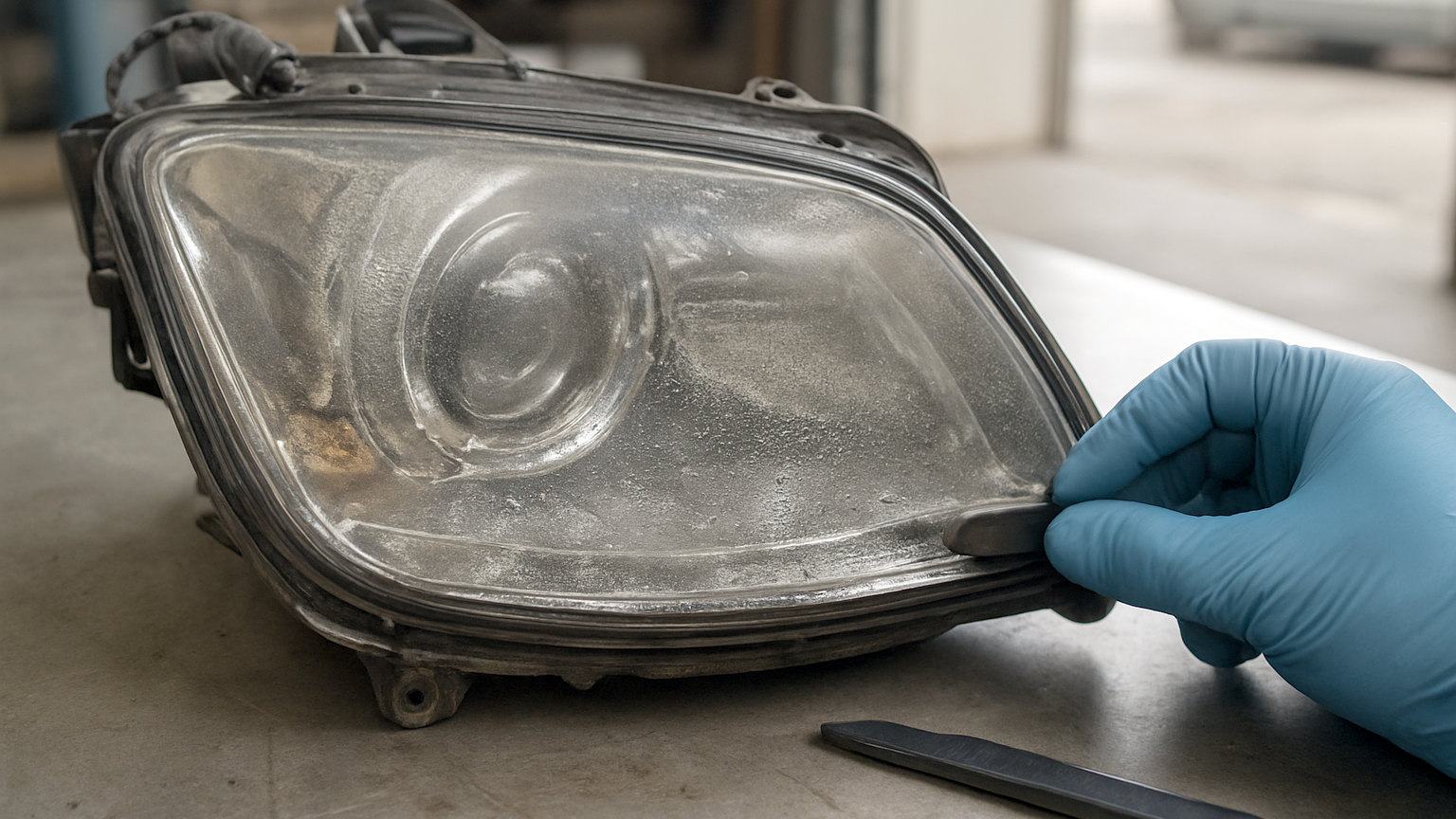
Condensation inside a headlight alarms owners and is very often entirely normal. Headlight units are not sealed containers; they are deliberately ventilated, because the air inside heats up dramatically when the lights are on and would otherwise build pressure. That ventilation lets moist air in, and when the unit cools it condenses on the inside of the lens exactly as it does on a bathroom mirror.
How do you tell normal from a fault?
By how much and how long. A light even mist across part of the lens, appearing after a cold damp night or after the car has been washed, and clearing within twenty minutes of the lights being on, is the ventilation system working. Droplets running down the inside, a visible pool of water in the bottom of the unit, or a mist that never clears even after a long drive with the lights on, is a failed seal.
Where does the water get in?
Through the rear bulb access covers, which harden with age and stop sealing, or which have been left loose or fitted crooked after a bulb change. Through the bonded seam between the lens and the housing, where the sealant perishes or has been disturbed. Through cracks in the lens or housing after a minor knock. And through blocked or missing breather vents, which are meant to let air move without letting water in.
Why does it matter?
Moisture corrodes bulb contacts and connectors, which causes intermittent lights and repeated bulb failures. It degrades the reflector coating inside the unit, and once that has clouded or peeled the light output falls permanently and cannot be restored. Standing water can also thermally shock a hot bulb. So while a light mist is harmless, persistent water quietly destroys an expensive component.
How do you dry one out?
Remove the rear covers to open the unit, then run the headlights for half an hour, which generates enough heat to evaporate most of it. On a warm dry day, leaving the covers off for a few hours helps. Some people place a small bag of silica gel inside before resealing. The important part is finding and fixing the entry point first, otherwise it simply fills again with the next rain.
How do you find the leak?
Inspect every rear cover for a proper seal and replace any that have hardened. Check the breather vents are clear and that any rubber tubes on them have not perished or fallen off. Look around the bonded seam for gaps or a lifted edge, and check the lens and housing for hairline cracks, particularly on the lower edges where stones strike. A hose test with the unit dry will usually reveal it.
Can a leaking unit be resealed?
Sometimes. The lens can be separated from the housing by warming the sealant, cleaned and rebonded with the correct headlight sealant. It is fiddly and requires care not to crack the lens or damage the reflector. It is a reasonable option on an expensive unit and often not worth the effort on a cheap one, where a replacement headlight is inexpensive.
Does it fail an MOT?
Light condensation does not, in itself. What fails is a unit sufficiently affected that the light output is impaired, a lens that is cracked or damaged such that water enters, or a beam pattern that has been compromised. In practice a headlight with water pooling in the bottom is likely to attract at least an advisory and may well fail, so it is worth resolving beforehand.
What should you do about a light mist?
Nothing beyond keeping an eye on it. Check after a long drive with the lights on and see whether it clears. If it does, the unit is working as designed. If the same unit is always damp while the other side is always clear, that asymmetry is the clue that one of them has a genuine problem.


