
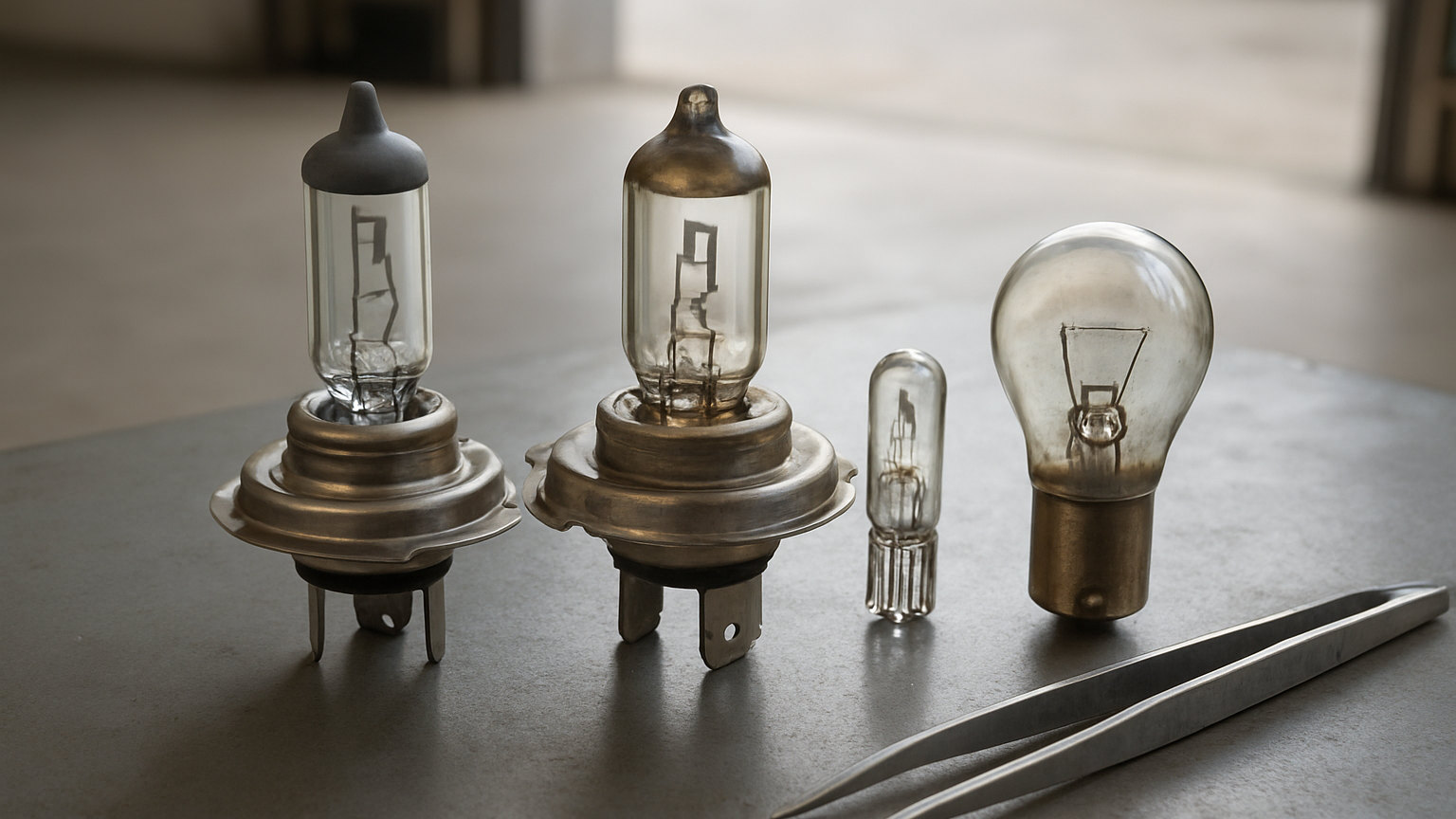
Bulb codes look like an arbitrary jumble of letters and numbers, and they are in fact a precise specification covering the base shape, the filament arrangement, the wattage and the position of the light source within the glass. That last point matters more than people expect, because a headlight reflector is designed around a filament sitting in an exact place, and a bulb that fits mechanically can still produce a poor beam.
What do the common headlight codes mean?
H7 is a single filament bulb used for one function, so a car using H7 will typically have separate bulbs for dipped and main beam. H4 is a dual filament bulb providing both dipped and main from one unit, which is why older and smaller cars often have a single bulb per headlight. H1, H11, HB3 and HB4 are further single filament types with different bases, all mutually incompatible despite looking broadly similar.
What about the smaller bulbs?
Codes such as W5W and T10 describe the small wedge base bulbs used for sidelights, number plate lights and interior lamps, where the glass base pushes directly into the holder with no metal cap. P21W and PY21W are bayonet fitting bulbs used for brake lights and indicators, with the Y indicating an amber bulb for indicator use. P21/5W is a dual filament version used where one bulb serves both tail and brake light.
What does the number after the letters mean?
The wattage. W5W is a five watt wedge bulb, P21W a twenty one watt bayonet, and so on. Fitting a higher wattage than specified draws more current than the wiring and holder were designed for, which produces heat, melts holders and can damage the lens or reflector. It is not a legitimate way of getting more light and it will eventually cause a fault rather than an improvement.
Why does filament position matter?
Because a reflector or projector lens is designed around a light source in one exact position, and the beam pattern depends entirely on that geometry. A bulb whose filament sits a millimetre out of place scatters light in the wrong directions, producing glare for oncoming drivers and less usable light on the road. This is the reason cheap unbranded bulbs frequently disappoint despite the correct code on the box.
How do you find the right bulb for your car?
The handbook lists every bulb type by position. The old bulb usually has the code printed on its metal base or glass. Retailers offer lookup by registration, which is convenient but occasionally wrong on cars that had different lighting options from new, so checking against the old bulb is worth doing. Photographing the old bulb before you go removes all doubt.
What about upgraded bulbs?
Bulbs marketed as producing substantially more light achieve it by running the filament hotter, which is legitimate and does work, but the trade off is a much shorter life. Bulbs described as having a whiter or bluer light usually achieve it with a tinted coating that filters output, so they look modern and produce less usable light than a standard bulb. Read what is actually claimed rather than the packaging.
Are the codes the same everywhere?
The European system described here is standardised and used across the market. Some bulbs carry an alternative American designation, so the same part may be listed under two codes, which explains why searching sometimes returns confusing results. Where two codes appear together on packaging, they are usually equivalents rather than a bulb that fits both applications.
Does the same code always fit?
Mechanically yes, since the base is standardised, but some cars use bulbs with additional features under the same designation, such as a longer life rating or a specific coating. Where a manufacturer specifies something particular, the handbook says so. For most cars a quality bulb of the correct code from a reputable brand is exactly what is required.
The one thing worth avoiding is buying on appearance alone, since several codes look similar in the packet and only differ in the base tabs or the filament position.


