
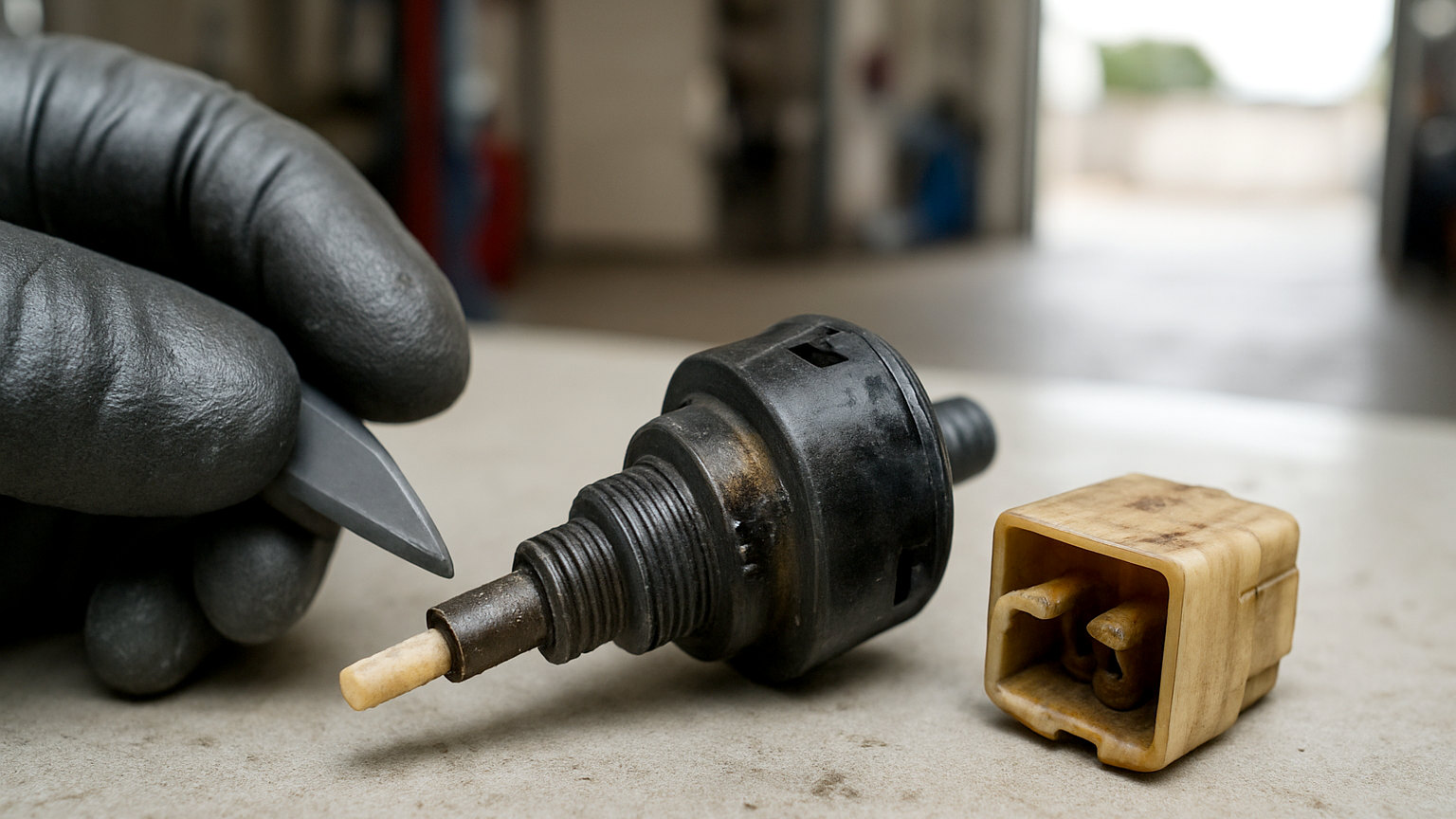
Brake lights are the one lamp on a car that the driver never sees, which is why they are so often discovered as a fault by somebody else. The useful diagnostic principle is simple: if one has failed it is probably a bulb, and if all of them have failed together it is almost certainly not, because bulbs do not fail simultaneously.
How do you test them on your own?
Reverse up to a wall, garage door or shop window at night and watch the reflection while pressing the pedal. Alternatively place something heavy on the pedal, such as a brick or a length of wood braced against the seat, and walk round to look. On many cars with keyless systems the ignition needs to be on for the lights to work, so check that before concluding there is a fault.
What causes all of them to fail at once?
The brake light switch, in the great majority of cases. It is a small plunger switch mounted on a bracket behind the brake pedal, operated every time the pedal moves, and it wears out. Because it feeds every brake lamp, its failure takes all of them out together. It is an inexpensive part and on many cars it is accessible in the footwell without removing anything.
What else does that switch do?
Rather more than people expect, which produces confusing secondary symptoms. On automatics it usually forms part of the interlock preventing the car being shifted out of park without the brake applied. It often tells the engine management the brake is being used, which affects cruise control and stop-start operation. So a car that will not come out of park, or whose cruise control has stopped working, alongside failed brake lights, is describing one switch.
Could it be a fuse?
It can, and it is worth checking first because it takes two minutes. A blown brake light fuse takes every lamp out at once, exactly as a failed switch does. If the fuse has blown, note that something caused it, so simply replacing it and finding it blows again points at a short circuit in the wiring or a bulb holder rather than a coincidence.
What if only one has failed?
Then it is a bulb, a holder or the earth to that lamp. Replace the bulb first, checking the holder contacts for corrosion while it is out. If a new bulb does not work, the earth for that cluster is the next suspect, since a corroded earth is a very common cause of one lamp failing while its neighbour works perfectly.
What about the high level brake light?
The third lamp in the rear screen or on the tailgate is a legal requirement on cars fitted with one from new, and it is an MOT failure if it does not work. On many cars it is an LED strip rather than a bulb, and when part of it fails the whole unit is usually replaced. It is easy to overlook because it is not visible in the mirrors.
What if the brake lights stay on permanently?
Usually the same switch, failed in the opposite direction, or a broken rubber stop pad on the pedal bracket that the switch presses against. Those pads perish and fall out, leaving the switch unable to reach its rest position. It is a very cheap part and a common fault. Left alone it flattens the battery overnight and confuses drivers behind you.
How urgent is it?
Immediately. Brake lights are the primary warning to the driver behind that you are slowing, and driving without them substantially increases the risk of being hit from behind. It is also an MOT failure and can be an offence. Given that the usual cause is an inexpensive switch or a bulb, there is rarely a good reason to delay.
How often should you check them?
Monthly is sensible, and before any long journey. Because you cannot see them from the driving seat, brake lights are the lamp most likely to have been out for weeks without anyone mentioning it. A quick reflection check in a shop window while parking costs nothing and removes the guesswork entirely.


