
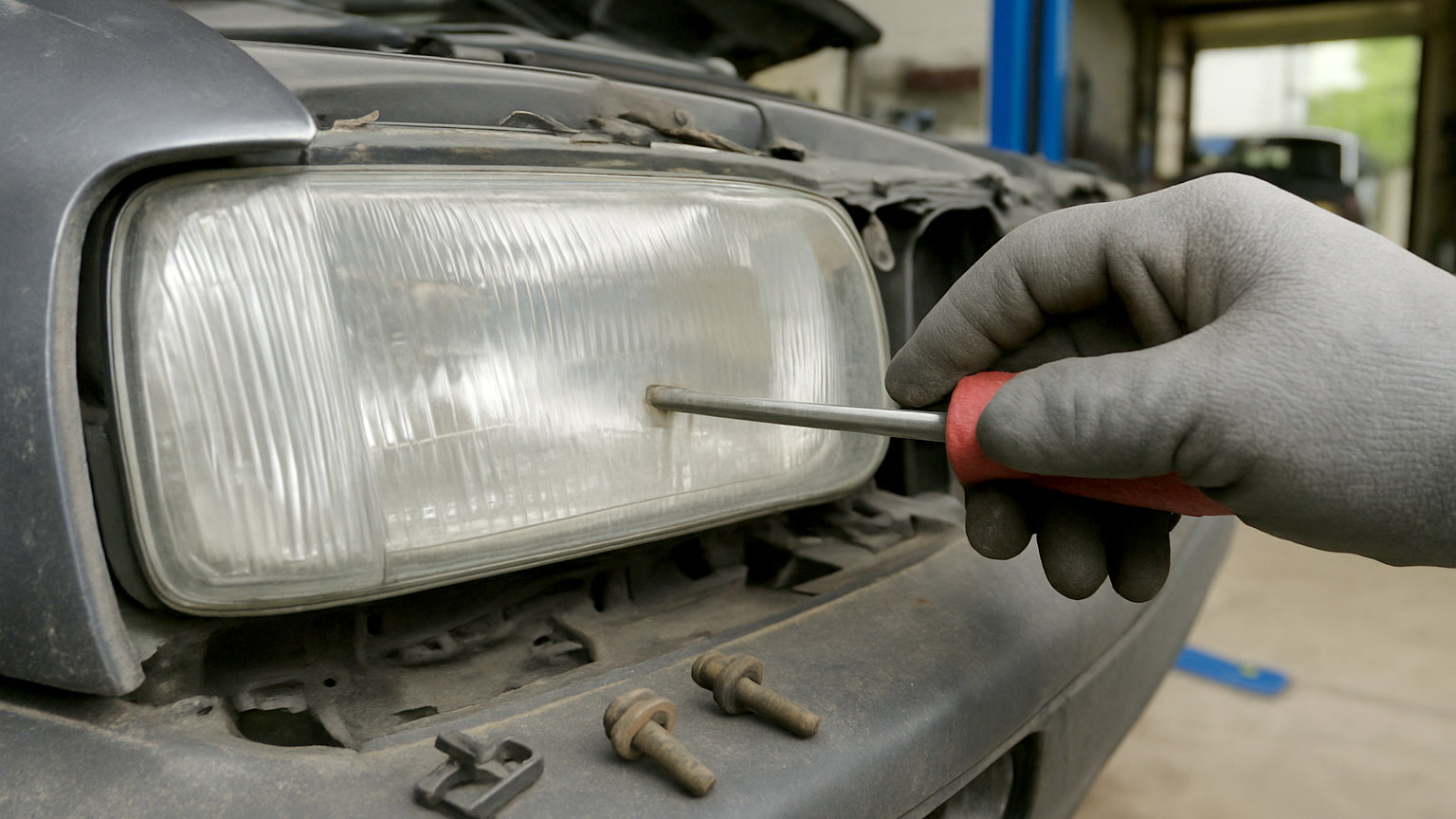
Headlight aim is one of the least considered settings on a car and one of the most consequential. Aimed too high, headlights dazzle oncoming drivers and scatter light into hedges and signs. Aimed too low, they illuminate a short strip of tarmac and leave everything beyond it dark, which drivers experience as dim lights rather than as a misalignment.
Why does aim drift?
Suspension settles over years, which changes the attitude of the whole car. Springs sag, particularly at the rear, tipping the nose up and the beams with it. Any front end impact, however minor, can move a headlight unit within its mountings. Adjuster screws corrode and their plastic gears strip. And headlight units replaced after damage are frequently refitted without the aim ever being checked.
What does the levelling control inside the car do?
It compensates for load. A car carrying passengers and a full boot sits nose up, raising the beams, and the dial lets you lower them to compensate. The problem is that people set it for a heavy load once and leave it there for years, running with beams pointing at the road immediately ahead. Before assuming anything is wrong, check the dial is on its normal setting, usually zero.
Can you check alignment yourself?
Roughly, and it is worth doing as a sanity check. Park on level ground facing a flat wall a few metres away, with the car loaded as it normally is and the tyres correctly inflated. Mark the height of the headlight centres on the wall, then reverse to a measured distance. The beam cut off should sit slightly below the marked height, and the horizontal kick up should be to the left on a car for British roads.
Why is a garage beam setter better?
Because the tolerances are tighter than a wall check can resolve, and because the machine measures the cut off line and the horizontal position precisely rather than by eye. A beam setter also removes the errors introduced by a sloping driveway or an uneven wall, both of which are hard to detect and easily produce a result that is confidently wrong.
How are the adjusters used?
Most headlights have two adjusters accessible from the engine bay, one for vertical and one for horizontal, usually turned with a screwdriver or a hex key. They should move smoothly. Corroded or stripped adjusters are common on older cars, and forcing one usually snaps the plastic mechanism inside the unit, which turns an adjustment into a headlight replacement. Free them with penetrating oil rather than force.
What should you check before adjusting?
Tyre pressures, since an underinflated rear tyre changes the attitude of the car. That the boot is not carrying an unusual load. That the levelling dial is at its normal setting. That both bulbs are working and of matched type and age, since setting aim with one dim bulb produces a poor result. And that the headlight units are securely mounted, because a loose unit will not hold its setting.
Does it affect the MOT?
Yes, and headlight aim is a common failure. The test checks both vertical and horizontal position and the sharpness of the cut off. Because a beam setter is used, marginal cases that look fine against a garage wall can still fail. Having the aim checked as part of a pre-test inspection is inexpensive and avoids a retest.
When should it be checked?
After any front end repair or bodywork, after replacing a headlight unit, after suspension work, and if other drivers begin flashing you regularly. It is also worth checking if your headlights feel poor, since low aim is a frequent cause of complaints that people attribute to weak bulbs and then spend money trying to solve the wrong way.
What about cars with automatic levelling?
Vehicles with HID or LED headlights usually adjust the beam automatically using suspension height sensors. When a sensor or its linkage fails, the beam can drop to its lowest position or sit too high, and no manual adjustment will correct it. That is a fault to be diagnosed rather than an alignment to be set.


