
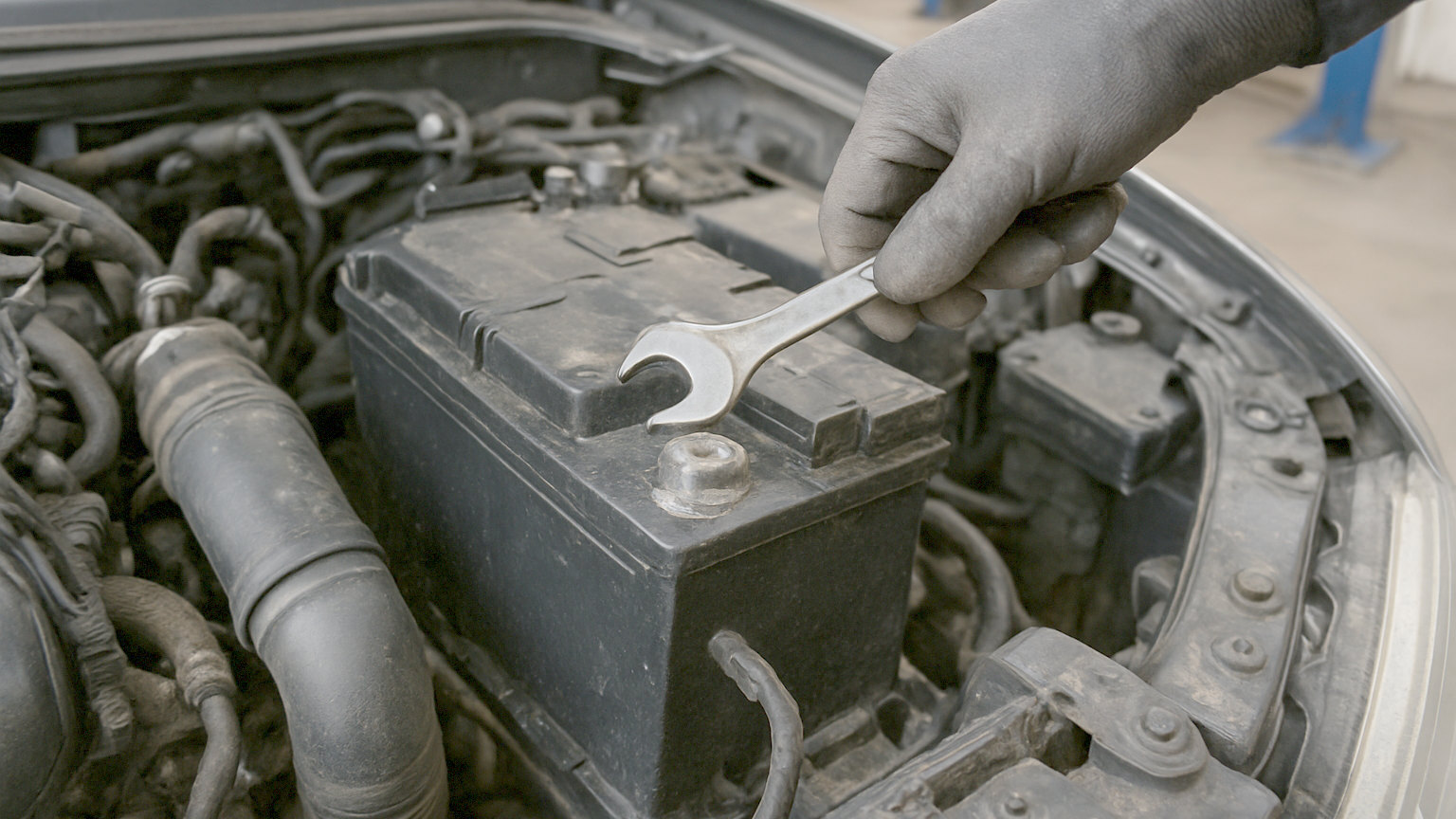
Batteries rarely fail without warning. The difficulty is that the warnings are gradual enough to be absorbed into normal experience, so the car cranking a little more slowly than last winter registers as nothing at all until the morning it does not crank at all. Knowing what to watch for turns an unplanned breakdown into a planned replacement, which is a considerably better experience.
What is the earliest sign?
Slower cranking, particularly on the first cold start of the day. A healthy battery spins the engine briskly and it fires almost immediately. A tiring one produces a noticeably longer, more laboured turn before the engine catches. Because the change happens over months, the comparison that matters is against how the car sounded last year rather than yesterday. If starting has become something you notice, that is the warning.
What do the lights tell you?
Headlights that are noticeably dim at idle and brighten when you rev suggest the system is short of capacity, and the same applies to interior lights that dim while cranking. Some cars show dashboard lights flickering as the starter engages. On its own this can also indicate a charging fault, which is why a test that covers both battery and alternator is more useful than replacing one on suspicion.
Why does stop-start switching off matter?
Because it is an early warning delivered by the car itself. A stop-start system only shuts the engine down when the battery management is satisfied there is enough capacity to restart, so a car that has quietly stopped doing it is often reporting a battery approaching the end of its life. Drivers frequently interpret this as a fault in the stop-start system when it is a fault in the battery it depends on.
What physical signs are worth looking for?
A case that looks swollen or distorted indicates overcharging or internal damage and means the battery should be replaced promptly. White or blue-green corrosion around the terminals suggests gassing or a poor seal, and it also increases resistance in the connection. A smell of rotten eggs around the engine bay after driving means the battery is being cooked, which points at a charging fault as much as at the battery. Any of these justify a test straight away.
Does electrical oddness count?
It can. Modern cars respond badly to low voltage, and a battery on its way out produces symptoms that look entirely unrelated: warning lights appearing at random, central locking behaving strangely, the infotainment restarting, or the car throwing multiple unconnected fault codes. Any competent workshop faced with a scattering of unrelated electrical faults will test the battery first, and it is frequently the answer.
How old is too old?
Most batteries last three to five years, less on cars doing short journeys. A battery in its fifth winter showing any of these signs is simply old, and further diagnosis is a poor use of money compared with replacement. A two year old battery showing the same signs is a symptom of something else, most likely a charging fault or a parasitic drain, and replacing it without finding that fault will produce a repeat.
When should you act?
Have it tested at the first sign rather than the second, since testing is free at most garages and parts retailers and takes minutes. Autumn is the sensible time, before the cold arrives to expose whatever margin is left. Replacing a marginal battery on a Tuesday afternoon in October costs the same as replacing it after a recovery call in January, minus the recovery call and the missed morning.
If the test comes back borderline rather than failed, ask for the actual figures and note them, since comparing the same measurement a few months later shows clearly whether the battery is holding steady or steadily declining towards a failure.


