
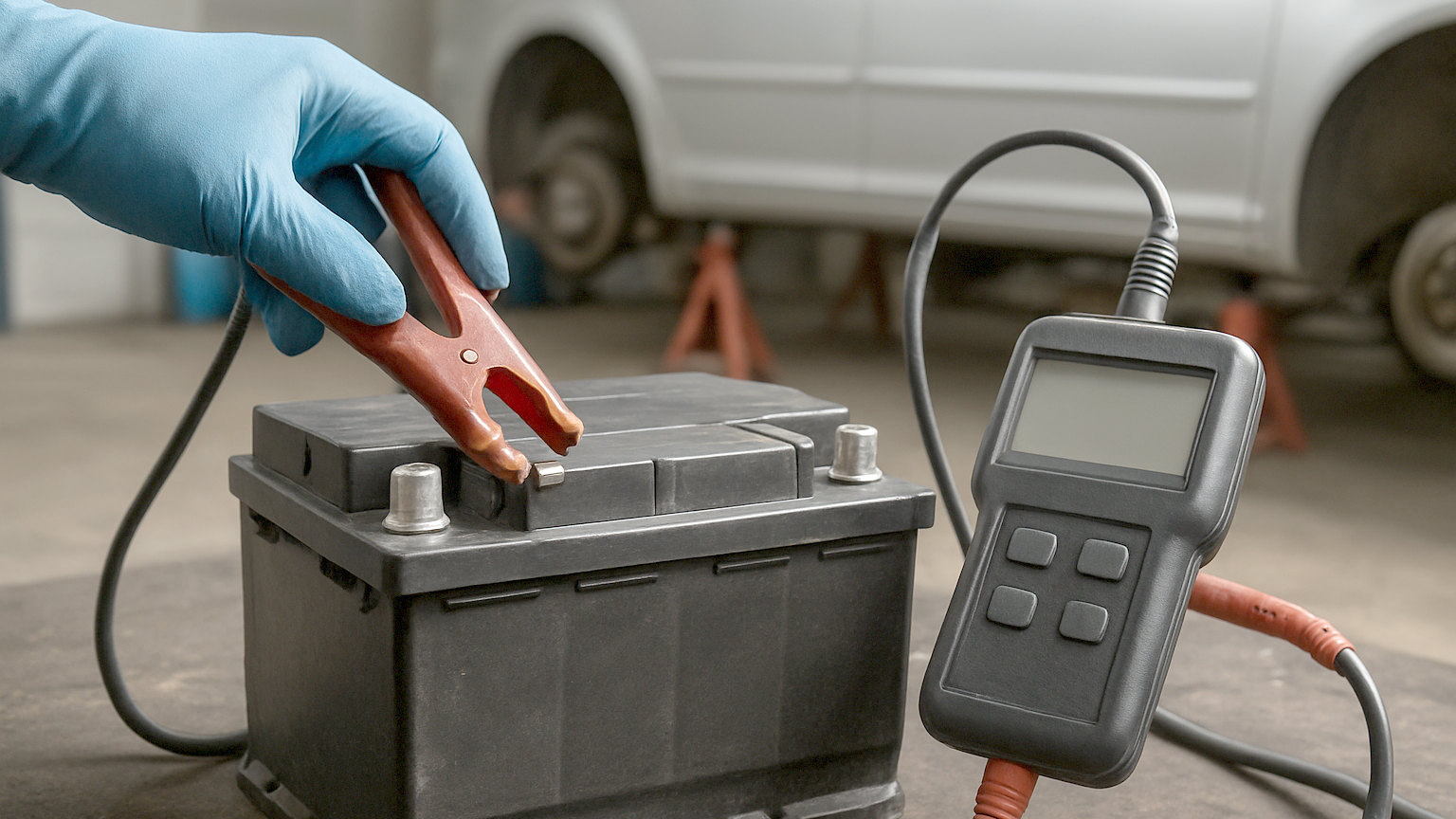
Testing a battery with a voltmeter and declaring it healthy is one of the most common diagnostic errors there is, because resting voltage answers a different question from the one you are asking. What matters is not whether the battery is charged but whether it can deliver several hundred amps to a starter motor for a couple of seconds without collapsing. Those are separate properties and only one of them shows up on a basic meter.
What does resting voltage tell you?
State of charge, and nothing more. A healthy fully charged battery reads around twelve point six or twelve point seven volts after standing for a few hours with nothing switched on. Around twelve point four suggests roughly three quarters charged, twelve point two about half, and anything below twelve volts is substantially discharged. Those figures are useful for knowing whether to charge it, but a badly degraded battery can still show a perfectly respectable resting voltage.
Why does the measurement have to be at rest?
Because a battery holds a surface charge immediately after being driven or charged, which reads high and disappears within minutes of any load. To get a meaningful reading, either leave the car standing for several hours, or switch the headlights on for thirty seconds to remove the surface charge before measuring. Skipping that step produces optimistic readings and is why so many failing batteries are pronounced healthy.
What is a load test?
The proper test. A load tester applies a substantial current draw for around ten seconds while monitoring voltage, simulating the demand of starting the engine. A good battery holds above roughly nine and a half volts throughout. One that sags well below that has lost capacity and will fail on the first cold morning, regardless of how good its resting voltage looked. Most garages and parts retailers will do this free while you wait.
What about conductance testers?
These are the small handheld units most workshops now use. They send a signal through the battery and calculate its internal condition, producing a cold cranking figure that is compared against the rating printed on the battery. They are quick, they do not require the battery to be fully charged, and they are generally reliable. The important detail is that the tester must be told the correct rating and battery type, since an AGM battery tested as a conventional one will give a misleading result.
How do you test the charging system at the same time?
Measure voltage at the battery terminals with the engine running. It should read comfortably above resting voltage, typically somewhere between thirteen and a half and fourteen and a half volts on most cars, showing the alternator is putting charge back in. A reading no higher than resting voltage means it is not charging. A reading above fifteen suggests overcharging, which cooks a battery and will destroy it in weeks. Both are worth knowing before buying a replacement.
Do smart charging systems complicate this?
They do, and it is worth knowing. Many modern cars vary charging voltage deliberately to improve fuel economy, and will sometimes charge at little more than resting voltage when the battery is full and conditions allow. A single reading taken at the wrong moment can therefore look like a charging fault when nothing is wrong. On these cars the meaningful test is carried out with a diagnostic tool reading the battery management data.
What should you do with the results?
If the battery fails a load or conductance test, replace it, matching the rating and type. If it passes but keeps going flat, the fault is elsewhere and a parasitic drain test is the next step. If the charging voltage is low, investigate the alternator, its belt and the wiring before replacing anything. Ask for the actual numbers rather than a verdict, because a battery that is borderline today will be a breakdown in January.


