
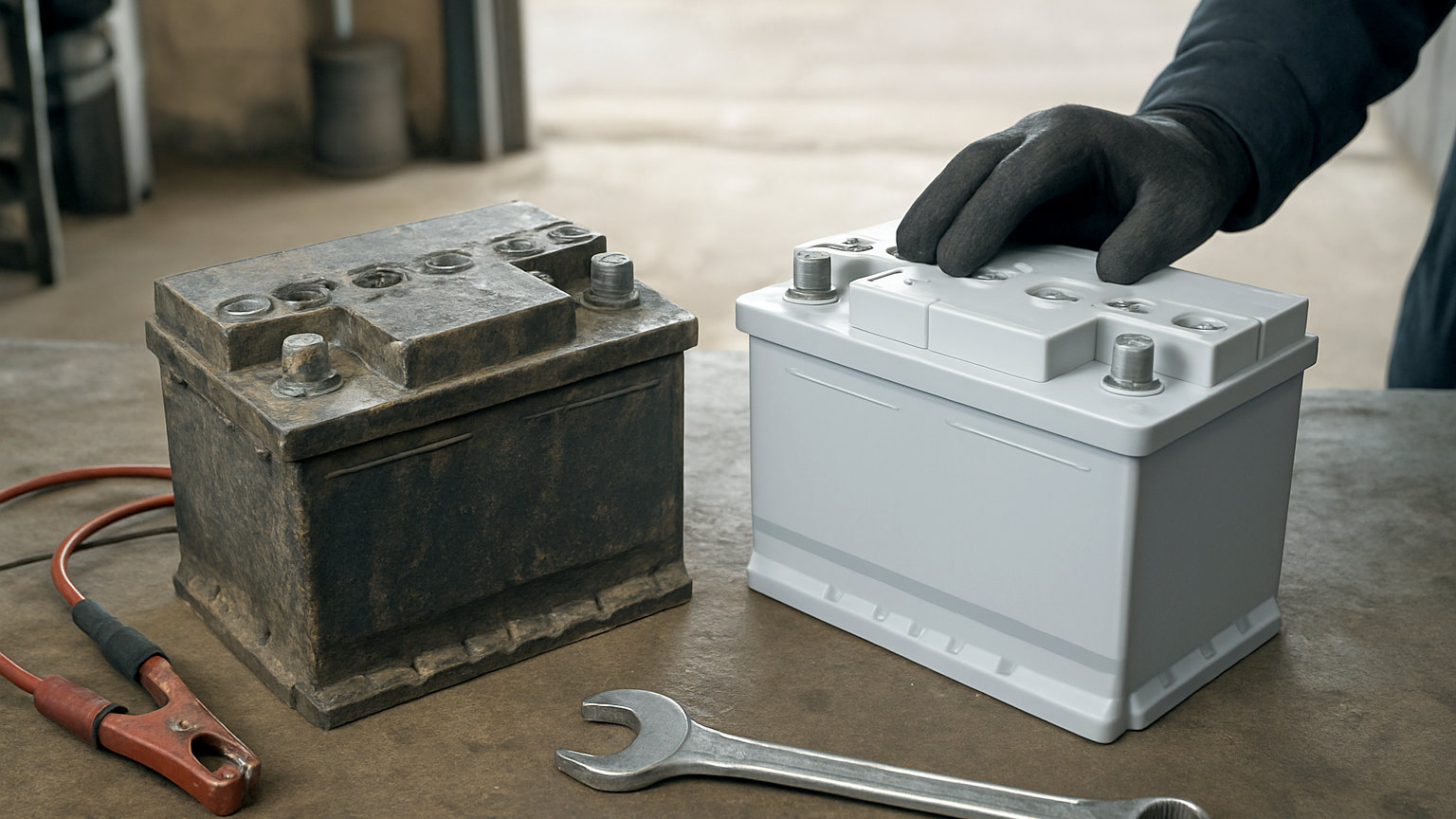
A modern car in good condition, with a battery in good condition, should stand for several weeks and still start. If yours will not survive seven days, something is wrong, and there are only two candidates: the battery has lost capacity, or something is drawing more current than it should while parked. Knowing which of the two is straightforward to establish and it prevents the common mistake of fitting a new battery into the same problem.
What is normal standing loss?
Two things happen while a car is parked. The battery self-discharges chemically, losing a small percentage of its charge per month regardless of whether it is connected to anything. On top of that, the car draws its own small current to keep the alarm, immobiliser and control modules ready, typically a few tens of milliamps. Together those should take weeks rather than days to make a difference to a healthy battery.
How do you tell which one is at fault?
Charge the battery fully with a mains charger, then disconnect the negative lead entirely and leave the car for a week. If the battery is still healthy when reconnected, the battery is fine and the car is drawing too much, so a parasitic drain test is needed. If the disconnected battery has also lost significant charge in that week, the battery itself is failing internally. That single test separates the two possibilities completely and costs nothing.
What causes a battery to self-discharge quickly?
Age and internal degradation. As plates deteriorate and sediment accumulates in the bottom of the case, internal leakage increases and the battery loses charge faster while doing nothing. A battery that has been deeply discharged in the past is particularly prone to this. Dirt and moisture across the top of the battery casing can also allow a small current to track between the terminals, which is worth checking since it is cleaned off in seconds.
What sort of drain flattens a battery in days?
Something drawing a few hundred milliamps or more. A boot or glovebox lamp burning permanently is the classic, since it is bright, constant and completely hidden. Aftermarket alarms, trackers and hardwired dashcams draw more than people expect. A door or bonnet switch that never registers as closed keeps the body module awake indefinitely. Any of these will empty a good battery within a few days while the car sits looking perfectly innocent.
Does the weather make a difference?
It does. Cold reduces the current a battery can deliver, so a partially discharged battery that would still start the car in July may not manage it in January, even though the state of charge is the same. Cold also slows self-discharge, which works in your favour, but the net effect is that winter exposes marginal batteries. A car that sat for a fortnight without trouble in summer may fail after five days in February.
What should you do about a car that sits regularly?
A smart trickle charger or battery conditioner left connected is the complete answer. Unlike an old fashioned charger it monitors the battery and maintains it without overcharging, and it can be left connected indefinitely. Where mains power is not available, disconnecting the negative terminal prevents standing drain, at the cost of resetting the clock and possibly needing radio codes. Both are better than repeatedly deep discharging a battery.
Is a short drive enough to keep it topped up?
Rarely. A ten minute run barely replaces what starting consumed, so using a car briefly once a week can leave the battery slightly worse off each time. If the choice is between a short drive and leaving it standing, a proper thirty minute run at reasonable speed is far more useful, and a conditioner is more useful still.
The habit worth building is treating a car that stands as one that needs a plan rather than one that needs nothing, since the battery is the component that quietly pays for the neglect.


