
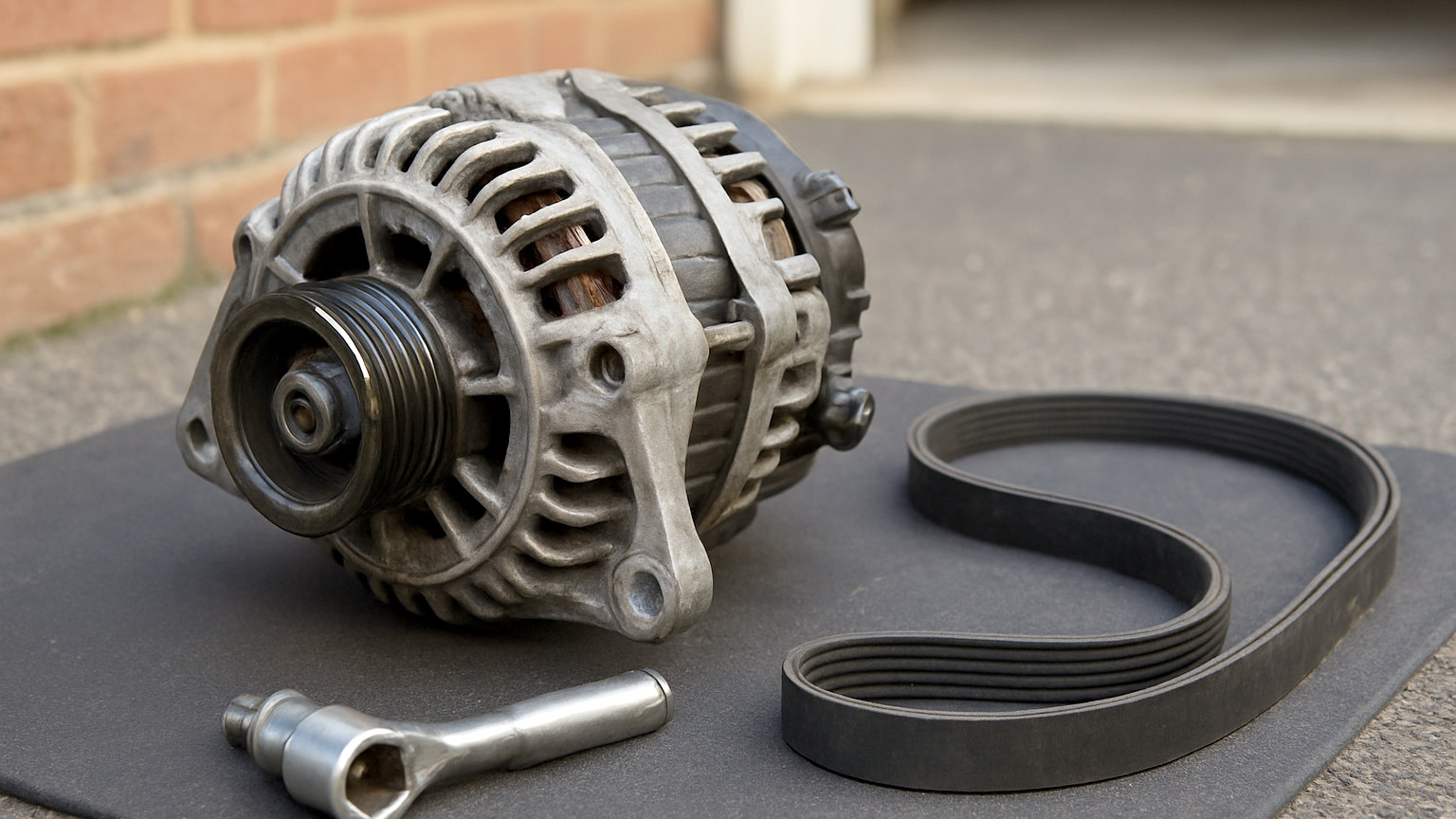
Most charging faults are misdiagnosed because of one misunderstanding: people assume the battery powers the car. It does not. The battery has one demanding job, which is starting the engine, and once that is done the alternator takes over and runs everything while also refilling the battery. Understanding that division of labour makes almost every symptom in this section immediately more legible.
How does an alternator generate electricity?
It is driven by the auxiliary belt from the engine crankshaft. Inside, a rotating electromagnet called the rotor spins within a set of stationary windings called the stator, and that moving magnetic field induces current in the windings. The output is alternating current, which is where the name comes from, and it has to be converted before the car can use it.
What do the diodes do?
A set of diodes forming a rectifier converts the alternating output into the direct current the car requires. Diodes allow current to pass in one direction only, so the alternating waveform is folded into a steady one-directional supply. When a diode fails, output falls and a residual alternating component leaks into the system, which causes flickering lights, radio interference and a battery that never quite charges properly.
What does the voltage regulator do?
Alternator output would otherwise rise and fall with engine speed, which would be useless for running sensitive electronics and destructive to the battery. The regulator controls the current fed to the rotor windings, and by varying the strength of that magnetic field it holds output steady regardless of revs. Most modern regulators are built into the alternator, and a failed one is a very common cause of both no charge and overcharging.
How much power does it actually produce?
Considerably more than most people assume. A typical modern car alternator is rated somewhere between ninety and one hundred and eighty amps, because contemporary vehicles carry substantial electrical loads: heated screens, heated seats, electric power steering, cooling fans, infotainment and dozens of control modules. That capacity is sized for the vehicle as delivered, which is why heavy aftermarket additions can push a standard system beyond what it was designed for.
Why does the belt matter so much?
Because everything depends on it. The auxiliary belt commonly drives the alternator, the power steering pump, the air conditioning compressor and, on many engines, the water pump. If it snaps or slips badly, charging stops immediately and on those engines the cooling system stops too. That is why a battery warning light accompanied by a rising temperature gauge is treated as a stop rather than a limp home.
How does the battery fit in?
It provides the enormous burst needed to turn the starter, then acts as a buffer that smooths momentary demand while the alternator supplies the steady load. A healthy battery makes a marginal alternator feel adequate, and a tired battery makes a healthy alternator look faulty, which is exactly why both should be tested together rather than one replaced on suspicion.
What changed with smart charging?
Many modern cars no longer charge at a constant voltage. To save fuel, the management reduces alternator output when the battery is full and increases it during deceleration, recovering energy that would otherwise be lost to braking. This is efficient and it makes traditional testing less straightforward, because a healthy system can briefly read little above resting voltage. On those cars, reading the battery management data with a diagnostic tool is more reliable than a single meter reading.
Why does any of this matter to an owner?
Because it explains the symptoms. Knowing that the alternator runs the car rather than the battery makes it obvious why a failing charging system leaves you stranded mid journey while a failing battery leaves you stranded on the driveway. Knowing that the regulator controls output explains why the same component can cause both no charge and overcharging. And knowing the belt drives the water pump on many engines explains why one warning light is a stop rather than a limp home.


