
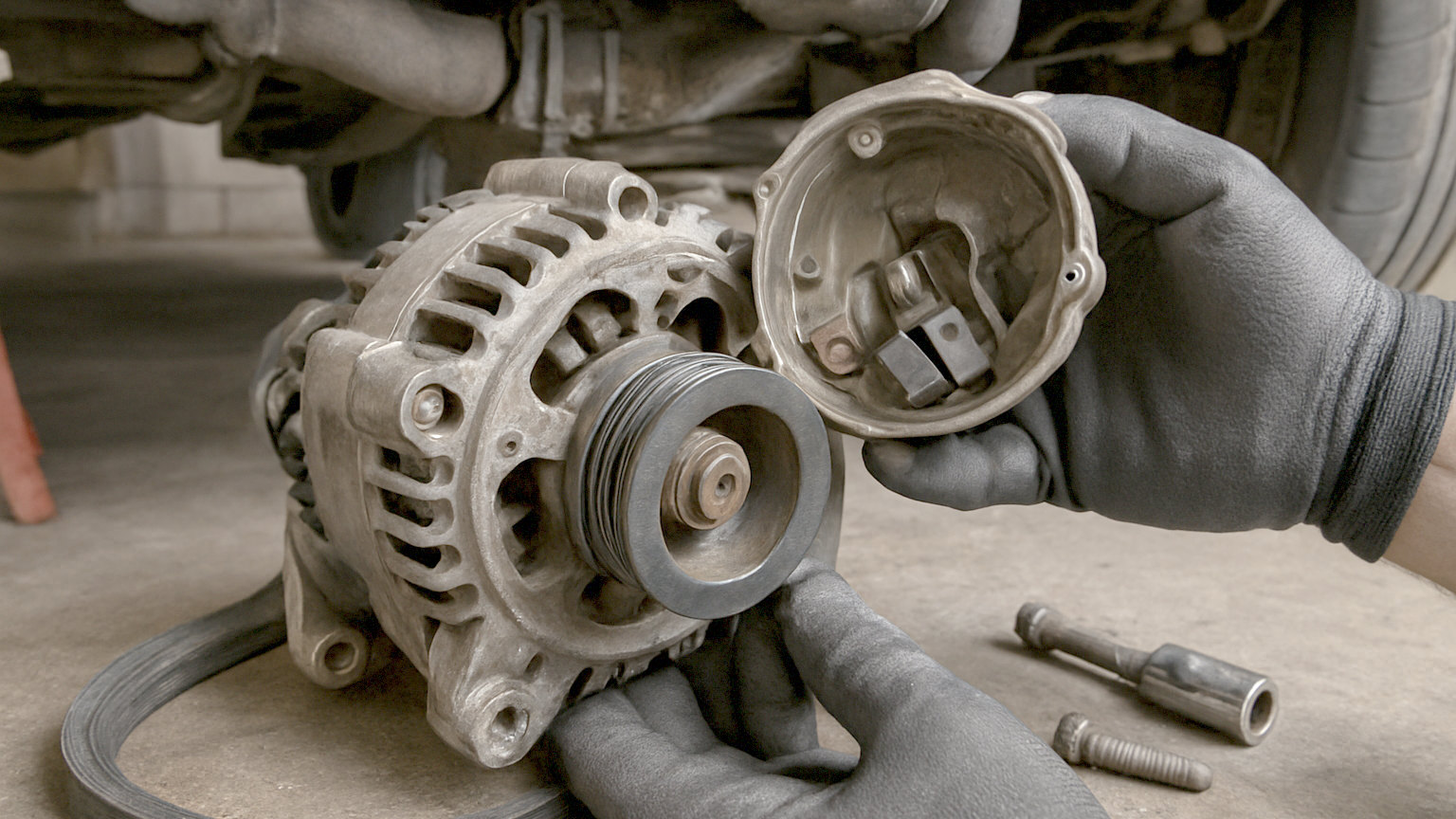
Being told an alternator has failed usually leads straight to a quote for a replacement unit, and that is sometimes the right answer and sometimes not. Alternators contain several components that are genuinely wear items, and on many designs those can be renewed for a fraction of the cost of the whole assembly. Whether that is worth doing depends on the fault, the design and the labour involved in reaching it.
What actually wears out?
Three things account for most failures. The carbon brushes that carry current to the spinning rotor gradually wear down and eventually lose contact, which produces intermittent charging and a flickering warning light. The voltage regulator fails, either producing no charge or overcharging. The bearings wear, which produces the whining and grinding covered elsewhere in this section. Each of those is a distinct part rather than a whole alternator.
Can brushes and regulators be replaced separately?
On many alternators, yes, and on some the brushes and regulator come as a single assembly held in by two screws on the back of the unit. The parts are inexpensive. On other designs the regulator is integrated in a way that makes separate replacement impractical, and on some the alternator has to come off the car and be partially dismantled to reach anything, at which point the labour begins to outweigh the saving.
What about bearings?
Bearings can be pressed out and replaced, but it requires the unit to be stripped completely and the correct tools to avoid damaging the rotor. It is specialist work rather than a driveway job, and for most owners it makes more sense to hand a noisy alternator to a rebuilder than to attempt it. A specialist will also test the diodes and regulator while it is apart, which a bearing swap alone would not.
Is a reconditioned unit a good option?
Frequently the best one. A properly remanufactured alternator from a specialist has had its bearings, brushes, regulator and diodes replaced and the whole unit tested on a bench, and it often costs meaningfully less than a new original part while lasting considerably longer than the cheapest aftermarket new unit. Many suppliers operate a surcharge system where the old unit is returned for credit.
How do cheap new units compare?
Variably, and the failures tend to come from exactly the components that matter. The cheapest units frequently use lower grade diodes, regulators and bearings, and a proportion fail within the first year or two. Since the labour to fit an alternator is the same whichever unit goes on, saving a modest amount on the part and paying the labour twice is a poor trade. Ask what warranty applies and whether it covers labour.
Does the labour position change the decision?
Considerably. On some engines the alternator sits accessible at the top and comes off in half an hour. On others it is buried behind the exhaust manifold or requires the subframe to be lowered, and the labour dwarfs the part. Where access is poor, fitting the best available unit is the sensible choice, because the cost of doing the job again is what dominates the arithmetic.
What should you ask before deciding?
Which component has actually failed, whether the fault was confirmed by measurement rather than assumed, what the labour time is, and what warranty comes with each option. Also ask whether the battery has been tested, because fitting any alternator to a car with a failing battery shortens the life of the new unit and is the most common reason these repairs come back.
Is it a job worth attempting yourself?
On an accessible engine with a straightforward belt routing, replacing an alternator is within reach of a competent home mechanic, provided the battery is disconnected first and the belt routing is photographed before anything comes apart. Where the unit is buried behind other components, or where the belt requires a special tool to release the tensioner, it is a job better handed over than begun optimistically on a Sunday afternoon.


