
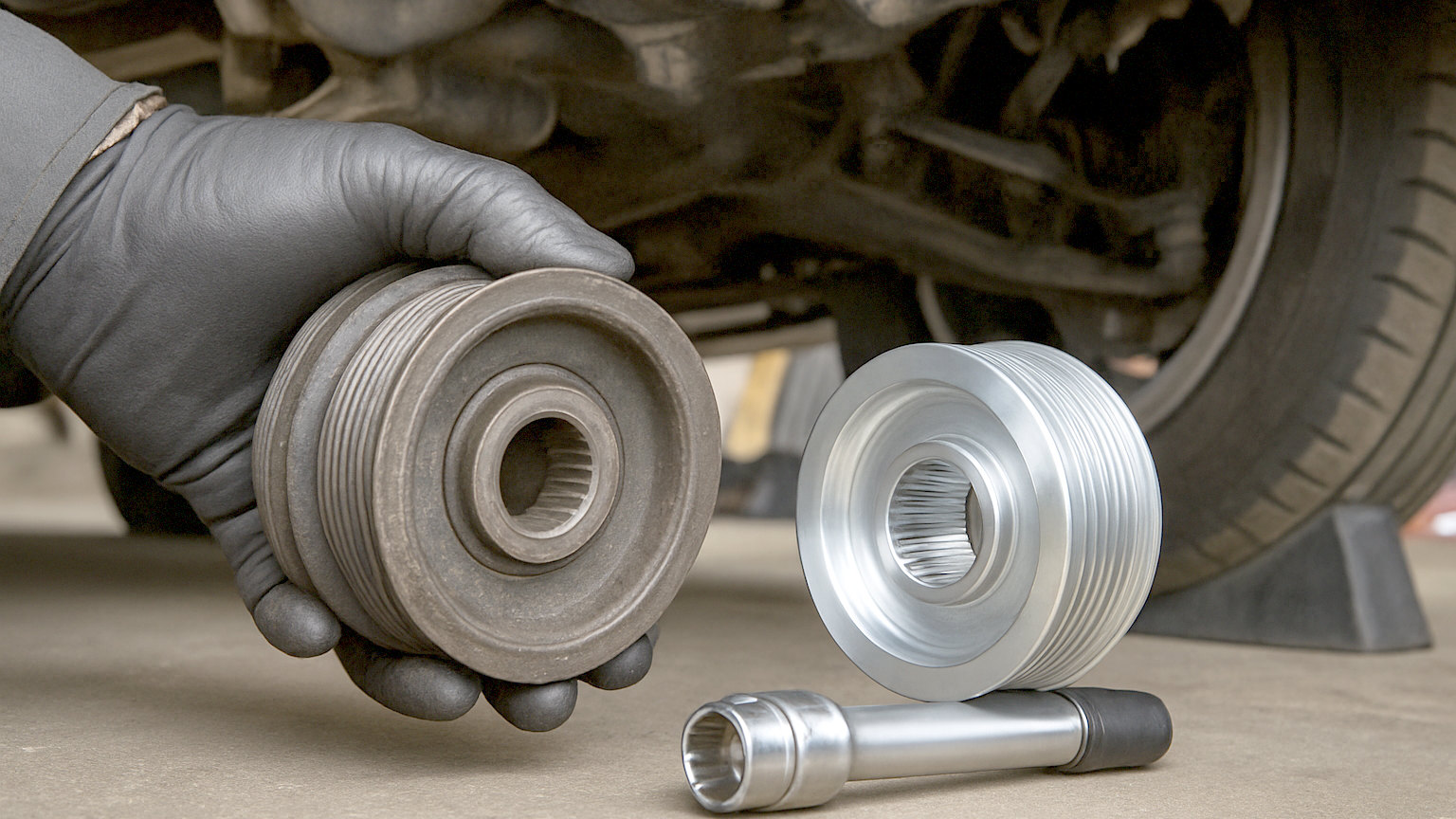
Many modern engines fit a pulley to the alternator that contains a one way clutch, known as an overrunning alternator pulley or a decoupler. It is a small component that most owners have never heard of, and when it fails the symptoms are usually attributed to the alternator, the belt or the tensioner. Recognising it matters because replacing the pulley alone is far cheaper than replacing the unit behind it.
What problem does it solve?
A crankshaft does not turn at a perfectly constant speed. It accelerates and decelerates slightly with every combustion pulse, and modern engines with fewer cylinders and higher torque produce more of this variation than older ones. The alternator has a heavy rotor with significant inertia, so it resists those fluctuations, and the resulting strain shows up as belt flutter, noise and accelerated wear on the belt and tensioner.
How does the pulley help?
The one way clutch drives the alternator when the belt accelerates and allows it to freewheel when the belt momentarily slows, so the rotor coasts through the fluctuation rather than fighting it. The result is a quieter, smoother drive with far less strain on the belt system. Some designs add a spring element for additional damping, which is where the term decoupler comes from.
What are the symptoms of failure?
A rattling or grinding from the front of the engine, often most obvious at idle or immediately after switching off as the engine comes to rest. Belt squeal and visible belt flutter, particularly on a cold start or when the engine is blipped. Premature belt and tensioner wear. In some cases a clutch that has seized solid behaves like an ordinary pulley, which causes no immediate fault but returns all the strain the component was fitted to prevent.
How is it tested?
With the engine off and the belt removed, the pulley should turn freely in one direction and drive the alternator solidly in the other. A pulley that turns freely in both directions has failed and is no longer driving properly, which causes undercharging. One that locks solid in both directions has seized. There should be no roughness, no rattle and no excessive play. Some designs require a special tool to remove, since the fixing sits inside the pulley.
Can it be replaced on its own?
On many alternators, yes, and that is the point worth knowing. The pulley is a separate part costing a fraction of a replacement alternator, and swapping it takes a modest amount of labour plus the correct removal tool. Some suppliers only sell the alternator complete with pulley, so it is worth asking specifically whether the pulley can be supplied separately before agreeing to a full replacement.
Should it be replaced with the belt?
It is worth considering on a high mileage car. These pulleys have a service life, often quoted somewhere around the same interval as the auxiliary belt and tensioner, and since the belt has to come off to reach it, doing both together saves a second labour charge. A failing pulley will also chew through a new belt, so fitting a belt to a worn pulley is a false economy.
What happens if it is ignored?
The belt suffers, the tensioner suffers, and the noise gets worse. In the worst case the pulley disintegrates, the belt is thrown, and everything it drives stops at once, which on many engines includes the water pump and power steering. Given the modest cost of the part, it is one of the better value repairs available once it has been correctly identified.
Which cars are most likely to have one?
Modern diesels in particular, along with many three and four cylinder petrol engines, because those produce the largest speed fluctuations at the crankshaft. If your car has a diesel engine built in the last fifteen years or so and the alternator area is rattling, this component is worth asking about specifically, since it is frequently overlooked in favour of the tensioner or the alternator itself and it is far cheaper than either.


