
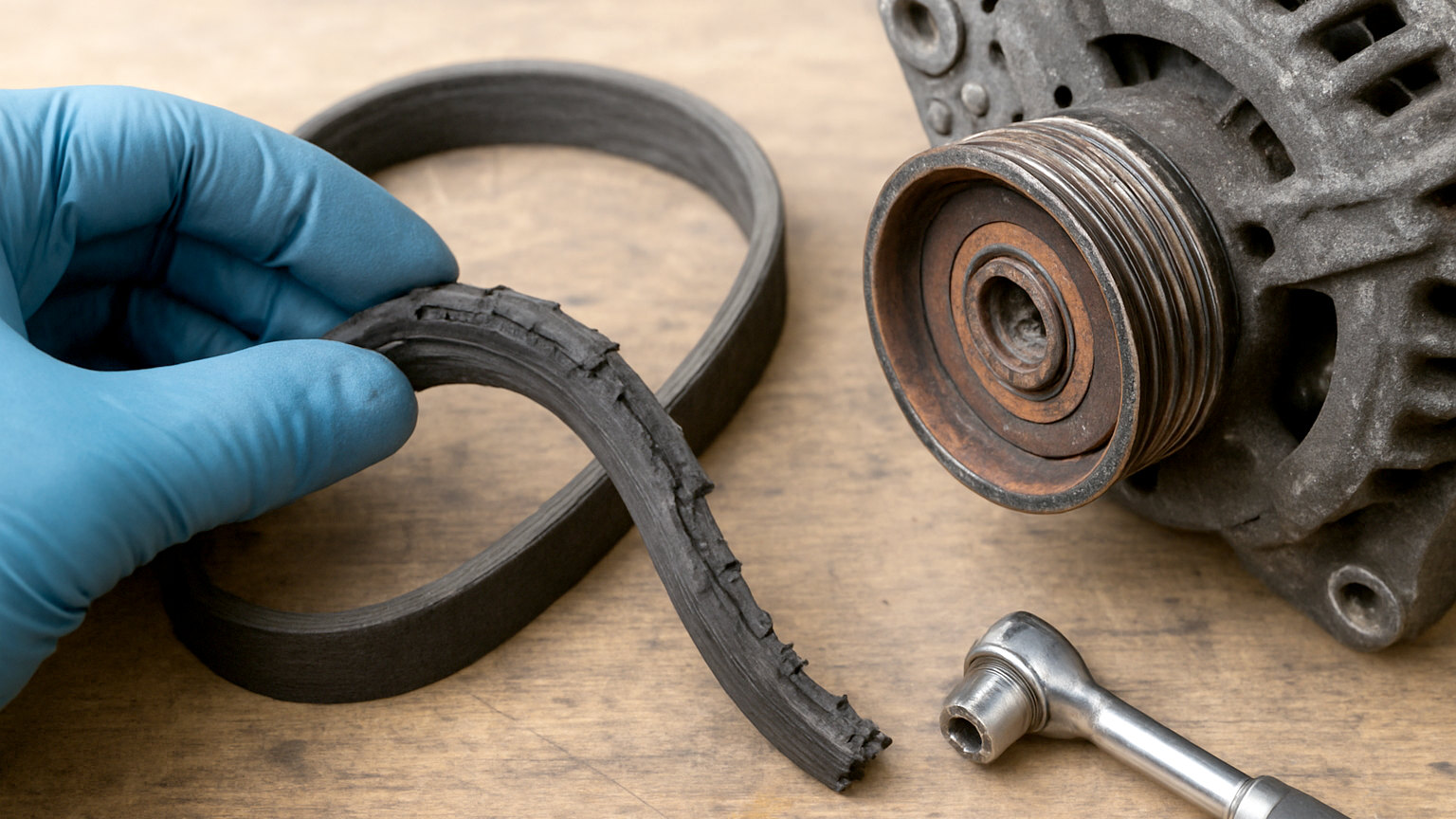
The auxiliary belt drives the alternator and, depending on the engine, the power steering pump, the air conditioning compressor and the water pump. A belt that squeals occasionally on a damp morning is a minor annoyance. A belt that squeals constantly or has snapped more than once is reporting a fault somewhere in the system it drives, and replacing the belt again without finding it simply buys a few more months.
Why do belts squeal?
Because they are slipping. A belt transmits power by friction against the pulleys, and when that grip fails it vibrates rapidly and produces the characteristic noise. Slip happens when the belt is worn or glazed, when tension is insufficient, when a pulley is seizing and demanding more torque than the belt can transmit, or when the belt is contaminated with oil or coolant. Cold and damp make all of these worse.
What does the tensioner do?
Most modern engines use an automatic tensioner, a spring loaded arm with a pulley that maintains constant tension as the belt stretches and as the load changes. Its spring weakens with age and its internal damping wears out, at which point tension becomes inadequate and the arm begins to oscillate. That produces squeal, visible belt flutter and rapid belt wear. A tensioner is a wear item and should be replaced alongside the belt.
Why would a belt snap repeatedly?
Because something is destroying it. A seizing pulley bearing on the alternator, tensioner, idler or water pump creates enormous drag and shreds the belt. A pulley that is not aligned with the others, often after a repair where a bracket was not seated correctly, wears the belt edge until it fails. A tensioner that is not holding tension lets the belt flap until it comes off. Belts almost never fail on their own.
How do you find the culprit?
With the engine off and the belt removed, turn every pulley in the system by hand. Each should spin smoothly with no roughness, no rumbling and no play when rocked. The alternator, tensioner, idlers, water pump and air conditioning compressor should all be checked, since any one of them can be the cause. Look also at the pulley faces for wear or wobble and at the belt itself for a polished edge, which indicates misalignment.
Does contamination matter?
Considerably. Oil from a leaking rocker cover or filter housing, or coolant from a weeping pump, destroys the friction the belt relies on and softens the rubber. No amount of tension will make a contaminated belt grip. Fitting a new belt without fixing the leak above it guarantees a repeat, so if the old belt came off wet, the leak is part of the job rather than a separate matter.
Is belt dressing worth using?
No. Aerosol dressings quieten a slipping belt for a few days by making it tacky, which masks the symptom while attracting dirt and accelerating wear. They are occasionally useful to confirm that a noise is belt related, since the noise disappearing after a spray identifies the source. As a repair they are worthless, and using one on a belt that is slipping because a pulley is seizing simply delays the moment it snaps.
What should be replaced together?
The belt and the tensioner as standard, and any idler pulleys at the same time on a high mileage car, since they are inexpensive and the labour is already being paid for. On engines where the belt also drives the water pump, consider its condition too. Doing the system rather than the single component is what turns a recurring annoyance into a repair that lasts.
How often should a belt be changed?
Most manufacturers specify an interval, commonly somewhere between sixty and a hundred thousand miles, though condition matters more than mileage. Cracks across the ribs, missing chunks, a glazed shiny surface or a belt that has begun to fray at the edges all mean replacement regardless of how far it has run. Inspecting it at every service costs nothing and takes seconds.


