
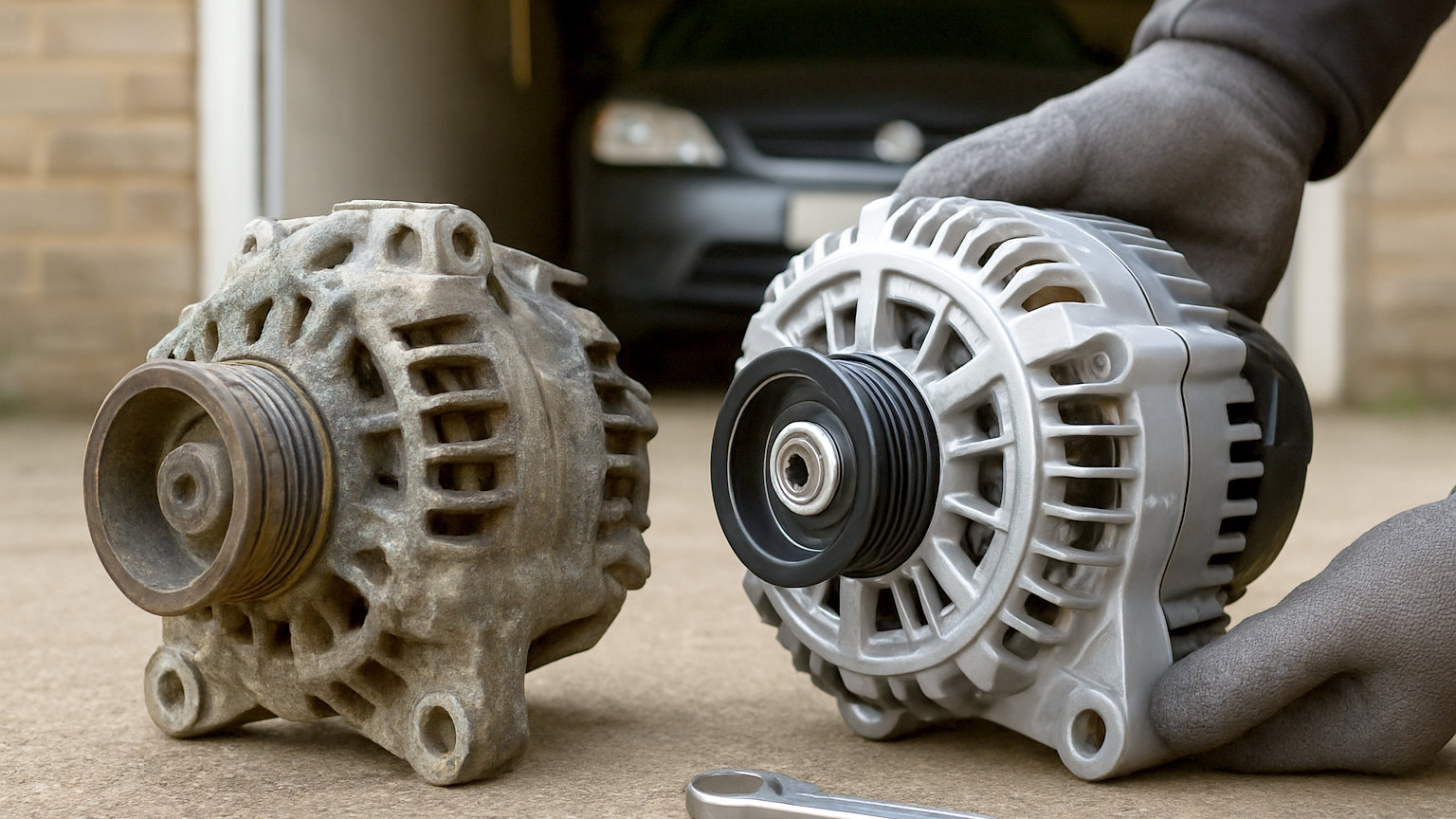
A battery and an alternator work as a pair, and when one is faulty the other suffers. This is the reason people find themselves buying a second and sometimes a third battery in a year, without anyone establishing why the first one died. A charging system can ruin a battery in two opposite ways, and both are straightforward to detect with a meter.
What does undercharging do?
An alternator producing too little output leaves the battery permanently short of a full charge. A battery held in that state sulphates, meaning hard crystals form on the plates and progressively reduce the capacity available. That damage is largely permanent. The battery still works for a while, gradually cranking more slowly, until one cold morning it will not start the car, at which point it is genuinely worn out even though it is new.
What does overcharging do?
It is faster and more destructive. A failed voltage regulator allowing output to climb too high forces excessive current into a battery that is already full, which boils the electrolyte, buckles the plates and can swell or crack the case. A new battery can be destroyed in weeks. Overcharging also stresses bulbs and electronics elsewhere in the car, so the damage is not confined to the battery.
How do you tell which is happening?
Measure voltage across the battery terminals with the engine running. A reading no higher than resting voltage, around twelve and a half, means it is not charging. A reading between roughly thirteen and a half and fourteen and a half on most cars is normal. Anything sustained above about fifteen is overcharging and needs attention immediately. That single measurement, taken in under a minute, distinguishes the two.
What are the physical signs of overcharging?
A battery that is hot to the touch after a drive, a case that looks swollen or distorted, a smell of rotten eggs around the engine bay caused by the electrolyte gassing, and heavy corrosion building rapidly around the terminals. Headlight bulbs failing more often than they should is another indicator. Any of these justify measuring charging voltage straight away rather than replacing the battery again.
Can a bad battery damage the alternator?
It can, which is the other half of the relationship. A battery with an internal short or one that has lost capacity presents a continuous heavy load, so the alternator runs at maximum output far more than it was designed to. That overheats the windings and diodes and shortens its life considerably. This is why fitting a new alternator to a car with a failing battery, or the reverse, so often produces a repeat failure.
Should both be replaced together?
Not automatically, but both should always be tested together. If an alternator has been overcharging, the battery has almost certainly been damaged and replacing it alongside is sensible. If a battery has been deeply discharged repeatedly by an undercharging system, it will rarely recover fully. Ask for both test results rather than accepting a recommendation for one part, since the numbers make the decision obvious.
What should you do after a charging fault is fixed?
Have the battery fully charged with a mains conditioner rather than relying on the alternator to do it, since an alternator is designed to maintain a battery rather than bulk charge a depleted one. Then have it load tested once charged. A battery that passes after proper charging can be kept, and one that fails has already been damaged by the fault and is better replaced now than in January.
How long does the damage take?
Overcharging can finish a battery in a matter of weeks, sometimes less if the voltage is well above normal. Undercharging is slower, working over months as capacity is gradually lost to sulphation. That difference matters when deciding what to do: an overcharging fault found today has probably already destroyed the battery, while an undercharging fault caught early may leave a battery that recovers fully once it is properly charged.


