
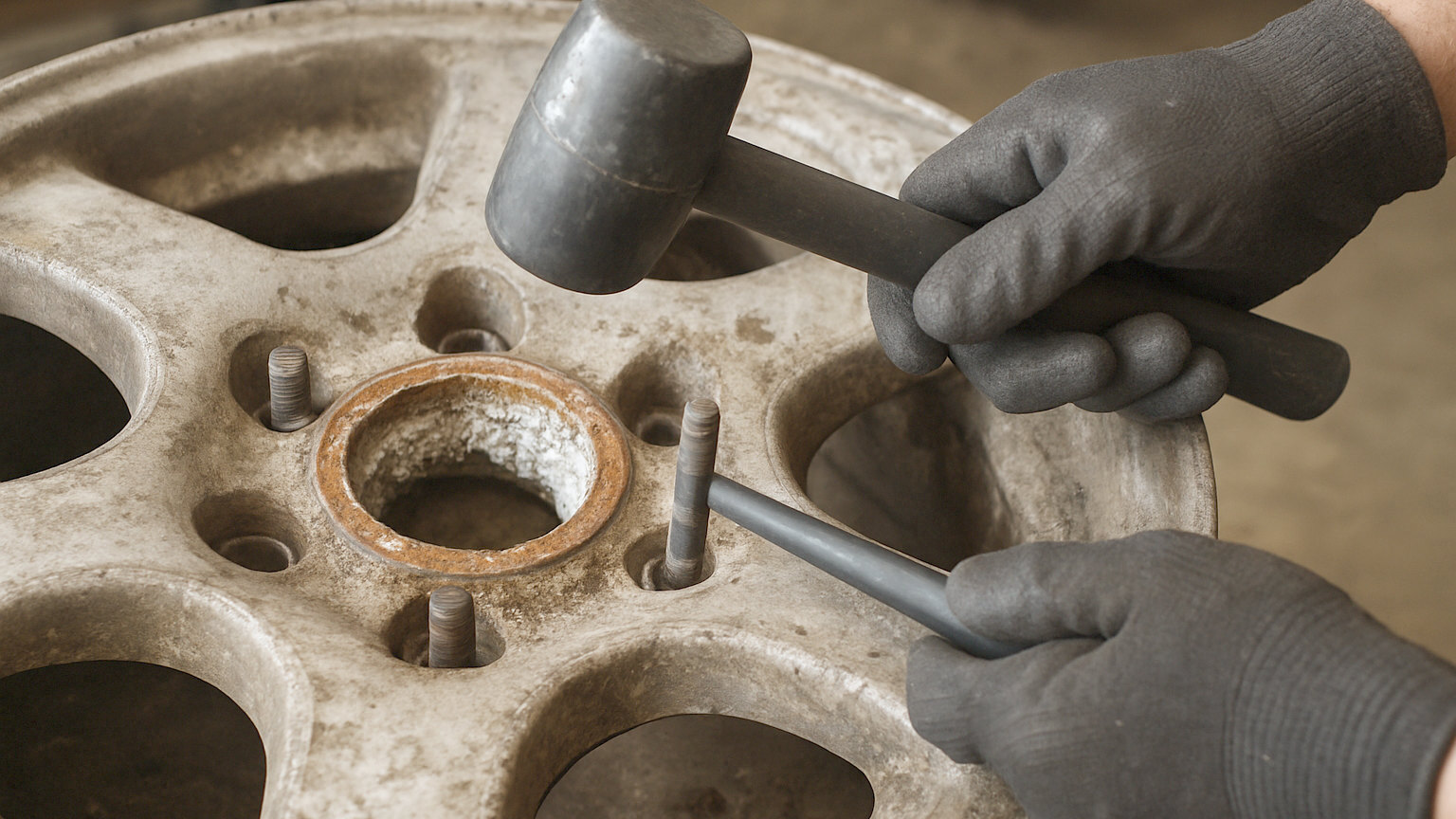
Undoing the bolts and finding the wheel will not move is a frustrating and surprisingly common discovery, usually made at the roadside in poor weather. The wheel has corroded onto the hub, and the bond can be strong enough to resist a considerable amount of persuasion. Freeing it safely matters more than freeing it quickly, because the obvious methods carry real risk.
Why does it happen?
Because an aluminium wheel sitting against a steel hub creates a galvanic couple, and in the presence of moisture and road salt the two metals corrode into each other at the contact face. Over a few years the bond becomes remarkably strong. Steel wheels seize as well, simply through ordinary rust between the two faces.
What is the safe method?
Refit the bolts loosely, leaving several turns of thread engaged, then lower the car until the tyres just touch the ground without taking full weight. Roll the car gently forwards and backwards, and the shock of the wheel taking load usually breaks the bond. The loose bolts are essential, because they stop the wheel flying off once it releases.
Why not simply kick it?
Because striking a wheel while the car is raised on a jack risks moving the car off the jack entirely, which is one of the more dangerous things that can happen while working on a vehicle. If the car must remain raised, it should be on axle stands rather than a jack, and blows should be applied to the tyre sidewall rather than the wheel face.
What about penetrating oil?
Applying it around the hub centre and the bolt holes and leaving it for an hour or overnight helps considerably, particularly on a badly seized wheel. It should not be sprayed onto the brake disc friction surface or anywhere it can reach the pads. Repeated application over a couple of days works better than a single soaking followed by force.
Can heat be used?
Cautiously, and it is a workshop technique rather than a roadside one. Gentle warming around the hub centre expands the wheel slightly and can break the bond. Naked flames near a tyre, brake fluid and a fuel line are an obvious hazard, and overheating an alloy wheel changes its properties. It is not something to attempt with a blowtorch on a driveway.
How do you prevent it?
By cleaning the hub face and the mating surface of the wheel whenever it comes off, and applying a thin smear of copper or ceramic grease to the hub face only. It must not reach the tapered seats where the bolts locate, nor the brake disc surface. That two minute step during any tyre change means the wheel will come off easily next time.
Does it matter beyond inconvenience?
It does. Corrosion between wheel and hub prevents the wheel sitting perfectly flat, which introduces runout, and that produces vibration and can cause brake disc thickness variation. Cleaning the hub face is one of the most important and most frequently skipped steps in both tyre fitting and brake work, for exactly this reason.
What if it still will not move?
Call for assistance rather than escalating the force. A recovery technician or a garage has the equipment and the space to deal with it safely, and the cost is small against the risk of injury or of damaging a wheel that then needs replacing. This is one of the situations where knowing when to stop is genuinely the right decision.
Does it happen more on some cars?
Cars whose wheels are rarely removed suffer most, which means anything that has kept the same tyres for several years. Coastal use and heavy winter salt exposure accelerate it considerably. Vehicles that have their wheels off regularly for tyre rotation or brake work almost never seize, which is a reasonable argument for the habit even on a car that does not otherwise need them touched.


