
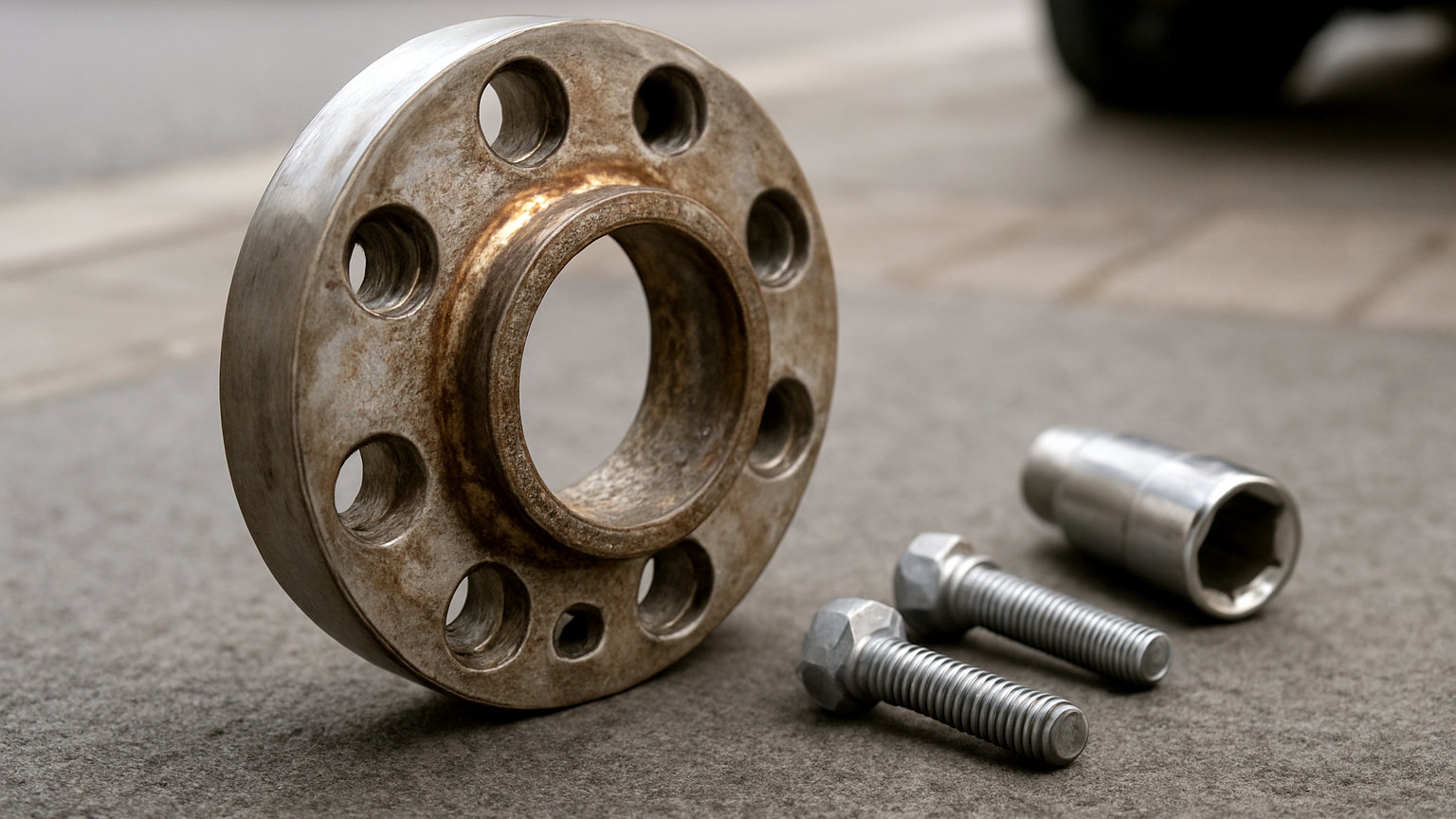
Wheel spacers sit between the hub and the wheel, pushing it further out to fill the arch or to allow a wheel with the wrong offset to clear the suspension. They are widely used and widely argued about, and the honest position is that a quality spacer correctly fitted is safe while a cheap one fitted carelessly introduces several distinct risks at once.
What is offset?
The distance between the wheel mounting face and its centreline, and it determines how far in or out the wheel sits. Manufacturers choose it to give a particular scrub radius, which affects steering feel, braking stability and the loads on the wheel bearing. A spacer changes offset directly, so it changes all of those things whether or not that was the intention.
What does it do to the bearings?
Moving the wheel outwards increases the leverage acting on the hub, so the bearing sees higher loads than it was designed for. A small spacer makes little practical difference; a large one meaningfully shortens bearing life. It also increases the load on the studs or bolts and on the suspension joints, which is the mechanical argument against large spacers rather than any legal one.
What is a hubcentric spacer?
One that has a machined bore matching the hub spigot on one side and a matching spigot for the wheel on the other, so the wheel is still centred by the hub rather than by the bolts. That is the important distinction. A plain spacer with only bolt holes leaves the wheel located by the fixings alone, which is less precise and a common cause of vibration.
What are the two types?
Slip on spacers, which fit over the existing studs with the original nuts used on longer studs, and bolt on spacers, which bolt to the hub and provide their own studs for the wheel. Bolt on types are generally preferred for anything more than a few millimetres, since they provide proper thread engagement in both directions rather than relying on longer fixings.
Do the bolts need changing?
With slip on spacers, yes, and this is where many installations go wrong. Adding a spacer without longer bolts means less thread engaged in the hub, which is exactly the situation that leads to bolts pulling out. The rule is that thread engagement should be at least equal to the bolt diameter, and preferably more.
Are they legal in the UK?
There is no specific prohibition, and the vehicle must remain roadworthy, with the tyres contained within the wheel arches and nothing fouling. What matters more practically is insurance: spacers are a modification and must be declared. Failing to declare them can invalidate a policy entirely, which is a far greater exposure than the premium difference.
Will they pass an MOT?
They are not automatically a failure, though a tester will assess the security of the wheel fixings and whether anything fouls. Poor quality spacers, insufficient thread engagement, or tyres protruding beyond the arches can all cause problems. A well engineered installation using hubcentric bolt on spacers generally passes without comment.
What is the sensible position?
If spacers are needed to fit a particular wheel, use hubcentric bolt on types from a reputable manufacturer, keep them as thin as the job allows, ensure correct thread engagement, torque everything properly and declare them to your insurer. If they are purely cosmetic, the honest question is whether the appearance is worth the additional bearing and stud loading.
How thick is too thick?
There is no single figure, and the practical guidance is to use the thinnest spacer that achieves what you need. Very thin slip on spacers of a few millimetres are widely regarded as low risk when correctly fitted. Anything substantial enough to change the stance noticeably is also changing the geometry and the loads noticeably, and it deserves proper bolt on hardware fitted by someone who understands what they are doing.


