
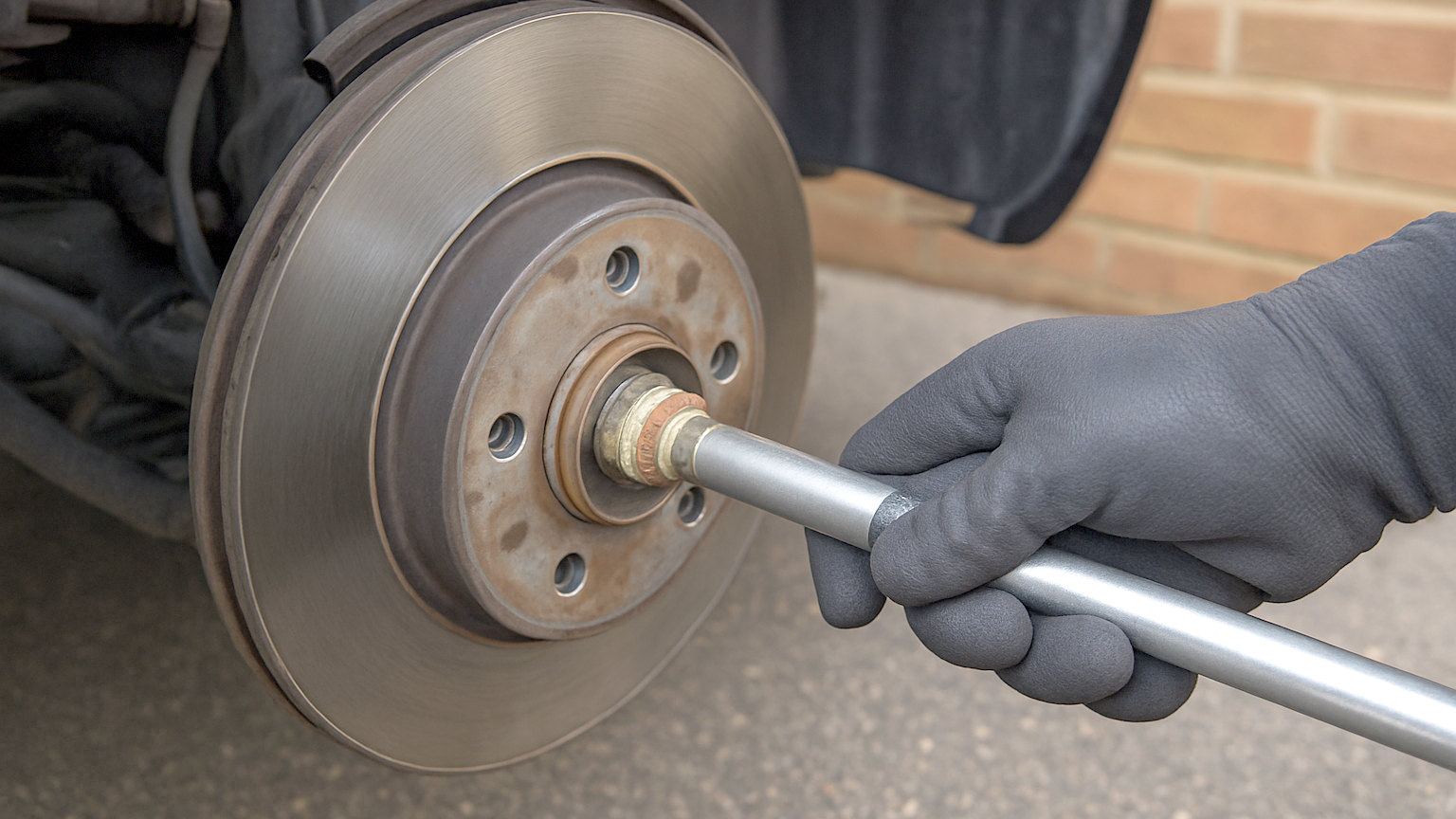
Wheel bolts and nuts sit in the harshest environment on a car, taking direct salt spray, water and heat from the brakes while being expected to undo cleanly years later. Many do not. A seized or rounded fixing discovered on a driveway is an inconvenience; discovered at the roadside with a flat tyre, it is a genuine problem with no easy solution.
Why do they seize?
Corrosion in the threads, principally, from water and salt reaching them past the wheel face. On cars where the bolts have not been removed for several years the rust bonds the threads together. Overtightening contributes as well, since a stretched fixing grips harder and its threads are already stressed, and an impact gun run at high torque makes both problems worse.
What causes rounding?
A worn or ill fitting socket, or a brace applied at an angle rather than square to the head. The chrome caps fitted to many wheel nuts are a specific problem, since they swell as the steel beneath corrodes, and a socket that fitted when the car was new no longer seats properly. That swelling is why so many capped nuts round off.
Should the threads be greased?
Not on the threads themselves. Torque figures assume dry threads, and lubrication means the same torque produces far more clamping force, effectively overtightening the bolt. What does help is a smear of copper or ceramic grease on the hub face and around the bolt hole chamfer, keeping it away from the tapered seat where the fixing locates.
How do you prevent it?
By removing the wheels periodically rather than leaving them untouched for years, which happens naturally if tyres are rotated or if brake work is done. Cleaning the threads and the hub face at each opportunity, replacing badly corroded fixings, and torquing correctly rather than with an impact gun all contribute. Replacing capped nuts with plain ones is worth considering on an older car.
How do you free a seized bolt?
Penetrating oil applied and left for as long as possible, ideally overnight and repeated. A well fitting six point socket rather than a twelve point, which grips the flats more securely. A breaker bar for leverage rather than a short brace, applied smoothly and squarely. Shock rather than steady force often works better, which is why an impact gun sometimes succeeds where a bar does not.
What if it rounds off?
Specialist extraction sockets are made for this, hammered onto the rounded head to bite into what remains. They are inexpensive and effective. Beyond that, the fixing has to be drilled or cut, which is a workshop job. Attempting to grip a rounded head with an adjustable spanner or grips usually makes it worse rather than better.
What if a stud snaps?
On a car with studs and nuts, a snapped stud must be replaced, which usually means removing the hub or pressing the old stud out and a new one in. It is a routine repair. Driving with a missing stud is not acceptable, since the remaining fixings are carrying more load than they were designed for and the wheel is no longer clamped evenly.
What should you check periodically?
That every wheel bolt or nut can be loosened with the brace supplied in the car, not just with a workshop tool. That is the test that matters, since the brace is what you will have at the roadside. Doing that once a year, and treating anything difficult before it becomes impossible, avoids the situation entirely.
Should corroded fixings be replaced?
Yes, and they are inexpensive. A bolt whose head is swelling under its chrome cap, or whose threads are visibly corroded, will eventually round off or seize. Replacing a set costs very little compared with the cost of extracting one that has failed, and it is worth doing while the wheels are off for other work rather than treating it as a separate job.


