
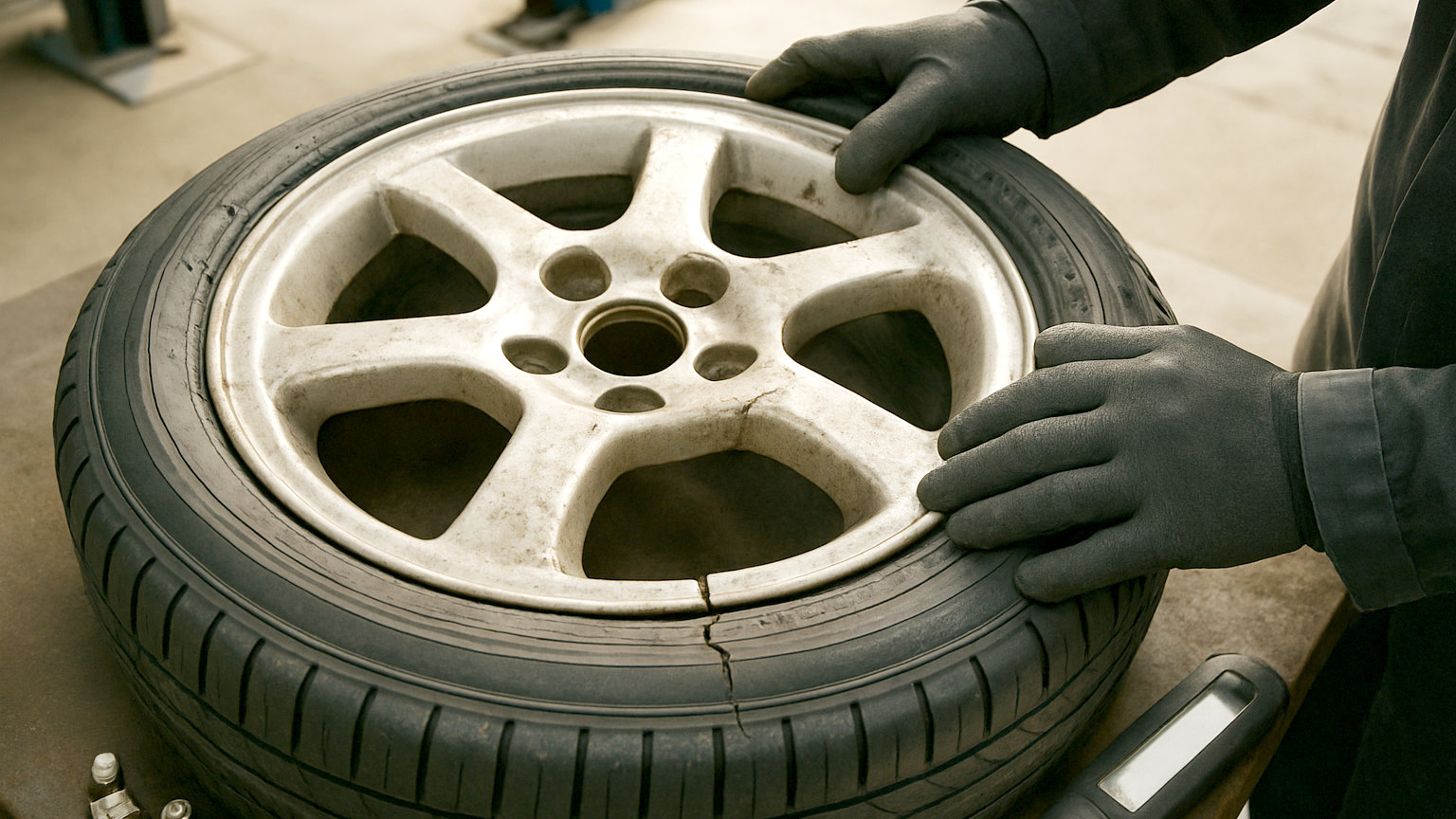
A cracked alloy wheel occupies uncomfortable ground between an economic repair and a genuine safety risk. Welding aluminium is entirely possible and specialists do it routinely, so the question is not whether it can be done but whether it should be, and that depends almost entirely on where the crack sits and how the wheel is stressed at that point.
How do wheels crack?
Almost always from a sharp impact, meaning a pothole or a kerb strike, particularly with a low profile tyre that offers little cushioning and in cold weather when the alloy is more brittle. Cast wheels are more prone than forged ones because the casting process leaves a less uniform grain structure. Fatigue cracking from long term stress is far less common but does occur.
Where do cracks usually appear?
On the inner rim flange, which takes the direct impact and is invisible without removing the wheel. Around the spoke roots where they meet the rim, which is a high stress area. And around the bolt holes, usually where the wheel has been repeatedly overtightened. The inner rim is by far the most common, which is why cracks are so often found only when a tyre is changed.
What are the symptoms?
A persistent slow loss of pressure with no puncture to find is the classic one, since a crack through the rim lets air escape steadily. A vibration that balancing does not resolve. Sometimes nothing at all, particularly with a crack that has not yet reached through. That is why a wheel should be inspected properly whenever a tyre repeatedly loses air.
When is welding acceptable?
Opinions differ and the cautious position is the sensible one. A short crack on the inner rim flange, away from spokes and bolt holes, welded by an experienced specialist who prepares and heat treats the area properly, is a repair many in the trade consider acceptable. What is far harder to defend is welding a crack running into a spoke or across a structural section.
Why is heat treatment important?
Because welding changes the properties of the alloy around the weld, softening the heat affected zone and introducing internal stresses. A specialist will preheat the wheel, weld it properly and then heat treat afterwards to restore some of the strength. A quick weld carried out cold leaves a repair that looks tidy while being weaker than the original casting.
How can a repair be verified?
Only to a limited extent, which is the fundamental difficulty. Dye penetrant testing shows whether a crack remains open at the surface, and pressure testing with the tyre fitted shows whether it seals. Neither tells you how much load the repaired area will take before failing. That uncertainty is why many specialists decline structural repairs entirely.
What happens if a wheel fails?
At speed, a wheel breaking up is among the more serious mechanical failures possible, since it takes away both support and steering on that corner. The consequence is severe enough that the argument for replacement over repair does not need to be finely balanced. A used replacement wheel is often available for less than a specialist repair would cost.
What is the sensible approach?
Have any suspect wheel inspected off the car by a specialist rather than judging it yourself. Accept a repair only on a non structural area, done by a reputable firm that will explain what they have done. For anything involving spokes, bolt holes or a long crack, replace the wheel. And have the alignment checked afterwards, since an impact heavy enough to crack a wheel usually disturbs the geometry.
What does insurance say?
Where a pothole caused the damage, a claim against the road authority is worth pursuing, and photographs of the defect with something for scale strengthen it considerably. Keep the invoices for both the wheel and any tyre damaged in the same incident, since the two often go together and the combined cost makes the claim worth the effort.


