
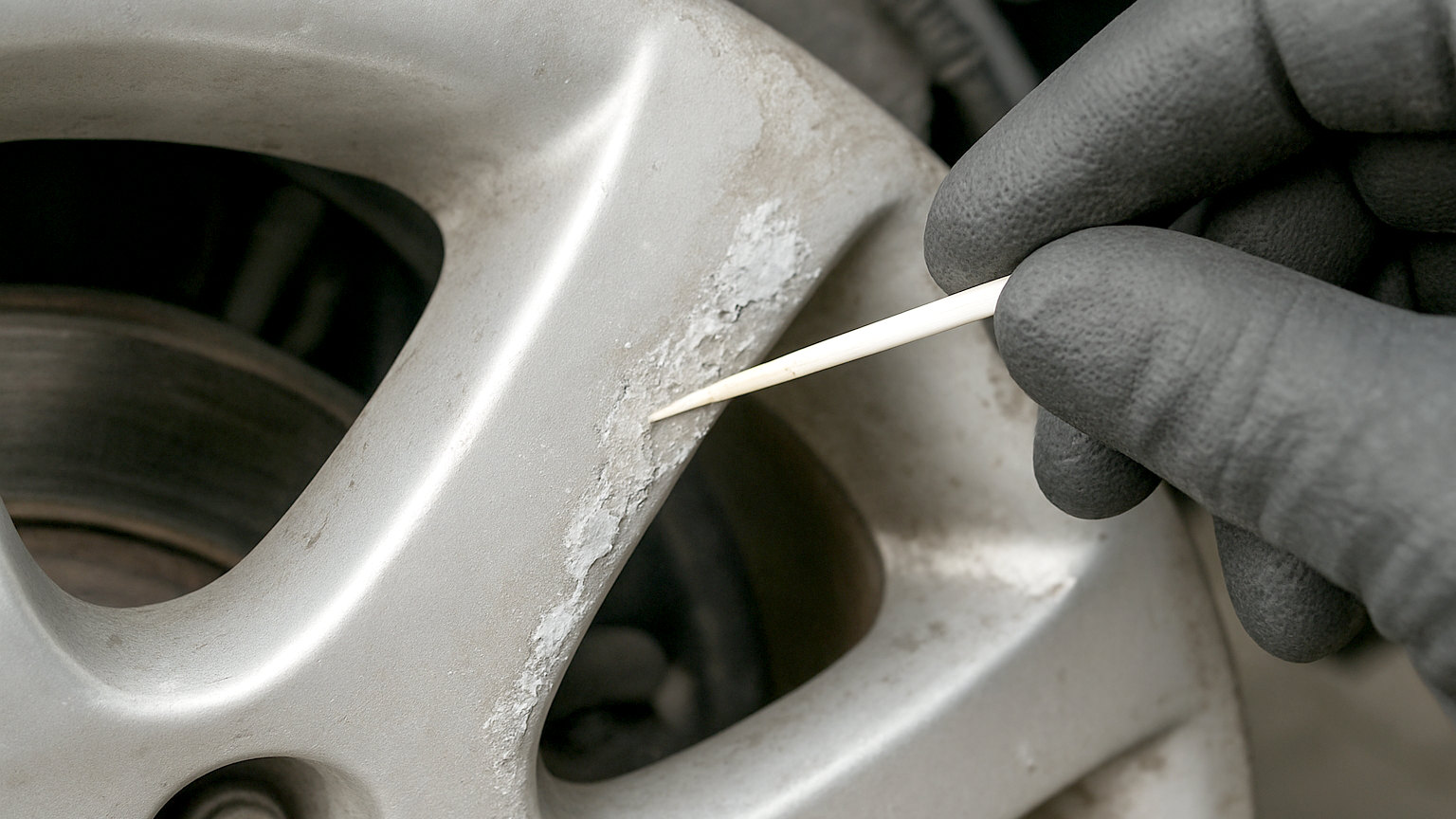
Alloy wheels are cast or forged from aluminium alloy, which does not rust in the way steel does but corrodes in a different and often more visible way. What protects them is a coating of paint and lacquer, and once that is breached, whether by a stone chip, a kerb scrape or an aggressive cleaner, the aluminium beneath begins to react and the damage spreads outwards under the coating.
What does aluminium corrosion look like?
A white or grey powdery deposit rather than the orange of rust, often appearing first as small bubbles or blisters under the lacquer. As it progresses the lacquer lifts and peels away in patches, exposing dull grey metal beneath. On a polished or diamond cut wheel the process is faster still, because the machined surface is protected only by lacquer with nothing beneath it.
Why does road salt matter so much?
Because salt in solution accelerates the electrochemical reaction dramatically, and wheels are the part of the car most consistently soaked in salty spray through winter. They are also hot from the brakes, which speeds the process further. A car driven through several British winters without its wheels being washed will show corrosion far sooner than one cleaned regularly.
What is bead corrosion?
Corrosion on the inner rim where the tyre bead seals against the wheel. It is invisible with the tyre fitted, and it produces a slow steady loss of pressure with no puncture to find, because the corroded surface is too rough for the tyre to seal against. It is one of the most common causes of a tyre that repeatedly needs topping up on cars more than a few years old.
How is bead corrosion fixed?
By removing the tyre, cleaning the bead seat back to clean metal, and refitting with a suitable sealant applied to the cleaned surface. It is a modest job for a tyre fitter. Repeatedly reinflating achieves nothing, and squirting sealant in through the valve is a temporary measure that makes any later inspection or repair considerably messier.
Do wheel cleaners cause damage?
Strong acidic products certainly can, particularly on diamond cut and polished finishes where the lacquer is the only protection. They can etch the surface, dull the finish and lift the lacquer edge, which then admits moisture underneath. They also attack the adhesive on stick on balance weights, which fall off and produce a vibration that is rarely connected back to the wheel cleaning.
How should wheels be cleaned?
With a pH neutral wheel cleaner appropriate to the finish, applied to a cool wheel rather than a hot one, agitated with a soft brush and rinsed thoroughly. Regular washing matters far more than any single deep clean, because it removes the salt and brake dust before they have time to work. Rinsing the wheels after a winter journey is a small habit with a real effect.
Can corroded wheels be refurbished?
Usually. A refurbisher strips the old coating, treats the corrosion, and applies fresh primer, colour and lacquer. Done properly it restores both appearance and protection. What matters is that the corrosion is removed rather than painted over, since anything left underneath continues to spread and the new finish lifts within a year or two.
Is it worth protecting new wheels?
A sealant or ceramic coating applied to clean wheels makes brake dust easier to remove and adds a sacrificial layer over the lacquer, which is worthwhile on a car being kept. It is not a substitute for washing, and it will not save a wheel whose lacquer has already been breached. Touching up stone chips promptly is more effective than any coating.
Does it affect the MOT?
Cosmetic corrosion does not, since the test assesses whether a wheel is structurally sound rather than how it looks. What can fail is corrosion severe enough to have weakened the rim or the area around the bolt holes, which is more common on older steel wheels than on alloys. A wheel that looks shabby but measures sound will pass without comment.


