
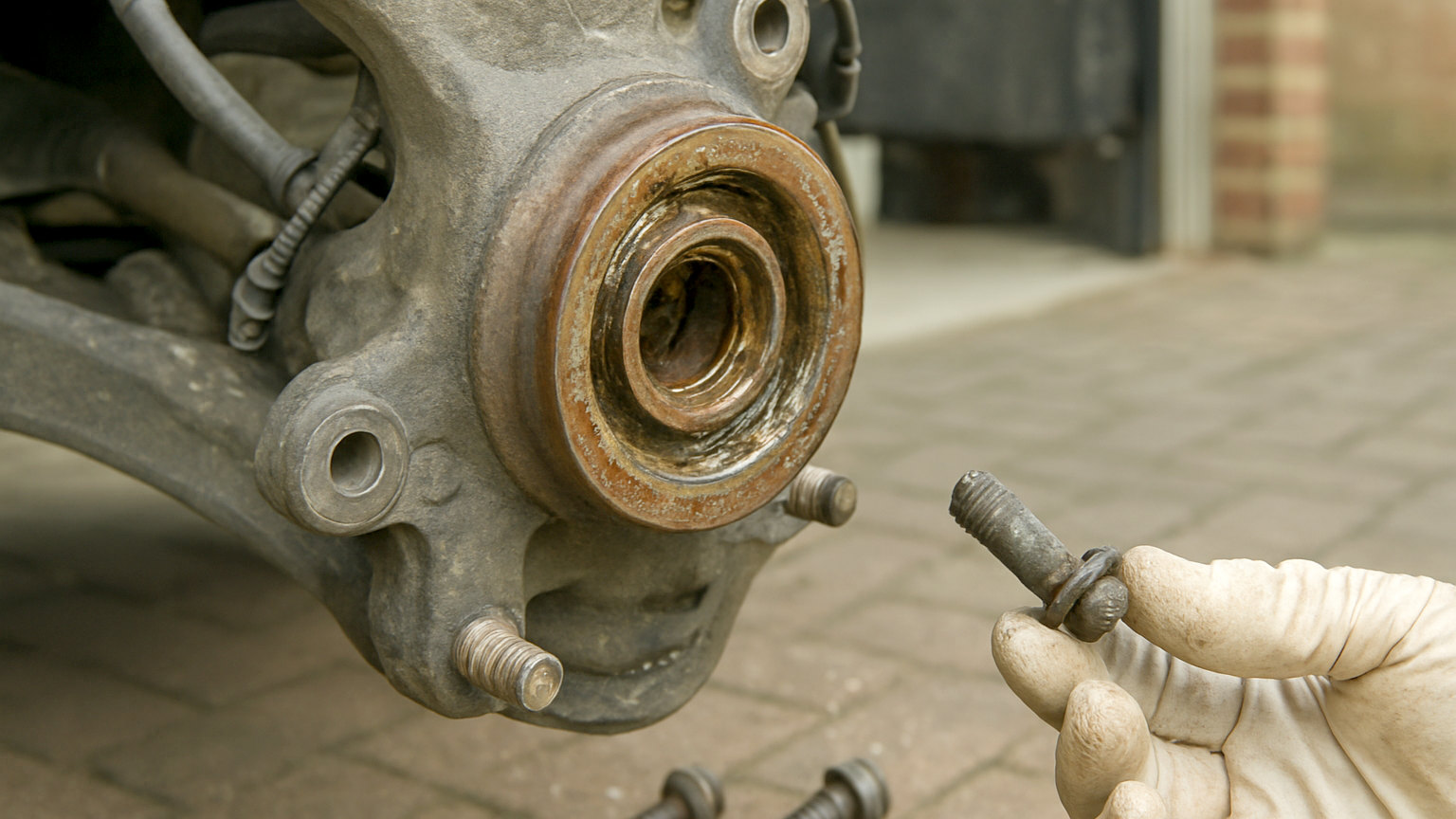
A modern sealed wheel bearing should comfortably last a hundred thousand miles and frequently lasts the life of the car. When one fails at forty thousand, something has caused it, and identifying what matters because the replacement will be subjected to exactly the same conditions. The causes fall into a short list, and most of them are avoidable.
What is the most common cause?
Water getting past a damaged or perished seal. Once moisture reaches the inside, it emulsifies the grease, which then lubricates poorly, and it corrodes the hardened races. Corrosion pits become the starting point for surface flaking, and the bearing deteriorates from there. Almost every early failure traces back to a seal that stopped doing its job.
Does pressure washing cause it?
It genuinely can, and it is worth knowing. A high pressure jet aimed directly at the hub from close range can force water past a seal that would happily resist ordinary road spray. The same applies to steam cleaning an engine bay or underside. Keeping the lance a sensible distance from hubs and directing it downwards rather than straight at the bearing avoids the risk entirely.
How do impacts contribute?
A hard pothole strike or kerb impact transmits a shock load through the bearing that momentarily exceeds anything it sees in normal use, and that can dent the races. Those dents, called brinelling, become noise sources and wear points immediately. It is why a bearing sometimes starts humming within weeks of a memorable pothole, and why the two are more connected than they appear.
Can fitting errors cause it?
Frequently, and this is a leading cause of a replacement bearing failing early. Pressing a bearing in through the wrong race transmits the force through the balls and dents them. Hammering a bearing home does the same. Incorrect hub nut torque either preloads it excessively or leaves it loose. Any of these produces a bearing that is damaged before the car has moved.
Does contamination matter?
Considerably. Assembling a bearing with grit on the hub or in the housing introduces a hard particle that circulates and damages the races. Cleanliness during fitting is not fussiness, it is the difference between a bearing lasting a decade and lasting a year. That is one practical argument for a bolt on hub assembly, since the sealed unit arrives ready to fit.
Do modifications affect them?
Yes. Wheel spacers move the wheel outwards, which increases the leverage acting on the bearing and therefore the load it carries. Larger and heavier wheels do the same. Lowering the car changes suspension geometry and can increase the loads. None of these guarantees an early failure, and all of them shorten the expected life to some degree.
Can a dragging brake destroy one?
It can. A seized caliper generates enormous heat at that corner, and the heat conducts into the hub and the bearing, degrading the grease and damaging the seals. A bearing that fails on the same corner as a brake that has been dragging is not a coincidence, and replacing the bearing without fixing the caliper simply repeats the outcome.
What should be checked when one fails early?
Whether the seal was damaged, whether the brake on that corner drags, whether the car has been pressure washed aggressively, whether spacers or heavy wheels are fitted, and whether the previous bearing was fitted correctly. Answering those before ordering the replacement is what stops the same conversation happening again in a year.
Can anything be done preventatively?
Keep pressure washers at a sensible distance from the hubs, replace damaged brake dust shields since they deflect a great deal of spray, and address a dragging caliper promptly. Beyond that, avoiding the worst potholes helps, and there is no maintenance to perform on a sealed bearing beyond leaving it alone.
Is it worth investigating a single failure?
If the car has high mileage and the bearing is original, probably not, since that is simply the component reaching the end of its life. If it failed at forty thousand miles or if it is the second one on the same corner, the cause is worth finding before the replacement goes on.


