
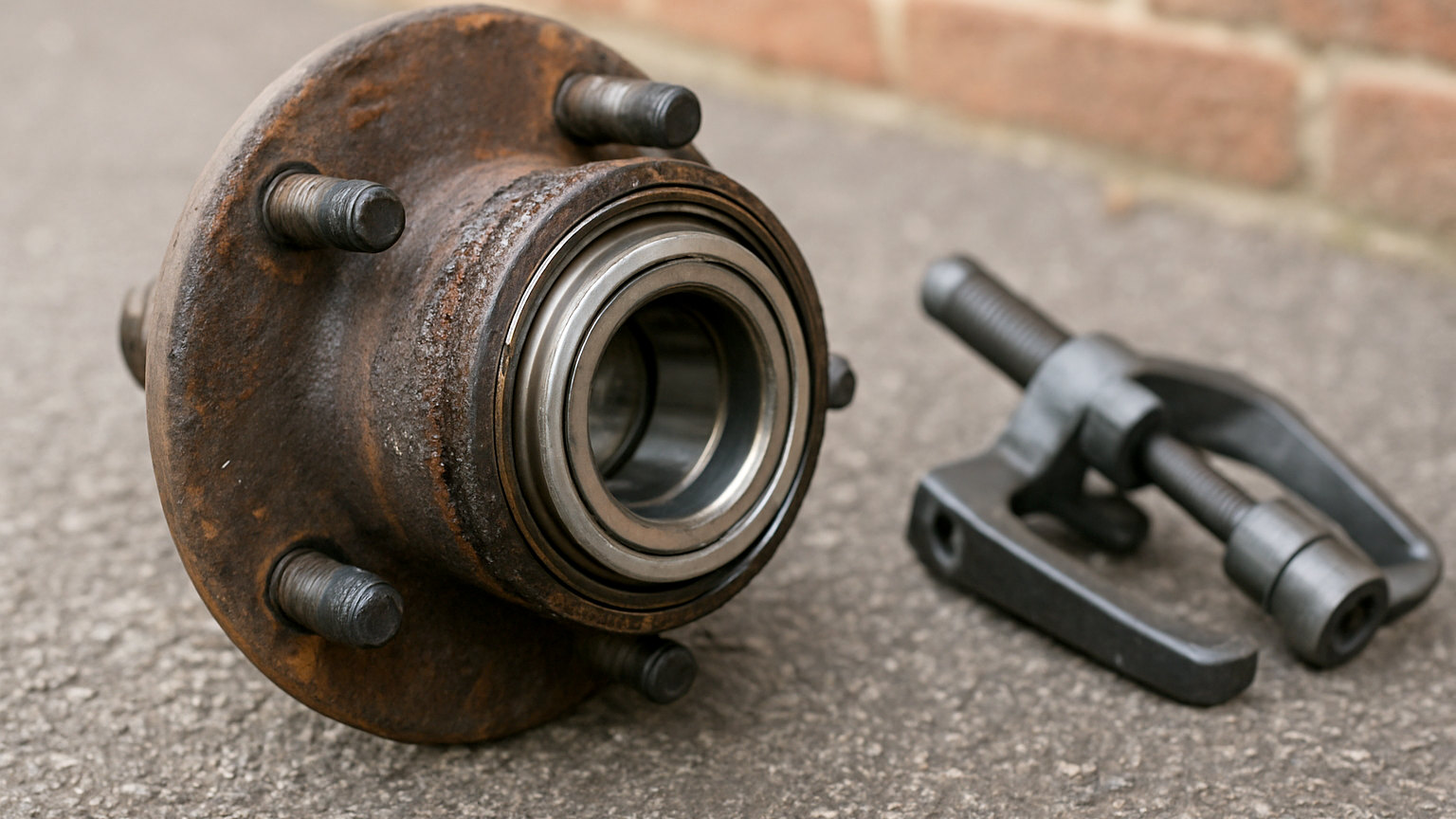
A wheel bearing sits between the rotating wheel and the fixed suspension upright, allowing one to spin freely while the other stays still. That sounds simple and the demands are considerable, because the same component has to carry the weight of the car, resist the sideways forces of cornering, absorb impacts from potholes and do all of it for a hundred thousand miles without attention.
What loads does it carry?
Radial load, meaning the weight of the car pressing down through the hub, and axial or thrust load, meaning the sideways force generated when cornering. A hard corner can produce lateral forces approaching the weight of the car itself, all channelled through a component a few inches across. The bearing must handle both simultaneously without allowing the wheel to move relative to the upright.
How is it constructed?
Hardened steel balls or tapered rollers run between an inner and an outer race, with a cage keeping them evenly spaced and grease providing lubrication. The races are ground to extremely fine tolerances, since any imperfection becomes a source of vibration and wear. Modern designs typically use two rows of elements to handle loads from both directions.
Why do the seals matter so much?
Because they are the only thing keeping the grease in and water out, and a bearing that loses either fails quickly. The seals sit in an exposed position taking direct road spray, salt and grit. Once one is damaged or perished, water enters, the grease is contaminated and diluted, and the hardened surfaces begin to corrode and pit. Almost every early bearing failure begins there.
What happens as it wears?
The rolling elements and the races develop pitting, then flaking of the hardened surface, which is called spalling. Each imperfection produces a small impact as the elements pass over it, and that is the noise you hear. As material is removed the clearances grow, so the wheel develops play, and the increasing clearance accelerates the damage further.
How has the design changed?
Older cars used separate tapered roller bearings that were adjustable, serviceable and required periodic repacking with grease. Modern vehicles almost universally use sealed units set at the factory, requiring no maintenance and lasting far longer. The trade off is that they cannot be adjusted or regreased, so when they fail the whole unit is replaced.
What is a hub assembly?
A bearing supplied already pressed into a hub, often with the wheel studs and sometimes the ABS sensor ring built in. It is fitted as a complete unit, which makes replacement far quicker and removes any risk of damage during pressing. It costs more than a bare bearing and it is frequently the only option the manufacturer offers.
Does it interact with the ABS?
On most modern cars, yes. A magnetic encoder ring is built into the bearing seal, and the ABS sensor reads it to measure wheel speed. That means a failing bearing can produce an ABS fault as well as a noise, and it means the encoder ring must be fitted the correct way round during replacement or the system will not work at all.
Why does one wheel do more work?
Front bearings generally work harder than rear ones because they carry more weight and take steering loads as well. On a front wheel drive car they also transmit drive. Nearside bearings on British roads take more punishment from kerbs and drain covers, which is why they often fail first. None of that is a fault, and it explains why bearings rarely wear out in matched pairs.
Does it need any maintenance?
On a modern sealed unit, none at all, which is why bearings appear in no service schedule. There is nothing to adjust, nothing to grease and no way to open one without destroying it. The only sensible attention is an occasional check for play and noise, and keeping high pressure washers away from the hubs.


