
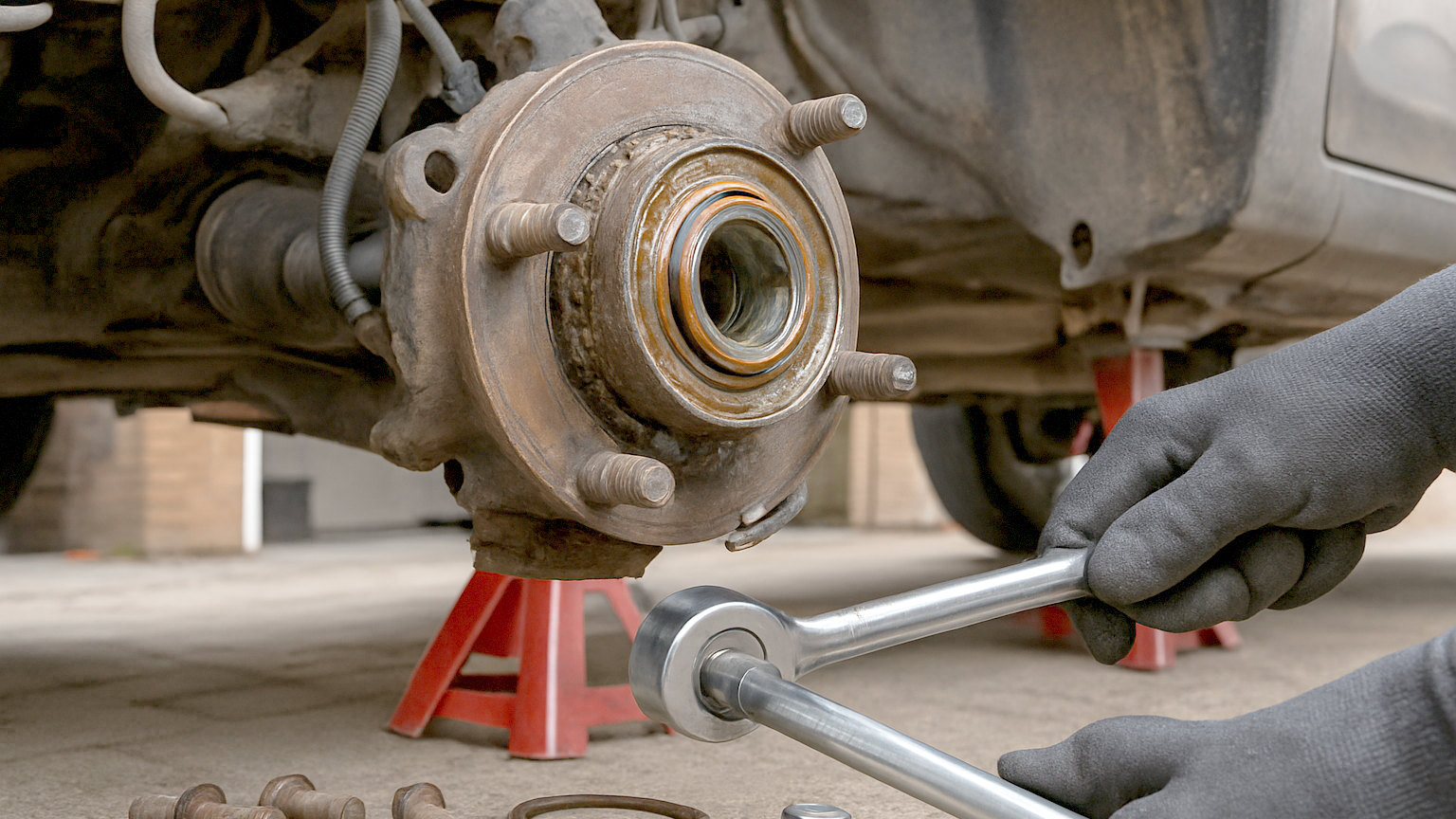
Brake pads, discs and tyres all have to be replaced in axle pairs, because differences between the two sides affect how the car behaves. Wheel bearings are different. A bearing is not a friction component and it does not need to match its opposite number, so replacing only the one that has failed is usually the correct and economical decision.
Why do they not need to match?
Because a bearing either allows the wheel to rotate freely or it does not. There is no equivalent of the friction level that makes mismatched brake pads cause a pull, and no rolling circumference issue as there is with tyres. A new bearing on one side and a healthy original on the other produces a car that behaves identically at both corners.
Do they fail at similar times?
Often not, which is the practical argument against replacing both. Bearings fail because of seal damage, a particular impact or water ingress, and those are usually specific to one corner. The nearside typically takes more punishment from kerbs and drain covers, so it frequently fails long before the offside, sometimes by years.
When does replacing both make sense?
When the second bearing is already noisy or has play, obviously. When the car has very high mileage and both are original, since the second may not be far behind. And when the labour overlaps significantly, which can happen where the hub carrier or driveshaft must be disturbed for other reasons. In those cases the incremental cost is much smaller.
Is the labour shared?
Usually very little. Each corner is a separate job with its own wheel, brake and hub removal, so doing both roughly doubles the labour. That is quite different from a job like a clutch, where most of the labour is shared. It is the main reason bearings are not routinely done in pairs while brake components are.
Should the other side be inspected?
Certainly, and it costs nothing while the car is raised. Rocking the wheel for play, spinning it by hand for roughness, and listening on the road test all take minutes. If the opposite bearing shows any symptom at all, doing both while the car is in the workshop saves a second visit and is worth the extra cost.
Does it matter for the MOT?
Only in the sense that each bearing is assessed individually for play. There is no requirement for them to match. A car with one new bearing and one original passes without any comment, provided neither shows excessive movement.
What about front and rear?
Entirely separate, and a car may go through several front bearings while its rears remain original. Front bearings carry more load and take steering forces, so they wear faster on most vehicles. There is no reason to touch the rears simply because a front has failed.
What is the sensible approach?
Replace the failed bearing, have the opposite one inspected while the car is up, and make the decision on the evidence rather than on a rule. If it is silent with no play, leave it. If it hums or knocks, do both. That is a more useful principle than an automatic pairs policy, and it usually saves money.
What about the same corner later?
If the replaced bearing fails again within a year or two, the answer is not to keep fitting bearings. Something is causing it, most likely a dragging brake, a damaged seal path or a worn housing that no longer holds the bearing tightly. Investigating that is what stops the cycle.
Should you replace both for peace of mind?
On a very high mileage car about to do a long trip, some owners reasonably do. Elsewhere the money is usually better kept, since the second bearing may have years left. Having it inspected and making the decision on evidence is more sensible than paying for a part that was not needed.


