
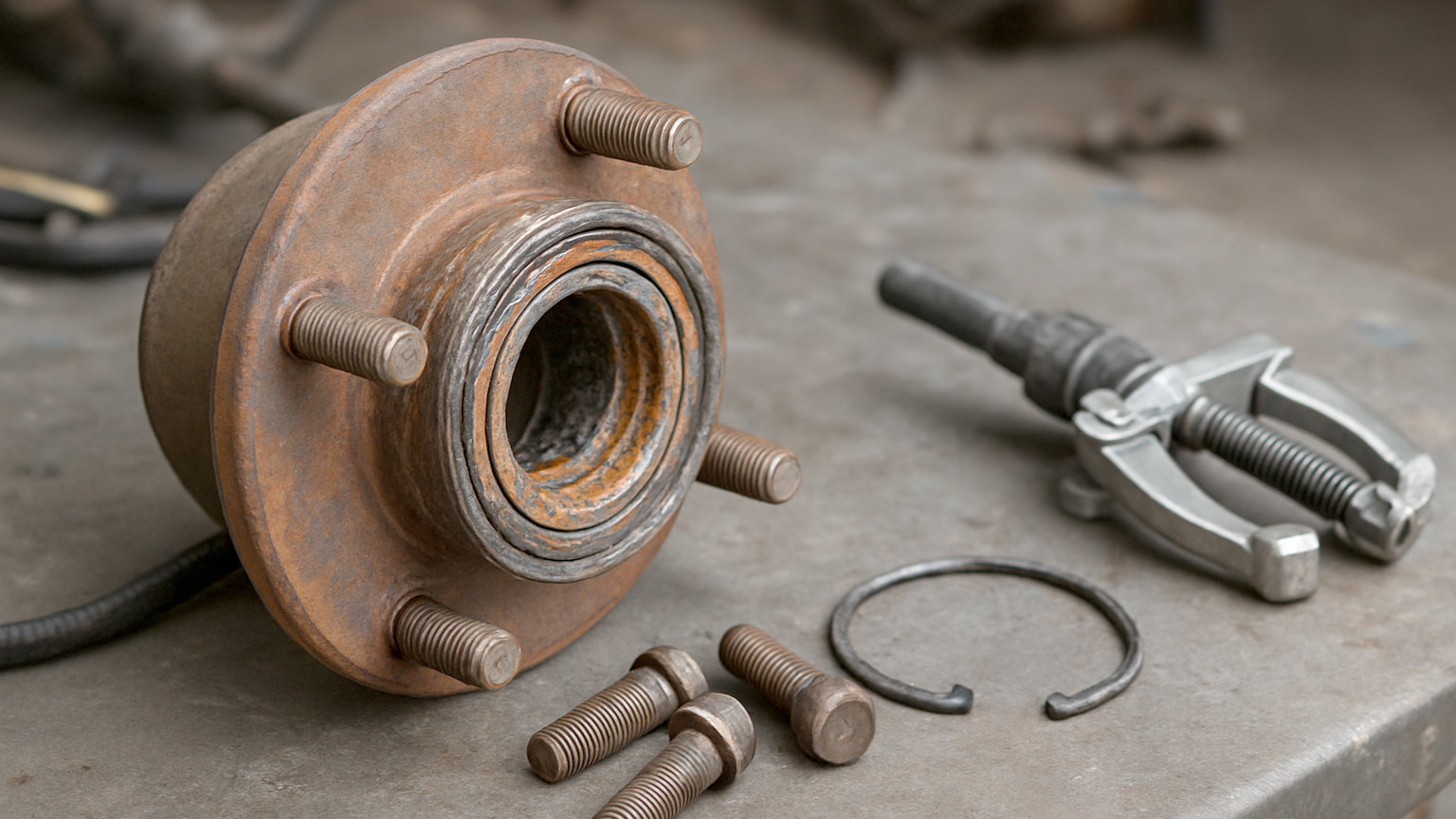
A wheel bearing should last many years, so one that becomes noisy within twelve months has almost certainly been damaged rather than worn out. That is worth establishing, because fitting a second bearing into the same circumstances produces the same result. There are five explanations that account for the great majority of early failures, and all of them are identifiable.
Was it damaged during pressing?
The most common cause by some distance. Force applied through the rolling elements rather than the correct race dents both races instantly, and the bearing is effectively finished before the wheel goes back on. Using a hammer and a drift rather than a press does the same. The damage is invisible and the noise appears within weeks or months.
Was the torque correct?
On many designs the driveshaft nut sets the bearing preload, so an incorrect figure either leaves the bearing loose or crushes it. Both destroy it quickly. Many of these nuts are single use and must be replaced, and the torque is frequently high enough that guessing with a breaker bar is not close enough. It is a specification worth confirming was followed.
Was contamination introduced?
Grit on the hub, in the housing or on the bearing during assembly circulates as a hard abrasive particle and damages the races. Cleanliness during this job is not fastidiousness, it is the difference between a decade and a year. A bearing assembled on a dirty bench or with a contaminated housing has a short and noisy future.
Was the underlying cause addressed?
If a dragging brake caliper cooked the original bearing, and the caliper was not repaired, the replacement will follow. If the seal failed because of a damaged dust shield or because the car is regularly pressure washed at close range, nothing has changed. The question of why the first one failed should have been answered before the second was fitted.
Was the part any good?
Quality varies considerably, and bearings are an area where very cheap parts have a poor reputation. The precision of the ground surfaces and the quality of the seals are what determine life, and neither is visible in the box. Given that the labour usually exceeds the part cost, choosing a recognised manufacturer is straightforwardly better value.
Could the housing be worn?
Yes, and it is often overlooked. If a bearing has been spinning in its housing, the bore is enlarged and a new bearing will not be held tightly enough. That produces a repeat failure regardless of how carefully the new one is fitted. In that situation the hub carrier itself needs replacing, which is a larger job and a conversation worth having.
Is it worth claiming?
Usually. Reputable manufacturers warrant their bearings, and a workshop that fitted one incorrectly should stand behind its work. Ask what the diagnosis is before accepting a simple replacement, since a second bearing fitted the same way by the same method will fail the same way. The conversation matters more than the part.
What should be done differently?
Use a quality part, press it correctly on the right race, torque the driveshaft nut to specification with a new nut where required, keep everything clean, and fix whatever killed the original. Adding an inspection of the brake caliper and the dust shield to that list covers essentially every cause, and it costs very little compared with doing the job twice.
How soon would you notice?
A bearing damaged during fitting frequently becomes audible within a few hundred to a few thousand miles, which is soon enough that the connection to the work is obvious. That is useful, because a noise appearing that quickly after a replacement is strong evidence of a fitting problem rather than bad luck with the part, and it is a reasonable basis for asking the workshop to look at it again without charge.
Keep the invoice and note the mileage at which the noise started, since both make that conversation considerably easier.


